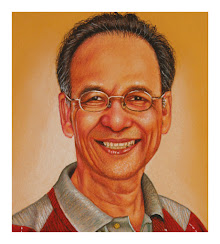
FROM DILIP MUKERJEA

"Genius is in-born, may it never be still-born."

"Oysters, irritated by grains of sand, give birth to pearls. Brains, irritated by curiosity, give birth to ideas."

"Brainpower is the bridge to the future; it is what transports you from wishful thinking to willful doing."

"Unless you keep learning & growing, the status quo has no status."
Showing posts with label Rapid Recap. Show all posts

Sunday, August 8, 2010

RAPID RECAP: BOOKAZINES OF BRILLIANCE ~ THE InGenius SERIES

The 'Bookazines of Brilliance' refer to The InGenius Series of unique bookazines by Dilip Mukerjea. They are written primarily for snappy reading - only 32 pages - by kids & their parents - to help them become future-savvy!

The first four editions have already been published, & they are:

#1 BRAINBABES: The Tapestry of Contents, includes: "An Opening Puzzle for You!"; "The Linear Association Game"; "The Radiant Association Game"; "Your Brain's Two Hemispheres"; "Can You Make the Connections?"; "Neuro-Nutrition";


#2 GOLDENMINDS: The Tapestry of Contents, includes: "What is Creativity?"; "The Clear Thinking Technique; "Is Feeling Believing?"; "Mindmapping Your Way to Success"; "Musical Moving Numbers"; "Negative Space Drawing Exercise";


#3 KINDERBLOSSOMS: The Tapestry of Contents, includes: "A Memory Test"; "Graph of Recall"; "Step-by-Step Mindmapping Guidelines"; "Who or What has a Brain?"; "Playing with Circle Doodles"; "Positively Negative";


#4 THINKERBELLES: The Tapestry of Contents, includes: "Metaphors"; "A Prescription to Eliminate Negativity"; "The Pike Phenomenon"; "The X-Y Graph"; "Conquains"; "ThumbCharts: Visual Learning the Fun Way";


To paraphrase the author, the topics in The InGenius Series are specifically designed for parents to learn & play together with their kids. More importantly, they aim to help every kid dazzle with brilliance!

Selected segments from the first four editions have already been featured in earlier blogposts of this weblog.

Annual subscriptions to The Ingenius Series are now available from this link, under 'Learning Miracles'.

Thursday, August 5, 2010

RAPID RECAP: LESSONS IN LEADERSHIP, from Marshall Goldsmith

In his wonderful book, “What Got You Here, Won’t Get You There: How Successful People Become Even More Successful”, executive coach to the corporate elite, Marshall Goldsmith, provides excellent insights into twenty habits leaders need to stop doing.

In his research and working with executives, Goldsmith has discovered the 20 habits that hold you back from the top.

Here are the 20 habits we as leaders need to do less of:

1. Winning too much: the need to win at all costs and in all situations, when it matters, when it doesn’t matter and when it’s totally beside the point

2. Adding too much value: the overwhelming desire to add our two cents to every discussion, idea or situation. Have you ever found yourself saying “That’s a great idea, but it would work better if you…”

3. Passing Judgment: the need to rate others and impose our standards on them and project our values on to others or the situation. Have you rated ideas by reinforcing with “that’s a great idea”, then the next person with a suggestion doesn’t get a “that’s great”. Whether intended or not, judgment has been passed.

4. Making destructive comments: the needless sarcasms and cutting remarks that we think make us sound sharp and witty.

5. Starting with No, But, However: The overuse of these negative qualifiers which secretly say to everyone “I’m right, you’re wrong.”

6. Telling the world how smart we are: the need to show people we’re smarter than they think we are.

7. Speaking when angry: using emotional volatility as a management tool.

8. Negativity, or “let me explain why that won’t work.” The need to share our negative thoughts even when we weren’t asked.

9. Withholding information: the conscious or unconscious refusal to share information in order to maintain an advantage over others.

10. Failing to give proper recognition: the inability to praise and reward. Don’t wait, thank people right away!

11. Claiming credit that we don’t deserve: the most annoying way to overestimate our contribution to any success.

12. Making excuses: the need to reposition our annoying behaviour as a permanent fixture so people excuse us for it. “I’m impatient, I’m always putting things off..”

13. Clinging to the past: blaming our upbringing, or people or events in the past.

14. Playing favorites: failing to see that we are treating someone unfairly.

15. Refusing to express regret: the inability to take responsibility for our actions, admit we’re wrong or recognize how our actions affect others. “I’m sorry” goes a long way!

16. Not listening: Yeah, yeah, I know that already, give me the summary! We are losing the fundamental need that each person wants to be seen, heard and understood. Are you truly listening?

17. Failing to express gratitude: How hard is it to say ‘thank you’ in a timely manner that is meaningful to the other person?

18. Punishing the messenger: This can be big or little responses we make throughout the day whenever we are inconvenienced or disappointed. It’s the momentary snort of disgust you exhale when you are told the boss is too busy to see you.

19. Passing the buck: blame everyone else, not yourself! A person who thinks he can do no wrong usually can’t admit that he’s wrong. Where are you when a project runs into trouble or an idea flops?

20. An excessive need to be “me”: exalting our faults as virtues simply because they’re who we are. Are you the type of person who is poor at returning phone calls or emails because you are so busy and overcommitted, or do you have a need to express your opinion, no matter how damaging it might be – just because you are exercising that right to be ‘me.’ “Hey, that’s me. Deal with it.”

By the way, did you recognize any of these habits for yourself?

Wednesday, July 28, 2010

RAPID RECAP: BOOKAZINES OF BRILLIANCE ~ THE BRAINDANCER SERIES

The 'Bookazines of Brilliance' refer to The Braindancer Series of unique bookazines by Dilip Mukerjea. They are written primarily for snappy reading - only 32 pages - by executives of the New Millennium - to help them become future-savvy!

The first four editions have already been published, & they are:

#1 'CATALYSING CREATIVITY': The Tapestry of Contents includes: Challenge Your Creativity; Innovate or Incinerate? The CQ Grid; Management & Creativity; Creative Story Telling; The 5 Stages of Creativity; Creativity & Nature; Checklist for New Ideas;


#2 'IDEASON ON IDEAS': The Tapestry of Contents includes Ideas on Ideas; Perspectives on Creativity; The Object Analogy; Creativity & Survival; Becoming a Creative Genius; Spatial Intelligence; Monitoring System for Ideas Suggested;


#3 'IGNITING INNOVATION'": The Tapestry of Contents includes MindPower has Replaced ManPower; Why the Need for Creativity? 15 Pathways to Creativity; The Mono Matrix; Humour is Serious Business; Focus on Innovation; The Creative Conscience;


#4 'LEADERSHIP, LEARNING & LAUGHTER': The Tapestry of Contents includes If You Aren't Distinct, You're Extinct; Are You Ready for the Microchip?; The Learning Revolution; The Learning Planet; The Learning Society; The Wisdom of Neurons; The Happiness Factor;


In the words of the author, Dilip Mukerjea, the topics in the Braindancer series will challenge your vision, values & virutes, & guide your brain to excel in:

- creativity & innovation;
- leadership & entrepreneurship;
- analysis & synthesis;
- writing & drawing;
- reading, mapping, memory, & tip-top thinking;
- respect for the planet;
- human values, family bonding & social role-modeling;

Selected segments from the first four editions have already been featured in earlier blogposts of this weblog.

Annual subscriptions to The Braindancer Series are now available from this link, under 'Learning Miracles'.

Thursday, November 12, 2009

RAPID RECAP: SERVANT LEADERSHIP

3M’s chairman and CEO, Livio D. DeSimone described the new role of the leader as “one of creation and destruction~supporting individual initiative while breaking down bureaucracy and cynicism,” essentially removing barriers to progress. Such a leader is in service to his or her followers, not commanding and concussing, but clearing a path for advancement.

SERVANT LEADERSHIP

Servant-Leadership is an expression coined by Robert Greenleaf. In his words:

“The servant leader is servant first… It begins with the natural feeling that one wants to serve, to serve first. Then conscious choice brings one to aspire to lead. He or she is sharply different from the person who is leader first, perhaps because of the need to assuage an unusual power drive or to acquire material possessions.

For such it will be a later choice to serve – after leadership is established. The leader firs
t and the servant-first are two extreme types. Between them there are shadings and blends that are part of the infinite variety of human nature.”

Source: 'The Servant As Leader' published by Robert Greenleaf (1904-1990) in 1970.

Greeleaf goes on to ask whether those served grow as persons and if they, while being served, become healthier, wiser, freer, more autonomous, more likely themselves to become servants?

Furthermore, he expresses concern towards the least privileged in society, whether they will benefit, or, at least, that they not be further deprived.

The concept of traditional autocratic andhierarchical modes of leadership are being phased out. Focus has shifted to the arena of workers and the enhancement of their personal growth.

Through teamwork and community, institutions can become paragons of societal excellence; with uncompromising high standards of ethics, care and compassion, the servant as leader becomes an example of a spiritual guide on the river of life.

“Most people in big companies today are administered, not led. They are treated as personnel, not people.”

~ ROBERT TOWNSEND, American business executive, CEO of Avis car rental group, and author. 'Further Up the Organisation' (Alfred A. Knopf, New York, 1970; revised edition Micahel Joseph, London, 1984)

"While in the past, many managers could succeed by imitating another company’s strategy or organisational model, today’s leaders are forced to invent, not copy: there are no surefire strategies or models to copy. Above all, the adaptive manager today must be capable of radical action ~ willing to think beyond the thinkable: to reconceptualise products, procedures, programs and purposes before crisis makes drastic change inescapable."

~ ALVIN TOFFLER, American scholar, lecturer and author. 'The Adaptive Corporation' (Gower, Aldershot, Hampshire, 1985)

[Excerpted from the 'Lifescaping' seminar participant's manual. The 'Lifescaping' seminar is conducted by Dilip Mukerjea about four times a year under the auspices of the Singapore Institute of Management.]

Wednesday, October 21, 2009

RAPID RECAP: THE CREATIVE SEQUENCE


[Excerpted from the 'Igniting Innovation' edition of 'The Braindancer Series' of bookazines by Dilip Mukerjea. Please refer to an earlier post in this weblog.]

Saturday, October 17, 2009

RAPID RECAP: ARE YOU REVOLUTION-READY?

In his book, 'Leading the Revolution: How to Thrive in Turbulent Times by Making Innovation a Way of Life', strategy guru Gary Hamel shares some ideas about how to re-tool & re-skill yourself in an age of revolution:

- understand the role of industry revolutionary plays wealth creation;

- know how to calculate the decay rate of current business models;

- know how to identify & deconstruct industry & company orthodoxies;


- adept at inventing new business concepts & reinventing old ones;

- able to distill proprietary foresight out of an ocean of information on discontinuities;

- feel personally responsible for business concept innovation;

- understand the principle of activism & know how to launch a grass-root innovation campaign;

- know how to build a low-cost experiment to test a radical new idea;

- working to apply the design rules for innovation to your part of the company;

Friday, September 11, 2009

RAPID RECAP: THINK DIFFERENT


"Here’s to the crazy ones.
The misfits.
The rebels.
The troublemakers.
The round pegs in the square holes.
The ones who see things differently.

They’re not fond of rules.
And they have no respect for the status quo.

You can praise them, disagree with them, quote them, disbelieve them, glorify or vilify them.
About the only thing you can’t do is ignore them.
Because they change things.

They invent. They imagine. They heal.
They explore. They create. They inspire.
They push the human race forward.

Maybe they have to be crazy.

How else can you stare at an empty canvas and see a work of art?
Or sit in silence and hear a song that’s never been written?
Or gaze at a red planet and see a laboratory on wheels?

We make tools for these kinds of people.

While some see them as the crazy ones,we see genius.

Because the people who are crazy enough to think they can change the world, are the ones who do."

~ from an advertising slogan of Apple Computers during the late nineties (up to about 2002);

[The one-minute television commercial (supplemented by print & billboard ads) featured black & white video footage of significant historical people of the past, including (in order):

Albert Einstein, Bob Dylan, Martin Luther King, Jr., Richard Branson, John Lennon (with Yoko Ono), R. Buckminster Fuller, Thomas Edison, Muhammad Ali, Ted Turner, Maria Callas, Mahatma Gandhi, Amelia Earhart, Alfred Hitchcock, Martha Graham, Jim Henson (with Kermit the Frog), Frank Lloyd Wright and Pablo Picasso.

The condensed version of the free verse poem was narrated by actor Richard Dreyfuss.

The commercial ended with an image of a young girl, Shaan Sahota, opening her closed eyes, as if to see the possibilities before her.]

Monday, May 25, 2009

RAPID RECAP: QUESTIONS TO PONDER (Q2P), FOLLOW BY, ACTION TO TAKE (A2T)


Ask yourself the following questions:

• In what ways am I a business innovator? What expertise have I gained? What tools am I equipped with?

• Do I have access to innovation role models? Are there any innovation mentors in my organisation who will nuture me, and help me to ignite innovation?

• Does my company culture encourage experimentation? If so, how feasible is it for me to get financial support to pursue my ideas? How many levels of bureaucracy would I have to go through?

• Is expertise in innovation a core component of my job description? Does a part of my compensation depend on my innovation performance?

• Do my organisation’s management processes support my efforts as an innovator, or hinder it?

• Can I confidently declare that my organisation has established an all-encompassing, corporatewide innovation system?

If your answer is NO to any of these questions, start doing something about it, and integrate the above steps into a business strategy for continual returns on innovation!

[Excerpted from The Braindancer Series of bookazines by Dilip Mukerjea. All the images in this post are the intellectual property of Dilip Mukerjea.]

Sunday, May 17, 2009

RAPID RECAP: THE MONOMATRIX

[This is an extension of an earlier post.]

How do we get ideas? Sometimes out of the blue! Often by looking at something that’s already there. Perhaps when someone suggests something.

But if you are alone, and wish to play at giving birth to ideas, have a go at The Monomatrix.

This works through combining the features of various noun and verb items.

For example, you could combine items to invent a product that holds up a book so that you can read whilst you eat! Or an alarm and camera built into your lunchbox in case a thief opens it!

In the example below, I have a mix of nouns (energy, funnel, sound, water, icecream, and bucket) and a verb (turning). The combination of funnel + icecream + turning gave us an Icecream Cone!

Similarly, with other combinations, we got the Waterwheel and Hydroelectric Power, and The Phonograph.


To use the monomatrix, place your finger on a word, slide to the right and down, or up; do the same with another word.

Where the two movements meet, place a mark in the diagonal-shaped checkbox.

For example, where ‘funnel’ and ‘sound’ have met in my example, I placed a blue dot . Where ‘water’ and ‘turning’ met, I planted a red square and so on.

You may make combinations with two or more items; it does not matter how many, as long as you come up with something useful. If you can then sell it, your invention becomes an innovation!

In the blank Monomatrix below, list your features (verbs and nouns) and play away!


The invention process is good for your creative brain. As you repeat the process, your problem solving abilities are likely to improve and enhance all areas of your life.

Identifying yourself as an inventor can make your resume or job application stand out from the crowd. Employers may see you as a problem solver and creative thinker - a desirable feature in most organizations.

Also, discussing your inventions during an interview can set you apart from other applicants being interviewed for the position. A great invention can be the start of a great business venture.

[Excerpted from the 'Thinkerbelles' edition of The InGenius Series of bookazines by Dilip Mukerjea. All the images in this post are the intellectual property of Dilip Mukerjea.]

Tuesday, April 21, 2009

RAPID RECAP: WHY THE NEED FOR CREATIVITY?

Welcome to the Age of Brainware.

Those who do not know this, are victims, not victors. The crucial variable in transforming knowledge into value is ‘creativity.’ Creativity ignites our audacity; it helps us convert pain into progress, and become what we are capable of being.

Incremental evolution has been trumped by quantum revolution. The workscapes of tomorrow have their genesis in the mindscapes of today. Corporate landscapes are littered with the charred remains of burnt-out executives. There is only one ultimatum: innovate or incinerate.

Too many organisations are obsessed with ‘best practices’ when what is needed are ‘revolutionary practices,’ ones that are radically different; the pace of change demands intellectual mutiny vis-à-vis past protocols. Previous success has become irrelevant in today’s fail-fast-leap-ahead quantum dance with competitive innovation.

Japan’s three most innovative companies -- Honda, NTT DoCoMo, and Sony -- are addressing a gargantuan social problem facing them, and also the world’s industrialized nations: the drop in the fertility rate, which has resulted in an escalating aging population. The problem will eventually hit developing nations, since the drop in fertility rates for countries like China and India will pose unheard-of challenges beyond the year 2050.

So will we witness the fruits of creativity in the guise of humanlike robots? These three Japanese companies are working on this new species for our planet.

A goal for these robots is to be ready to challenge the winner of the FIFA World Cup to a soccer match in about 50 years. If they can play soccer, then they surely will be able to do a lot of things for you, both at home -- like wash the dishes, vacuum the floor, baby-sit -- and at work.We know that robots represent the future. We need to start preparing for them. The challenge facing humans is to make sure that these robots behave morally and ethically -- something that we have a hard time doing ourselves.

Exercise: Write down at least 3 ways in which you have demonstrated a good measure of creativity in the past month.

[Excerpted from the 'Igniting Innovation' edition of The Braindancer Series of bookazines by Dilip Mukerjea. All the images in this post are the intellectual property of Dilip Mukerjea.]

Say Keng's personal comments:

Re-reading what Dilip Mukerjea has written reminds me of a National Day Rally 2000 speech by the then Prime Minister Goh Chok Tong, now Senior Minister, during which he had painted the new economic landscape for Singapore (as recorded in my scratchpad notes).

He had even quoted from then visiting consultant Prof Gary Hamel, who wrote 'Leading the Revolution: How to Thrive in Turbulent Times by Making Innovation a Way of Life':

"In the new industrial order, the battle lines don’t run between regions and countries. It's no longer Japan versus the USA versus the EU versus the developing world. Today, it’s the insurgents versus the incumbents, the revolutionaries versus the landed gentry . . . First the revolutionaries will take your markets and your customers . . . Next they’ll take your best employees ... Finally, they’ll take your assets."

With the world changing so radically, naturally it cannot be "business as usual" for us. We have to reinvent ourselves continually.

What Gary Hamel and Goh Chok Tong had put forward still rings true today.

To succeed - and thrive - in an environment of disruptive change, we will have to be more versatile, more ready than ever to anticipate and adapt.

Creativity, as argued by Dilip Mukerjea, is just one avenue. We also have to stay agile & remain nimble, mentally as well as physically.

With greater creativity, versatility and agility, I reckon we can have more options to deal with any insurgency.

Sunday, February 1, 2009

RAPID RECAP: ENTER BRAINPOWER, EXIT HORSEPOWER, by Dilip Mukerjea

Writing in an online magazine many years ago, Dilip Mukerjea gives an enlightening perspective about building brainpower:

Question: How is it that a 3½ pound mass of tissue with the consistency of raw egg is able to generate a mind, produce thoughts, craft personalities, encapsulate memories, mould feelings, and give birth to the magical kaleidoscope that is consciousness?

Part Answer: The brain, an organ which is tantalizingly different to any other within the human body.

The question was a beguiling conundrum until very recently. However, in the last two years we have witnessed the most astonishing and spectacular progress in the excavation of facts, clues, and ideas on this subject.

But why focus on the brain now?

Lester Thurow, leading world expert on economic issues and noted author in this domain, offers us this insight from his research: In the decade of the 1960s the world economy grew at the rate of 5.0 percent per year after correcting for inflation. In the 1970s, growth dropped to 3.6 percent per year. In the 1980s there was a further deceleration to 2.8 percent per year, and in the first half of the 1990s the world could manage a growth rate of just 2.0 percent per year. In two decades capitalism lost 60 percent of its momentum.

Yet we have seen the defeat of capitalism’s nineteenth and twentieth century competitors – fascism, socialism, and communism.

What has emerged as the new order out of chaos, is a novel form of capitalism. It is Intellectual Capitalism. How wonderfully ironic that the word ‘capitalism’ emerges from the Latin caput, meaning ‘head.’ It is the currency of the intellect that will spawn the currency of commerce.

A spate of literary headlines, articles, and books on the subject of Intellectual Capital have emerged in response to the focus placed by governments on The Brain. The challenge facing players in the corporate ecosystem is the conversion of employee candlepower into institutional wattage. Intellectual Capital is the raw material from which financial results will emerge.

And this is why, at the beginning of the 1990s, both the Congress of the United States and the European Parliament declared the 1990s as “The Decade of the Brain.” We are now approaching the dawn of a new millennium which will commence with “The Century of the Brain” and surely blossom into “The Brain Millennium.”

Tracking back to the genesis of civilisation, we saw the emergence of the Agricultural Age about 10,000 years ago. This was succeeded by the Industrial Age some 300 years ago, following which, in the last few decades, we saw ourselves functioning in the Information Age. Today, we are in The Age of Competitive Intelligence, where an avalanche of information is available for conversion into usable intelligence. The life-span of information however, is all too brief, and if we are not able to swiftly avail of its characteristics, it will almost instantly metamorphose into dead data!

The signals that reach us arrive as data, ready for conversion into information, mutating into knowledge, finally crystallising into wisdom. But none of this can transpire if we are not equipped with the techniques and tools for instant processing of this constant cascade of sense-ations.

It is my firm belief that we are all equipped with the infinite capacity to become multipreneurs. Naturally, we cannot achieve anything because of what we are going to do; we must DO.

Thought leads to action.
Action influences behaviour.
Behaviour shapes destinies.

Tools & Techniques

In this age when so much focus has been placed on Creativity, we need to apprise ourselves of the elements involved in the new dimensions of learning. ‘Creativity’ comes from the Latin creare, which means ‘to make out of nothing.’ Since only God can do that, we need two essential ingredients: knowledge and memory. The manipulation of these two items via formidable processing tools is now a ‘brain skill’ avidly sought after by the Fortune 100 companies.

One of these tools is Mind Mapping ®, the brainchild of Tony Buzan, the world’s most formidable living genius. It is a skill which enables one to quickly, and powerfully sift through an avalanche of information, with clear focus and total recall. This is a technique based on the physiology of the brain and on the psychology of memory.

If there is anything worse than too little information it is too much information.

The average executive needs to read over 4 million words per month, almost 50 million words a year.

The average reading speed of most people is about 240 words per minute (wpm), well below the rate stipulated by the U.N. for functional literacy, 400 wpm.

Knowledge today, doubles every five years, but by the year 2000 it will do so in less than 2 years.

We have received more information in the last 50 years than in the last 5000. How do we deal with ‘information anxiety?’

The fundamental techniques involved in developing a powerful memory come from the ancient Greeks. These have evolved into a set of skills which any executive can use with great force in the competitive world of business. Areas such as Sales & Marketing, Communications, Law, Accounting, Engineering, Public Relations, and other diverse vocations, would benefit immensely if people were to develop a trained memory.

Scientists now believe that we use less than 1% of our brain power. How can we gain access to the other 99%?

Research shows that the human brain forgets 80% of detail in 24 hours . . . if revision is excluded. This means that 80% of an investment, for example, in say seminars, can be lost in a day if one is not trained to use his or her brain optimally. Most executives have top-heavy workloads, and frenetic schedules . . . how much time can they devote to revision?

And yet it takes five to six revisions to transfer data from short-term to long-term memory. What’s to be done?

A solution lies in Mind Mapping ®. It is the ONLY technique in the world where vast amounts of data can be effectively distilled onto one sheet of paper. Revisions then take barely minutes. This means that 80% of an improvement in savings can be made . . . IMMEDIATELY!

When merged with the other skills of Speed Reading, Memory, Creative Problem Solving & Solution Finding, and Perceptual Skills in Drawing, we have a smorgasbord of items on the intellectual menu ready for immediate application in ANY field of endeavour.

We were born unarmed; our mind is our only weapon!

In today’s world, where knowledge is power, the conversion of raw data into competitive intelligence will hinge on how effectively an organisation is able to harness its brain power.

Dr. Abraham Maslow, psychologist and visionary, prescribes we can no longer approach information-age problems with industrial-age thinking skills.

The development of your brainpower leads:

1) To the conversion of information into usable intelligence;

2) To the emergence of simple solutions to complex problems;

3) To the understanding that true TQM equates directly with effective brain usage;

Are YOU ready to begin expanding your corporation’s Intellectual Capital?

Say Keng's expert comments: Dilip's principal premise is building & sustaining a repertoire of brain skill sets, thus embracing the 'Law of Requisite Variety', in order to deal effectively with a rapidly-changing world.

Dilip also emphasises action-mindedness, to push what you have learned to work immediately in your own lives &/or other spheres of predominant activity.

Albert Einstein had once put it beautifully:

"Knowledge is experience; everything else is just information."

As for Mind-Mapping, which has its own merits, there are a lot of other visual tool alternatives. Splash Maps, as conceived by Dilip in recent years, is a good example. Others include concept maps, causal loops, fishbones, venn diagrams, holonomic frameworks, just to name a few.

The most important thing is not to get stuck with one single viewpoint &/or truncated perspectives.