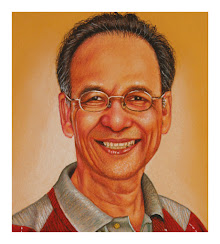
FROM DILIP MUKERJEA

"Genius is in-born, may it never be still-born."

"Oysters, irritated by grains of sand, give birth to pearls. Brains, irritated by curiosity, give birth to ideas."

"Brainpower is the bridge to the future; it is what transports you from wishful thinking to willful doing."

"Unless you keep learning & growing, the status quo has no status."
Showing posts with label Paradigm Pliancy. Show all posts

Sunday, August 7, 2022

IF YOU WANT TO CHANGE YOUR RESULTS, YOU HAVE TO CHANGE YOUR PARADIGM FIRST!

At the subconscious level, your paradigm controls your Perception, Use of Time, logic, Creativity, Effectiveness, Productivity and even your Money Making Ability!
Just as Napoleon Hill put it:
"THE SINGLE MOST INFLUENTIAL FORCE THAT CONTROLS YOUR ATTITUDES, BELIEFS, CAPABILITIES AND EMOTIONS IS REPETITION - THE WORDS YOU SILENTLY USE, OVER AND OVER AGAIN, IN YOUR INTERNAL DIALOGUE WITH YOURSELF." 

Monday, July 25, 2022

Just sharing an astute observation:

"The answers to our questions are everywhere; we just need to change the lens with which we see the world."

~ Janine Benyus, science writer, innovation consultant, and conservationist; better known as the champion of biomimicry;

Once again, this elegant expression of "compressed wisdom", as I like to call it, drives home my point about the importance of enhancing our perceptual sensitivity and paradigm pliancy.


Think about the quote from Sandy Gallagher, as it's in tune with Napoleon Hill's thinking as follows:

"THE QUALITY OF YOUR LIFE IS A DIRECT REFLECTION OF YOUR THOUGHTS, BELIEFS, HABITS AND PERSPECTIVES.'
"There’s a very real enemy you’re dealing with - we're ALL dealing with - one that’s strategizing against you, holding you tightly bound to the comfort of your current results.
Your Paradigm!"
~ Sandy Gallagher, CEO, Proctor Gallagher Institute;

Monday, December 14, 2009

QUESTIONS TO PONDER

Thanks to Google Alert, which has led me to the following action-oriented questions - to help you sustain your paradigm pliancy - from Tom Borg, president of Tom Borg Consulting Development & Training, writing in his weblog:

1. What is a business challenge you are currently facing in your business?

2. How could changing your business paradigm or your problem solving approach, help you create a profitable solution?

3. What new problem solving approach could you try?

4. Who else in your organization needs to be involved?

5. When will you begin tackling this challenge?

Monday, August 10, 2009

THE ART OF SEEING THE INVISIBLE: WHAT DO YOU SEE?


If you can see only the alphabets or colours, then you are not mindful enough.

However, if you can see additionally a hidden graphic symbol (seemingly embedded in the trade name), then your mind is pretty flexible. That's to say, your mind can shift perception.

According to creativity guru, having the fluidity of perception or multiple perspectives is the key to boosting personal creativeness.

Futurist Joel Arthur Barker has a more powerful phrase for the phenomenon: paradigm pliancy.

Monday, March 23, 2009

WHAT FUTURISTS BELIEVE

"During the next decade many people will be coming around blind curves yelling things at you. They will be too busy to stop and explain, so it will be up to you to figure it out.

If you have paradigm paralysis [i.e. unable to think in new ways], you will be hearing nothing, but threats.

If you have paradigm pliancy [i.e. being pliant or tolerant of new ideas; be tolerant of people who are suggesting those new ideas, and have tolerance toward people who see the world differently], you will be hearing nothing, but opportunity.

I would submit, in the context of all that I have said, that the choice of which you hear is entirely up to you."

~ Joel Arthur Barker, 'Future Edge' (1992) [an update of his earlier debut book, 'Discovering the Future: The Business of Paradigms' (1988);

Friday, March 20, 2009

DEVELOPING PARADIGM PLIANCY

What Dilip Mukerjea has talked about in an earlier post, entitled 'Paradigm Paradise vs Paradigm Paralysis', is basically the critical importance of developing paradigm pliancy as we navigate the 21st century.

In a nut shell, paradigm pliancy is just the purposeful search for new ways to stretch the mind & break out of the box, or rather, 'paradigm paralysis'.

According to change strategist/futurist Joel Arthur Barker, who first alerted the corporate world to the business of paradigms during the 80s, it's an active behaviour in which we constantly question & challenge our prevailing paradigms by asking the 'paradigm shift' question:

"What do I believe is impossible to do in my field of activity today, but if it could be done, would fundamentally change my way of doing it for the better?"

To me, as a model for change, it is analogous to 'Developing Mindfulness' as advocated by Dr Ellen Langer of Harvard University in her classic book, 'Mindfulness'.

Also, my sentiment is best captured in the apt quote by French novelist Marcel Proust (1871-1922), as follows:

"The real voyage of discovery consists not in seeking new landscapes but in having new eyes."

So, how does one develops paradigm pliancy?

First things first. For a quick start:

1) Seeing the old world in new ways:

- that's seeing the commonplace with new eyes, transforming the familiar to strange & the strange to familiar;

2) Challenging your daily status quo, assumptions & premises:

- that's daring to question your sacred cows & traditional taboos;

3) Making novel connections;

- that's bringing together seemingly unrelated objects, events or ideas, in a way that leads to new revelations;

4) Recognising new patterns;

- that's perceiving significant similarities & contrasts of objects, events or ideas in the world out there;

In the end analysis, considering the many similarities in outcomes, I like to equate 'developing paradigm pliancy' with 'creative opportunity finding'.

Recommended Readings, based on my personal favourites:

i) 'Future Edge: Discovering the New Paradigms of Success', by Joel Arthur Barker;

ii) 'Wide Angle Vision: Beat Your Competition by Focusing on Fringe Competitors, Lost Customers, & Rogue Employees', by Wayne Burkan;

iii) 'The Whack-A-Mole Theory; Creating Breakthrough & Transformation in Organizations', by Lindsay Collier;

iv) 'Breakthrough! The Problem-solving Advantage: Everything You Need to Start a Solution Revolution', by Debbe Kennedy;

vi) 'Business Blindspots: Replacing Your Company's Entrenched & Outdated Myths, Beliefs & Assumptions With the Realities of Today's Markets', by Benjamin Gilad;

vi) 'Thoughtware: Change the Thinking & the Organization Will Change Itself ', by Philip Kirby;

[Note: Wayne Burkan, Lindsay Collier & Debbe Kennedy have collaborated with Joel Arthur Barker in the past. From my point of view, their subsequent writings essentially help to expand our understanding of the paradigm phenomenon from different angles.

The remaining two works are great for helping to make the future a function of your renewed thinking.]

PARADIGM PARADISE vs PARADIGM PARALYSIS

Problems are birthplaces for solutions. The more difficult a problem, the greater the possibility for a creative solution. In being able to solve problems with fluidity and flexibility, we free ourselves from intellectual bondage.

An article in the New York Times (reprinted in the Detroit Free Press, P B1, January 3, 1993) reveals a typical example of ‘mind set’ versus ‘mind flux.’ The article tells us that a major reason customers defected from buying GM cars was that they compared the key entry system and the key ignition of the GM car unfavourably with that of a Toyota car.

Two keys are required for the GM car. One can be used only for the car door and the trunk while the other, only for the ignition. This is so that you can permit someone to drive your car, if required, and yet, keep the contents of the trunk safely locked away.

Furthermore, the keys work only if inserted the right way up. Such a system becomes exasperating, especially when fumbling for the right key and aligning it correctly when rushed, or overloaded with packages, or in the dark.

In the mid-1970s, Toyota introduced a single key that unlocks the door, trunk, and glove compartment, and also starts the ignition. An added bonus, the key could be inserted either way up. This innovation was copied by other Japanese auto makers.

More than 15 years later, however, GM had yet to adopt this idea. Apparently, they were not even considering the alternatives. This paradigm paralysis remained entrenched despite research demonstrating the overwhelming preference of customers for a single key.

This example is simply one of many where GM has been caught in paradigm paralysis resisting the forces of innovation. Other examples include seat belts, air bags, advanced engines, and transmissions.

But that was before. Today, GM has an OnStar system. With octopus-like tentacles, it is able to connect a car to the Web, provide directions to motorists, unlock a car with the keys trapped inside, and summon an ambulance after an airbag has been activated.

Further innovative moves include products that will track a car when it is stolen, and for sake of good order, eavesdrop on the burgler. Paradigm paradise at last!

Watch the Paradigm Shift

In 1968, the Swiss claimed 80 percent of the world market in watch sales. Today, this dominance has been eroded; they hold less than 10 percent of the market. This is because of the emergence of the quartz digital watch, a Swiss invention that was initially ignored by Swiss watchmakers!

A paradigm shift in wristwatch technology had occurred, but the Swiss failed to adopt this new technology because they were caught in a paradigm paralysis. Seiko and Texas Instruments happily grabbed the Swiss idea and made a fortune out of it.

Unsweetened Success

Up until the mid 1880s, champagnes were sweet and drunk at the end of a meal like ports and sherries.

Charles Perrier was a successful champagne producer in France. In 1837 he began marketing and selling Perrier-Jouët™ Champagne in the US, and between 1840 and 1870 exported over a million bottles. His success and fortune continued to grow to the extent that he constructed a $120,000 chateau (a lot in those days) in Epernay, France. The chateau featured six miles of underground cellars containing 8 million bottles of champagne.

In the mid-1880s, a family friend encouraged Perrier to produce a dry (i.e. less sweet) champagne, one that would not compete with the after-dinner sherries and ports. Perrier considered the idea and thought it was interesting. But why should they change? Who would buy it?

Though not the leading champagne company in France, they were extremely successful and were concerned that such a change would bring ruination. Nevertheless, they did take a risk and began producing a dry champagne. Although it sold slowly to start with, by the early 1890s it was out-selling sweet champagne.

By the turn of the century, over 1 million bottles per year of their dry champagne were being exported worldwide. Nowadays, virtually all champagnes are dry.

~ NWA World Traveller, 25, No.8, p.28, 1993

"Most people use a very small portion of their possible consciousness, much like a man who out of his whole body organism should get into the habit of using and moving only his little finger."

~ William James;

[Excerpted from the book, 'Surfing the Intellect: Building Intellectual Capital for a Knowledge Economy', by Dilip Mukerjea. All the images in this post are the intellectual property of Dilip Mukerjea.]

Please read my personal comments in a subsequent post.