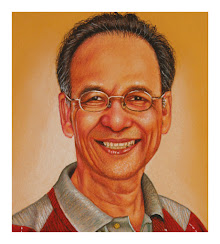
FROM DILIP MUKERJEA

"Genius is in-born, may it never be still-born."

"Oysters, irritated by grains of sand, give birth to pearls. Brains, irritated by curiosity, give birth to ideas."

"Brainpower is the bridge to the future; it is what transports you from wishful thinking to willful doing."

"Unless you keep learning & growing, the status quo has no status."
Showing posts with label Change Readiness. Show all posts

Monday, August 29, 2022

Just as my favourite global technology futurist Daniel Burrus puts it:

  • “Your FUTUREVIEW will determine the FUTUREYOU.”
  • “You can thrive in the future if you understand what is shaping it today.”
  • “The visible future is the part of the future that you can clearly see.”
  • “When planning for the future, remember that the present is obsolete.“
  • “Dwelling on current reality reinforces sameness. Dwelling on future goals reinforces action.”
  • “The ability to anticipate the future provides the biggest competitive advantage.”
  • “Change is opportunity.”
  • “You cannot stop change, but you can shape it to your advantage.”
  • “Future success depends on the strategic decisions you make today.”
  • “Time is the currency of the new economy.”
  • “When you see the future before others, you have an advantage.”
  • “Don’t just anticipate your customer’s future needs, create them!”
  • “The decisions of today must be based on the facts of tomorrow.”
  • “When we see change as a positive challenge, we will respond with constructive action.”
In a nut shell, always be Change-Ready and Future-Savvy!

Enjoy your reading, exploration and assimilation!

Sunday, January 25, 2015

MANIFESTO FOR A LEARNING REVOLUTION TO ADDRESS ALL SECTORS OF SOCIETY


This is the front cover and brief table of contents of Dilip Mukerjea's latest masterpiece, which will be published shortly. 

It contains a slew of future-readiness and future-savviness imperatives and it's targeted at policy makers, administrators and educators.

 He may have written the book with India in mind, but all the ideas are applicable elsewhere.

Saturday, April 19, 2014

WHAT KIND OF MIND DO YOU NEED?

An astute observation, from one of my most favourite strategist-authors, Dudley Lynch, President of Brain Technologies Corporation, a consulting and training outfit on accelerated self-growth, and author of 'LEAP!: How to Think Like a Dolphin & Do the Next Right, Smart Thing Come Hell or High Water', among others:

"The future just flip-flopped on you. Again.

But change isn't the greatest danger.

Inertia is."

Monday, April 7, 2014

NOTES FROM MY IDEAS SCRATCHPAD: 7 TRAITS OF CHANGE READINESS


According to Robert J Kriegel, an authority on change management and author of 'Sacred Cows Make the Best Burgers: Developing Change-Ready People and Organizations', change readiness is a learnable skill set.

He has identified 7 principal traits of change readiness, as follows:

1) Resourcefulness:

- the bias for action and able to utilise whatever resources that are available to develop plans and contingencies;

2) Adaptability:

- the mental flexibility and emotional resilience in the face of challenges, obstacles and setbacks, if any;

3) Optimism:

- the feeling of enthusiasm and positivity about changes and faith in the future;

4) Confidence:

- a strong sense of self-esteem, and belief in own ability to handle and tackle changes;

5) Adventurousness:

- an inclination to take risks and courage to pursue the unknown;

6) Tolerance for ambiguity:

- prepared to deal with any indefiniteness or uncertainty in the environment;

7) Passion and Drive:

- the personal dynamism, physical energy and emotional vitality to pursue what really matters;

[Robert J Kriegel is also the author of 'If It Ain't Broke . . . Break It!', 'How to Succeed in Business without Working so Damn Hard' and 'C Zone: Peak Performance under Pressure'. 


I particularly like the author’s first book ('Sacred Cows'), which has lots of specific ideas on building a change-ready outfit and provides a self-scoring test on your change-readiness.]

ACCENTUATING CHANGE READINESS AND FUTURE SAVVINESS


These grim reminders accentuate why change readiness and future savviness are critical skill sets in our daily repertoire. 

Tuesday, March 25, 2014

LEADERSHIP IN THE 21ST CENTURY

Here's the link to two insightful and incisive articles from Forbes.com, which read as if one is attending a crash course in "Leadership in the 21st Century'. 

Laden with great examples to illustrate strategic leadership as well as systems thinking in action in our globally interconnected business landscape, they have numerous links to more great ideas. 

http://www.forbes.com/sites/glennllopis/2014/03/24/every-leader-must-be-a-change-agent-or-face-extinction/

http://www.forbes.com/sites/marymeehan/2014/03/24/flux-the-new-rules-for-innovation-and-growth/


Tuesday, December 8, 2009

CHANGE, ON YOUR TERMS, OR BE SHORT-CHANGED ON THE MARKET'S TERMS!

[continued from the Last Post.

My personal musings, inspired by Page 4 of 'The Brainaissance Program of iCAPitalism Seminars with... The World's Most Powerful Learning Systems for... The Learning Economy', by Dilip Mukerjea.]

The following pertinent question from Dilip Mukerjea can be quite scary.


I reckon, the only option for us today, as part of our longer term strategy to survive & thrive, is to keep on learning new things, & at the same time, keep on learning to apply technology-enablement to increase our personal productivity, so that we become more productive, efficient & irreplaceable.

I recall my early exposures as a working professional to what futurist Alvin Toffler has once described as "a turbulent environment filled with revolutionary reversals, surprises, & competitive upsets..." as far back as the late eighties or early nineties.

At that time, I had also just started to indulge myself in the beautiful writings of economist Paul Zane Pilzer.

The following jottings in my ideas scratchpad came from his brilliant work, particularly 'Unlimited Wealth: The Theory and Practice of Economic Alchemy':

"... The overwhelmingly largest determinant of success today for both the individual & the organisation is the speed with which they can accept, learn, & work with technological change... Prosperity today belongs to the person & organisation that learns new thins the fastest..."

"... The key to achieving financial success today, or success in any field for that matter, is being able to learn new things. And the key to having the ability to learn new things, is developing confidence in your ability to learn...'

"Indeed, technology is advancing on so many fronts that the main constraint on innovation today is not so much the capacity of engineers & entrepreneurs to come up with new ideas, but their ability to keep abreast of & integrate the latest developments from fields outside their own particular specialty..."

Just imagine that he wrote all that in the early nineties, & to me, they are still very relevant today.

As a matter of fact, Dilip Mukerjea has recently made a wonderful observation in an expert advisory to a client [actually, an extract from his currently still 'work-in-progress' book, tentatively entitled 'Brainaissance'] as follows:

"Corporations and capital markets differ in their attitudes towards the forces of creative destruction ~ specifically, in the way they enable and manage this phenomenon. Corporations focus on operations. They aspire to function perpetually as ‘going concerns’, and thus work on the assumption of continuity.

Capital markets have no such concerns — they function on the presumption of discontinuity; their focus is on creation and destruction. Whilst corporations may tolerate long-term underperformance, markets have no qualms about annihilating the underperformer.

Outstanding corporations might stand out amongst the downtrodden, but unless they become perpetual learning organisms, the very processes that led them to success will anchor them to failure.

The choice for organisations: change, on your terms, or be shortchanged on the market’s terms!"


The foregoing insightful observation certainly sums up very well what Dilip has originally in mind when he poses the question as outlined in the foregoing imaginal picture.

[to be continued in the Next Post.]

Thursday, December 3, 2009

DEVELOPING CHANGE READINESS, ORGANISATIONALLY & PERSONALLY

Here are some excellent suggestions from the experts, based on notes from my scratchpad:

- Build in some quality time to think about the future and possible change that could occur;


- Generate a range of possible scenarios and write down what might need to change now to avoid a problem or capitalize on an opportunity;

- When significant events or situations occur, try to anticipate what could happen;

- Plan how you might respond positively to new or unusual experiences;

- Look to network with a wide range of people to actively keep up-to-date and ahead of the game;

- Think about every reasonably significant change as a project (like moving a house or launching a new advertising campaign);

- Develop a written plan to include contingencies, milestones, and measures for each of your more significant projects;

- Think about how you will organize yourself, other people, and resources to cope day-to-day and week-by-week;

- Carefully assess the risks that you foresee before each significant change event or project takes place;

- Spend quality time looking ahead so you are prepared for change, or as unsurprised as possible when it occurs;

- Look to build relationships with people who are open and generous with their time;

- Ask people about their ideas and suggestions about how to tackle changes;

- Start to offer a few ideas and thoughts of your own (where you have experienced success);

- Solicit input from as many types of people as you can (especially the more reserved ones), to gain a better appreciation of reactions to change;

- Seek to regularize this informal exchange process as part of your daily schedule;

- Act enthusiastic about the future, and highlight the opportunities to do things in new, better, and more interesting ways;

- Sketch or draw your vision of the future on regular occasions, or find time to close your eyes and think about what tomorrow could be like;

- Having done this, work backwards to list all the things that would have to be initiated now or in the short-term to help this vision become a possible reality;

- Develop a list of future steps, in sequence, that would need to be taken to achieve your ultimate goals;

- Use analogies and metaphors to describe what you think the future could look like to capture peoples imagination in different and interesting ways;

- Practice writing or presenting what is important for people to understand about a future change on one piece of paper before reading it aloud (to the mirror, your family, or even a pet if you have no one else to listen);

- Think about the different audiences that will receive your message, and how it might need to be adapted to make it entirely clear to everyone;

- Carefully monitor rumors or gossip, so as to feed the right information to people whenever necessary;

- Translate any information that may be complex or confusing, so that every individual can readily understand it;

- Look to draw early comparisons of past and future approaches or practices, once you have evidence that the new way is better or clearer;

- Develop different ways to describe the non-benefits of the old and the value of the new ways;

- Firmly but fairly lead people to talk about new changes, rather than to ignore them or criticize them gratuitously;

- If possible, find a visible way to be a role model for others to accept new change willingly;

- When planning any change transition, design and develop progressive opportunities for people to gently take on new practices or behaviors;

- Make sure that people do not feel coerced or "jettisoned" too quickly, to the point where they become uncomfortable and fail to standardize and learn to cope by themselves;

- Create opportunities for people to pilot, practice, test, or experience a change in a limited way to help them come to terms with it on a wider scale in the future;

- Evangelize to people about the benefits of continual learning and broadening the mind;

[Source: 'Change Management Effectiveness Profile']

Saturday, October 17, 2009

RAPID RECAP: ARE YOU REVOLUTION-READY?

In his book, 'Leading the Revolution: How to Thrive in Turbulent Times by Making Innovation a Way of Life', strategy guru Gary Hamel shares some ideas about how to re-tool & re-skill yourself in an age of revolution:

- understand the role of industry revolutionary plays wealth creation;

- know how to calculate the decay rate of current business models;

- know how to identify & deconstruct industry & company orthodoxies;


- adept at inventing new business concepts & reinventing old ones;

- able to distill proprietary foresight out of an ocean of information on discontinuities;

- feel personally responsible for business concept innovation;

- understand the principle of activism & know how to launch a grass-root innovation campaign;

- know how to build a low-cost experiment to test a radical new idea;

- working to apply the design rules for innovation to your part of the company;

Monday, April 27, 2009

ARE YOU EXPERIENCING BREAKTHROUGHS?


Are you experiencing breakthroughs? or . . . have you broken down, irrelevant to the present, relegated to the past?

The concept of jobs is becoming obsolete. There will be work aplenty, and that will require incessant creativity. It is now well known that our counterparts at the end of the 21st century will see today’s struggle over jobs as a fight over deck chairs on the ‘Titanic’.

You may feel secure in your present situation. But only one thing is sure: the notion of a permanent job is an illusion.

Consider the story of Balmung, the magic sword. It belonged to Siegfried, the Germanic hero. Balmung was so sharp that it could slice an armoured warrior in two, from the top of his helmet to the soles of his iron boots. But the cut was so fine that the wounded man could not even feel it. Until he moved. And then he fell into two pieces.

You may feel likewise. But just wait until you leave your job. We live in perilous, gyrating times.

And the possibilities are exciting. New challenges are bringing us to the threshold of our minds.

The choices that dominate:

- Education or Extinction!

- Creativity or Catastrophe!

- Innovation or Incineration!

[Adapted & excerpted from the 'Igniting Innovation' edition of The Braindancer Series of bookazines by Dilip Mukerjea. All the images in this post are the intellectual property of Dilip Mukerjea.]

Say Keng's personal comments:

While re-reading Dilip Mukerjea's foregoing brief essay, I am again reminded of this wonderful quote, which had often reverberated throughout my entire career span in the corporate world (attributed to American psychologist & physician Dr George Crane):

"There is no future in any job. The future lies in the man who holds the job."

With that note, I like to share 10+1 'Great Action Words' (adapted from futurist/change strategist Jim Carroll) for everyday use in the workplace, as transformational grammar to help you get into the right frame of mind to create your own personal future:

- OBSERVE trends as well as fads around you;

- Learn to THINK & THINK to learn;

- CHANGE your habitual routines;

- DARE to take some risks;

- BANISH killer &/or negative phrases from your daily vocabulary;

- EXPERIMENT with new concepts & ideas to create novel ways of doing things;

- EMPOWER yourself as well as everybody around you with new skills;

- QUESTION your assumptions & beliefs as well as your organisational code;

- GROW by tackling challenges & grabbing opportunities;

- D0 to renew yourself & others around you;

- ENJOY your passion & enthusiasm;

[Jim Carroll is the author of two superb guides, 'What I learned from Frogs in Texas: Saving Your Skin with Forward-Thinking Innovation' (2004) & 'Ready, Set, Done: How to Innovate When Faster is the New Fast' (2007). I have already reviewed them on Amazon as well as in the 'Optimum Performance Technologies' weblog.]