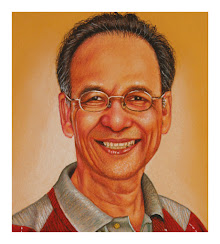
FROM DILIP MUKERJEA

"Genius is in-born, may it never be still-born."

"Oysters, irritated by grains of sand, give birth to pearls. Brains, irritated by curiosity, give birth to ideas."

"Brainpower is the bridge to the future; it is what transports you from wishful thinking to willful doing."

"Unless you keep learning & growing, the status quo has no status."
Showing posts with label Opportunity Sensitive Mindset. Show all posts

Monday, August 8, 2022

Think about it!
Here are a quick sampling of illuminating insights from others:

"The reasons that many opportunities pass us by is a perceptual one - we do not recognise an opportunity for what it is. 
An opportunity exists only when we see it."

~ Dr Edward de Bono;

"Everyone is surrounded by opportunities. But they only exist once they have been seen. And they will only be seen if they are looked for."

~ Dr Edward de Bono;

"If you wait for opportunities to occur, you will be one of the crowd... Opportunity ideas do not lie around waiting to be discovered. Such ideas need to be produced."

~ Dr Edward de Bono;

Dr Edward de Bono offered his expert opinion as to why we often miss opportunities:

- We simply cannot see the opportunity;
- We can see the opportunity, but cannot see any possible way of evaluating it;
- We can see that it is a worthwhile opportunity, but cannot see how it can be achieved;
- We can see that it is a worthwhile opportunity & even how to achieve it, but nevertheless it is not for us;
- We can see the opportunity, but can also see huge problems with people, resources & money;
- We can see that it is a worthwhile opportunity, but we have better use of our resources & efforts;
- We can see that it is a worthwhile opportunity, but in our opinion the risks are too great/rewards too small;

"Numerous connections are waiting to be discovered today, especially in the business world. We're surrounded by simple and obvious ideas that can increase our income and success dramatically. The problem is that we simply don't see them."

~ Jay Abraham, author of 'Getting Everything You Can Out of All You've Got';

"Successful opportunities for innovation & growth are right here, in front of us, & we often can't see them or don't act on them."

~ Erich Joachimsthaler, author of 'Hidden in Plain Sight: How to Find & Execute Your Company's Next Big Growth Strategy';

Thursday, August 4, 2022

One of the most inspirational and pivotal quotes which I have had ever encountered when I first read Dr Maxwell Maltz's Psycho-Cybernetics classic back in the late 70's is this valuable piece:

“What is opportunity, and when does it knock? It never knocks. You can wait a whole lifetime, listening, hoping, and you will hear no knocking. None at all.
You are opportunity, and you must knock on the door leading to your destiny.
You prepare yourself to recognize opportunity, to pursue and seize opportunity as you develop the strength of your personality, and build a self-image with which you are able to live -- with your self-respect alive and growing.”
I like to single out one line from Dr Maltz's quote:

"... You prepare yourself to recognize opportunity, to pursue and seize opportunity as you develop the strength of your personality... "

It spurred me to enhance my opportunity-sensitive mindset, as part of my life-long and life-wide quest in building and enhancing personal mastery throughout the ensuring years.
I became a fast and voracious reader.
When I left the corporate world in the early nineties to pursue my bliss, one of my three small entrepreneurial ventures was the setting up of a small, but unique retail store, aptly called The Brain Resource in the Central Business District of Singapore.
It retailed books, audios, videos, thinkertoys, construction kits, posters and other resources only on the brain and learning, creativity, innovation, peak performance (including intelligence amplification) and longevity.
It was the one and only kind of store in Singapore.
My primary rationale for setting up the store was to use it as a side-gig to bankroll and fuel my voracious reading habit.
By the way, I even took up PhotoReading under the tutelage of Patricia Danielson from New England, USA, during the early nineties. She was the co-developer of the innovative reading methodolgy with Paul Scheele of Learning Strategies Corporation.
To cut my story short, one of the great books I have had owned and read around that time was You2: A High-Velocity Formula for Multiplying your Personal Effectiveness in Quantum Leaps, by strategy consultant Dr Price Pritchett.
If readers haven't yet read it, I strongly recommend you to do so. It has only 30 odd pages but it will be worth your while.
Here's a nice quote from the author:
"Most people operate with a mindset that assumes success comes one step at a time. The unspoken but popular notion is that we must move systematically from our present level of achievement to the next.
Then, the thinking goes from that stage we can begin working toward graduating to still the next higher level in the sequence. Gradual progress.
You2 (You Squared) implies an 'explosive jump' in your personal performance that puts you far beyond the next logical step."
By the way, I even bought the entire collection of books written by the author.
Interestingly, America's Greatest Prosperity Teacher Bob Proctor gave a nice intro here: https://youtu.be/XRr-t96l_Qw

Monday, July 25, 2022

As I read, Napoleon Hill's insights are indeed revealing.

They remind me of this beautiful quote from internationally acclaimed accelerated business growth strategist Jay Abraham:
"As soon as you open your mind to doing things differently, the doors of opportunity practically fly off their hinges."
He adds:
"You are surrounded by simple, obvious solutions that can dramatically increase your power, influence and success. The problem is, you just don't see them."
Internationally acclaimed creativity guru Dr Edward de Bono shares his sentiment, for he says:
"If you wait for opportunities to occur, you will be one of the crowd... Opportunity ideas do not lie around waiting to be discovered. Such ideas need to be produced."
Even world renowned brand strategist Erich Joachimsthaler has similar thoughts:
"Opportunities for innovation and growth are right here, in fact, in front of us, and we often can't see them or don't act on them."
To cut to the chase, we just need to sharpen our perceptual sensitivity.


Friday, April 9, 2010

A GLIMPSE OF RAW IDEAS FROM 'INNOVATION LIFESCAPE'

One of Dilip's newest books in his thought pipeline is, tentatively titled, 'Innovation Ecosystem Lifescape'. In many respects, it's a work-in-progress.

Below, I have taken the liberty of giving readers a glimpse of one of his many raw ideas:

There are four 'Interconnected Pathways to Innovation', as follows:

(1) Seeding: Ideas arrive ready to refine … after initial market sensing (*).

This is where sensations of fun, frolic, and free-spirited, freewheeling, freethinking, ideation are encouraged. Creative conversations are sparked through toys, puzzles, random images and objects, merging and morphing through a sense of purposeful play. This is a birthing stage, where idea seeds emerge as raw materials for prototyping, to be followed in subsequent stages by options for development into products, services, processes, systems, or relationships.

(2) Growing: Ideas arrive ready to develop.

This is a what-if? stage, where the prototype (physical or virtual) is created. Serious play involves experimenting with options and ideas, converging on, for example, experimental design concepts, service layouts, risks and uncertainty analysis, resource planning, technological acquisitions and development, and deeper project scaling.

(3) Harvesting: Ideas arrive ready to use.

This is the how? stage, where focus is directed at a successful realization of innovation objectives. For example, some items on the agenda might include development and testing of system functionality, beta-prototype trials in the market, pre-production/service trials and feedback, specifications and documentation, and qualification and certification.

(4) Reaping: The invention becomes an innovation through commercialization of the original idea.

This is where focus is placed on market penetration and revenue generation. Procedures might include identifying specific markets, distributors, and retailers, defining and determining point(s) of sale, sourcing and selecting commercial partners, defining financial accounting systems, and deciding on a commercial marketing strategy (profit, place, position, and promotion).

The process is highly dynamic, fuzzy, ambiguous. Chaos eventually gives birth to order to chaos to order, inspired by nature, where multiple systems run in parallel.

Thus, we have all four stages interacting with one another, and not always sequentially as described above. The trick is to remain focused on real-world results in real-time. Only then will the emergent innovations be timely, relevant, and profitable.

[According to Dilip, 'The Stages of Innovation' runs as follows:

(1) Market Sensing (*)
(2) Idea Generation
(3) Idea Sorting & Focusing
(4) Idea Development
(5) Piloting & Prototyping
(6) Rolling Out & Distribution
(7) Receiving Feedback, Measuring, & Analysing
(8) Scaling Up, or performing Creative Destruction;]

Say Keng's personal comments:

Dilip is absolutely right on the ball with regard to putting 'market sensing' as a prelude to innovation.

I always hold the view that enhancing perceptual sensitivity to the environment - marketspace, to be precise - is not only the vital key to creativity & problem solving, but also to innovation & entrepreneurship.

Perceptual sensitivity (or sensory acuity) - to express in more specific terms, acute perception, fluidity of perception & multiple perceptions - empowers one's ability to recognise opportunities.

Some food for thought:

"The real voyage of discovery consists not in seeking new landscapes, but in having new eyes."

~ Marcel Proust, (1871-1922), French novelist;

"You are surrounded by simple, obvious solutions that can dramatically increase your income, power, influence & success. The problem is, you just don't see them."

~ Jay Abraham, marketing strategist & author of 'Getting Everything You Can Out of All You've Got';

"Everyone is surrounded by opportunities. But they only exist once they have been seen. And they will only be seen if they are looked for."

~ Edward de bono, creativity guru & author of 'Opportunities: A Handbook for Business Opportunity Search';

To share one great example from the real world:

When Walt Disney took his young daughter to play in a park, he noticed the details around him: the adults were bored, the rides were run-down, & the ride operators were unfriendly.

He thought: "Wouldn't it be fun if there was a place where kids & adults could play together?

From those initial observations, he hatched the idea of his famous theme parks.

Sunday, August 16, 2009

DEVELOPING AN OPPORTUNITY-SENSITIVE MINDSET

[This blogpost has been extracted from the 'Optimum Performance Technologies' weblog. It was originally written for a US-based teen magazine with circulation in Singapore & Malaysia.]

"In the field of observation, chance favours only the prepared mind."

This wonderful quotation is attributed to Louis Pasteur, the scientist who discovered the Germ Theory in the 1880s, which had contributed tremendously to the development of modern medicine.

According to my dictionary, 'chance' means 'opportunity or possibility of something happening."

How does one get prepared for chance or opportunity.

In the course of my work as a strategy consultant to small companies, as well as to schools and students, I have discovered and synthesized the following viewpoints, which I believe can readily help you to become sensitive to the opportunities around you.

SEEING WITHIN:

You must know yourself and believe in yourself. You must know who you are and what you want in life. If you believe you are a champion, and think like one, all you can see are the winning opportunities waiting for you!

SEEING AHEAD:

In essence, this is planning ahead. You must set goals in all areas of your life, and take consistent action to put your goals to work, for tomorrow…for the next 90 days…and for next year.

As a student, your priority is your study goals. Once you have this as your priority, then all you can see are the important things that will make your dreams come true.

SEEING BEHIND:

This is essentially learning from your past experiences. The past does not guarantee the future, but you can learn a lot from it:

-1 What work?;

-2 What doesn't work?

-3 What corrections do I need to make in my life in order for me to move forward?;

Anthony Robbins, internationally acclaimed Success Coach, once said:

"The difference between those who succeed & those who fail isn't what they have - it's what they choose to see and do with their resources and experiences of life."

SEEING ABOVE:

Senior Minister Lee Kuan Yew calls this 'having the helicopter ability'. It means having the ability to rise above and to see the entire forest, instead of seeing only one or two trees.

Oftentimes, we are too close to a problem, we just don't see the opportunities lurking inside it. Therefore, you must learn to rise above your problem and learn to see the larger picture of what is happening around you, and not get bogged down by nitty-gritty stuff.

SEEING UNDER:

Oftentimes, when we look at problems, we tend to look at only the surface and jump quickly to conclusions, without even looking at the underlying reasons or factors.

When we look at problems, we must also go under the surface and examine the root causes. For example, in addition to asking what has happened, who did it, and why it had happened, we should proceed further by asking what did not happen, who did not do it, and why something else did not happen…

Like icebergs, root causes of problems - hidden possibilities or opportunities - are always deeply submerged!

SEEING SIDEWAYS:

To paraphrase Dr Edward de Bono, a renowned creativity guru, this is thinking laterally. Only by moving sideways from looking at a problem , then only we can get to a new viewpoint, which will give us a new perspective to our problem. With a new perspective of a problem, we are able to see and take an alternative route to solving it.

When Mr Philip Yeo, the former Chairman of Singapore's Economic Development Board went to the United States to sell Singapore as an offshore petrochemical hub, the American investors laughed at him. They appreciated the attractive tax incentives offered but lamented that our offshore islands were too small - and they were right.

Mr Yeo rounded up all the top guns in the Economic Development Board, Jurong Town Corporation and other related government agencies to brainstorm the problem. They thought seriously - and laterally - and eventually offered the American investors a proposition they could not refuse: a new Jurong Island, formed by the merging of seven small offshore islands!

SEEING THROUGH:

This is perseverance and persistence in the face of adversity. Many of us tend to give up easily when we fail in something. For example, in school, when we got an F in the Chinese Language test or flunked the O Levels, we thought it was the end of the road. There is no such thing as failure, only feedback.

When we made a horrendous mistake in some part of our life, we just wanted to give up. According to motivational experts, there are no such things as mistakes, only learning experiences. But please, don't make the same mistake twice!

In fact, I like what F Buckminster Fuller, recognised as Planet Earth's Friendly Genius & inventor of the geodesic dome, once said:

"There are no failed experiments; only unexpected results!"

If Thomas Edison had not persevered and persisted in experimenting with some ten thousand filament alternatives, we would probably still be using large candles today!

SEEING BEYOND:

It is difficult to predict the long-term future, especially in a world that is rapidly and constantly changing. However, this should not stop us from considering and playing with some plausible scenarios in the future, in which we plan to play a major role in them.

In the corporate world , we call this scenario planning.

For a young student, it is pertinent for you to take a longer term perspective, at least ten or more years down the road, in terms of what you want to do with your life. This can affect invariably what you do today.

Let me illustrate. Today, you are a lower secondary school student and your dream is to become a neurosurgeon.

To become and succeed as a neurosurgeon, you need to have adequate working experience in a reputable hospital. To do that, you need to graduate from a top-notch medical university.

For entry to study in a top-notch medical university, you need to score excellent grades in your A Levels, and you also need to do well in your SAT. To attain that, you need to go into a good junior college to mix around with the best, and just to get into one, you need to achieve excellent scores in your O Levels.

So, it is obvious that your planning starts from today, and you will have to start by seeing beyond in order to consider all the educational options open to you!

Once you set this in motion, you will get to see the opportunities along the way that will pave the time-path for you to achieve your ultimate dream!

Be prepared for all the opportunities lurking around you, but first things first, go and enjoy your exploration from different viewpoints!

I would like to conclude this post with a quotation from Leonardo da vinci:

"If you wish to gain knowledge of the form of problems, begin with learning how to see it in many different ways."