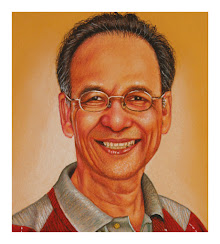
FROM DILIP MUKERJEA

"Genius is in-born, may it never be still-born."

"Oysters, irritated by grains of sand, give birth to pearls. Brains, irritated by curiosity, give birth to ideas."

"Brainpower is the bridge to the future; it is what transports you from wishful thinking to willful doing."

"Unless you keep learning & growing, the status quo has no status."
Showing posts with label Strategic Anticipation. Show all posts

Wednesday, August 24, 2022

From the opportunity-sensitivity standpoint, I like to append herewith a wise message from global technology futurist Daniel Burrus.

"It is important that all business leaders and executives find their way in becoming the force of change in their industry from inside their company rather than watching change disrupt them from the outside world."

To me, his astute observation applies equally for any professional who wants to stay relevant in today's VUCANT world.
As a matter of fact, it reminds me of what former GE Chairman & CEO Jack Welch once said:

"When the rate of change outside exceeds the rate of change inside, the end is in sight.“

To paraphrase Dr Maxwell Maltz writing in his Psycho-Cybernetics classic:
"What is opportunity, and when does it knock? It never knocks. You can wait a whole lifetime, listening, hoping, and you will hear no knocking. None at all.
You are opportunity, and you must knock on the door leading to your destiny.

You prepare yourself to recognize opportunity, to pursue and seize opportunity as you develop the strength of your personality, and build a self-image with which you are able to live -- with your self-respect alive and growing."

Putting all these astute observations together and taking a deep drive into what Daniel Burrus has highlighted in the preamble, here are my personal thoughts:
  • Be prepared, by relentlessly increasing our  skills and competencies;
  • Learn to develop a strategic eye and long-range vision in looking at emerging trends (Daniel Burrus calls it strategic anticipation);
  • Constantly talk to knowledgeable persons, including our customers, suppliers and facilitators like bankers,  in and out of our industry;
  • Continuously expand our strategic portfolio via cross-skilling, up-skilling, re-skilling and even expert-skilling initiatives via the cycle of learning, unlearning and relearning;
  • Pay attention to what's happening and even what's not yet happening (be anticipatory, as Daniel Burrus loves to put it);
  • Be inquisitive, and ask a lot of questions!
  • Read, read and read widely and deeply, as well as differently;
In summing up, I like to draw intellectual cues from Dr Maxwell Maltz:
"Self improvement is the name of the game, and your primary objective is to strengthen yourself, ... "
Godspeed!

Thursday, August 4, 2022

I have found this insight piece from success coach Joe Duncan, which to me, reflects the essence of strategic anticipation.

It is a critical leadership attribute for a professional in today's VUCANT world!

"If you are not able to think ahead and see things ahead of time you will never have control of your life.

You may be gifted, intelligent and have all the talent & potential in the world but if you can't think ahead and see what challenges, obstacles, threats and opportunities that may lie ahead of you then you will most likely never have any real control over yourself and your life.

Not having control over your life and not being able to make conscious decisions and choices will also greatly impact the quality of your life, the results you get and how people consider you.

You will be forever blaming everyone and everything for your life and sadly your life will ultimately be a mess rather than the masterpiece it deserves to be.

If you want to take charge of your life and you actually want to be in control of your life then you are going to have to have conscious thoughts and make conscious choices that take into account the possible scenarios and outcomes you will face in your day to day life and beyond.

Now I know more than anyone that you won't always be able to predict the future and see what's up ahead, but you can at the very least take some time out each day to calmly consider and think about what may come next and what challenges and opportunities may present themselves on your unique journey.

Thinking ahead is one simple step and strategy that might save you a lot of pain and frustration and allow you to take back control of yourself and your life, rather than feeling like you are at the mercy of everyone and everything around you."

Hey! Not so fast.

Following a mistake or failure, one should always do a deep dive to find out what has caused it, what anticipatory process could be put in place to spot such a mistake, and how best you could prevent its occurrence in the near future.

This post-mortem analysis creates your teaching moments.
Drawing on intellectual cues from internationally acclaimed peak performance strategist Anthony Robbins, especially his Ultimate Success Formula, observe closely what you are doing at all times, so that you can tweak quickly what's not working in your forward trajectory.
This is the tactical essence of strategic anticipation.

Wednesday, July 20, 2022

Just as global technology futurist Daniel Burrus puts it, the name of the game today is to embrace and practise the Art and Discipline of Strategic Anticipation!

Monday, May 10, 2010

LESSONS FROM THE RUMBLE IN THE JUNGLE: STRATEGIC ANTICIPATION

I like to take this opportunity to reproduce the following post, which first appeared in my 'Optimum performance Technologies' weblog slightly more than a year ago. It offers interesting lessons on 'Strategic Anticipation'.

"The other day, my good friend, Dilip Mukerjea, & I had afternoon tea in my neighbourhood coffee shop. We were having our usual pow-wow!

I was sharing with him how he could explore using action movies as part of his training props to motivate under-achieving students to pursue their fondest dreams.

We talked at length about 'Rocky III', with the character of Sylvester Stallone regaining his fight - using the 'Eye of the Tiger' - against the menacing character of Mr T, as the loud-mouthed Clubber Lang.

Our conversation also went into 'The Rumble in the Jungle'.

In a nut shell, 'The Rumble in The Jungle' was a historic boxing event that took place on 30 October 1974, in the Mai 20 Stadium in Kinshasa, Zaire (now Democratic Republic of the Congo).

It had pitted the then world heavyweight champion George Foreman against former world champion & challenger Muhammad Ali.

As we all knew by then that Ali had been suspended from the boxing sport for 3-1/2 years following his refusal to obey his army draft.

The boxing world also knew that the younger Foreman was obviously an overwhelming favorite against an aging Ali.

Also, Foreman was greatly feared for his punching power, physical size, & sheer ring dominance.

Dilip told me that Foreman & Ali had in fact spent much of the summer of 1974 training in Zaire, getting their bodies used to the weather in the tropical African country.

However, unknown to the Foreman's camp, Ali was actually training his physical body to take on horrendous punches from his sparring partners during the training. He knew that the only way for him to beat Foreman was his newly hardened body against Foreman's formidable punches.

Interestingly, according to Dilip, Ali also had somehow mentally psyched the Foreman's camp that he would probably stay on course with his conventional strategy of amazing speed & maneuvering skills.

Ali started off the first round by attacking Foreman. While this openly aggressive tactic may have surprised Foreman, it failed to significantly hurt him, despite getting a few solid punches from Ali.

Before the end of the first round, Foreman caught up to Ali, & began landing a few punches of his own. Foreman had also been trained to cut off the ring, preventing escape. Ali realized that he would easily tire if Foreman could keep making one step to Ali's two, so he changed strategy immediately.

Almost right away in the second round, Ali started lying on the ropes, in his classic pose & allowing Foreman to keep punching him, without any attempt to counter-attack Foreman (a strategy Ali later dubbed as the 'rope-a-dope').

As a result, Foreman spent all his brute force by throwing punches (remember, in oven-like heat), that either did not hit Ali or were deflected in a way that made it difficult for Foreman to hit Ali's head, while sapping his own strength.

This loss of physical energy on the sad part of Foreman was essentially the key to Ali's 'rope-a-dope' technique.

After several rounds, this really caused Foreman to be somewhat disoriented. Worst still, his stamina looked to be gradually draining from him.

So, after the fifth round Foreman was really very clumsy, & he looked increasingly exhausted too.

Ali, in his usual classic provocative self, continued to taunt Foreman by saying "They told me you could punch, George!" & "They told me you could punch as hard as Joe Louis."

Finally, in the eighth round, Ali landed the final combination, a left hook that brought Foreman's head up into position so Ali could smash him with a hard right, straight to the face.

Foreman staggered for a while, then twirled across half the ring before landing on his back. He finally managed to get up, but it was already too late.

Dilip & I concurred that this is the greatest demonstration of strategic anticipation & tactical execution ever displayed in a heavyweight fight.

[Dilip has also revealed that fight was also analysed as a case study by Harvard Business School.

By the way, the events before & during the fight were captured in the Academy Award winning documentary, 'When We Were Kings'.]

Ali came into the fight with a brilliant strategy, executed it beautifully, & achieved a great triumph.

The fight also revealed just how great Ali was at taking punches, & also highlights the different, perhaps dangerous, mid-ring strategy change that Ali had made in his fighting style, by adopting the 'rope-a-dope', instead of his former style that emphasized speed & movement.

This fight has since become one of the most famous fights of all time, because it resulted in Ali, against all the odds, regaining the title against a younger & stronger Foreman.

After this fight Ali once again told the world that he was the greatest.

[Incidentally, Dilip also revealed that when Ali was defeated in his fight with Ken Norton, & while still lying on the floor with all the reporters hanging around & waiting for his comments as a loser, Ali, grabbing one of the microphones, blurted out to the effect:

"He may be the champ, but look at me (apparently pointing at all the reporters around him), I am still the greatest!".

To me, this guy has really true mental strength.]

Amazingly, Foreman & Ali became great pals after the fight.

As I have always said, everything is possible in life or business; it's just a question of strategy & discipline, as exemplified by Muhammad Ali in 'The Rumble in the Jungle'.

[If you had watched 'Rocky III', you would certainly recall the movie segment near the tail-end when Clubber Lang (Mr T) was interviewed by a reporter prior to the final fight, He was asked about his strategy to defend his title against Rocky (Sylvester Stallone). In response, he just arrogantly blurted out 'PAIN!'. He got it, man!]"

Monday, July 6, 2009

TEN NEW LEADERSHIPS SKILLS FOR A VOLATILE, UNCERTAIN, COMPLEX & AMBIGUOUS WORLD

Having read sociologist-turned-futurist Bob Johansen's earlier book, entitled 'Get There Early: Sensing the Future to Compete in the Present', about two years ago, I am naturally attracted to read his latest book, entitled 'Leaders Make The Future: Ten New Leadership Skills for an Uncertain World'.

Besides understanding the 'Foresight to Action' cycle as well as the proven anticipatory management methodology, originally developed by the Institute for Future (reportedly the only futures think-tank to outlive its forecasts), where he had served as President & CEO from 1996 to 2004, to deal with the challenges of a "volatile, uncertain, complex & ambiguous" (VUCA) world, I am impressed by his personal insights as well as professional wisdom on anticipating & making the future.

I certainly like the way he demystifies the forecasting process. On top of that, I also like his clear distinctions between problem solving & dilemma sense-making as well as flipping.

[Actually, his 'What's Different about Dilemmas?' & 'It Takes a Story to Understand a Dilemma' in the earlier book are marvellous pieces of original thought.

As a matter of fact, for me, the author's apt use of Frank Stockton's short story (1882), 'The Lady, or the Tiger', in the earlier book is a superb tale of dilemma & ambiguity.]

Although he continues to backtrack in his new book, i.e still touching on old grounds already covered in the earlier book, especially the VUCA perspectives, I nonetheless have enjoyed reading his artful exposition of the ten new leadership skills, which leaders need to create the future.

They certainly made my day.

Here is a quick summary:

1. Maker Instinct: The ability to exploit your inner drive to build and grow things, as well as connect with others in the making.

2. Clarity: The ability to see through messes and contradictions to a future that others cannot see. Leaders are very clear about what they are making, but very flexible about how it gets made.

3. Dilemma Flipping: The ability to turn dilemmas – which, unlike problems, cannot be solved – into advantages and opportunities.

4. Immersive Learning Ability: The ability to immerse yourself in unfamiliar environments; to learn from them in a first-person way.

5. Bio-Empathy: The ability to see things from nature’s point of view; to understand, respect, and learn from nature’s patterns.

6. Constructive Depolarizing: The ability to calm tense situations where differences dominate and communication has broken down – and bring people from divergent cultures toward constructive engagement.

7. Quiet Transparency: The ability to be open and authentic about what matters to you – without advertising yourself.

8. Rapid Prototyping: The ability to create quick early versions of innovations, with the expectation that later success will require early failures.

9. Smart Mob Organizing: The ability to create, engage with, and nurture purposeful business or social change networks through intelligent use of electronic and other media.

10. Commons Creating: The ability to seed, nurture, and grow shared assets that can benefit other players – and sometimes allow competition at a higher level.

Interestingly, the author repeats his earlier innovative way of using the inside or flipside of the jacket cover to give a visually-appealing global overview of all the important stuff from the book.

For me, the last chapter of the book aka 'Conclusion: Readying Yourself for the Future' is my personal favourite, because he has included a full spectrum of probing questions to help the reader to personalise the ten new leadership skills.

I have one suggestion for the interested reader, prior to reading this book:

Please go to the 'Appendix' first, & rate yourself on each of the future skills [or go to this link to do it online]; then proceed to turn the jacket inside out to read the global overview, before actually settling down to read the book in its entirety.

In conclusion, I must say that this is a masterclass on strategic anticipation. If you are looking for a myriad of strategic tools to enhance your anticipatory prowess, for both career & daily life, this is one good book to read.

From the reading standpoint, the author's writing style is very clear, succinct & easy-going.

For companion reading, at least from my perspective, this book will go very well with Prof Howard Gardner's 'Five Minds for the Future', as well as strategist Bill Welter's 'The Prepared Mind of a Leader: Eight Skills Leaders Use to Innovate, Make Decisions, & Solve Problems'.

Saturday, February 14, 2009

WHERE DO YOU POSITION YOURSELF ON THIS MATRIX?

This particular matrix has been created by Dilip Mukerjea in his book, 'Brain Symphony: Brain-blazing Practical Techniques in Creativity for Immediate Application'.

He poses this pertinent question to readers:

Where do you position yourself on the matrix?

The answer you have in your mind will serve as an interesting perspective of your future orientation.

I have in fact mentioned to Dilip that his matrix reminded me of an almost similar matrix, but with a twist, from futurist Joel Arthur Barker in his debut book during the mid-eighties, entitled 'Discovering the Future: The Business of Paradigms'.

Using Dilip's matrix as a reference, just replace:

- "Metagrobolised" with "Problem Solving";

- "Masterful" with "Opportunity Finding";

- "Moronic" with "Reaction";

- "Mastermind" with "Anticipation";

& you have Joel Arthur Barker's original matrix.

In a nutshell, & according to Joel Arthur Barker, in order to anticipate - & shape - our future, we need to head in the direction of "Matchless", just as Dilip has originally envisaged.

[All the images in this post are the intellectual property of Dilip Mukerjea.]

Sunday, February 1, 2009

BUREAUCREATIVE, NOT BUREAUCRATIC!

Dilip Mukerjea & I share a lot in common:

- we are engineers by training;

- we have been globe-trotters in our own ways;

- we are voracious readers;

[That's how Catherine & I met Dilip during the mid-nineties, as we had then owned a bookstore. Dilip happened to find us by chance one day. When he stepped into our store for the first time, he was overwhelmed by all the great stuff, & subsequently, was made poorer by more than a thousand dollars! That's also why Dilip always remember Catherine.];

- we are fellow explorers in the field of creativity & innovation;

- more importantly, we like to urge corporations & professionals, to be changeable & change-ready!

The way we see it, they have two options:

- they can stand still, & wait to see what happens; or

- they can charge ahead with an eye on the future!


In reality, they can’t afford to stand still, because, as one futurist (Peter Bishop?) once said:

“Change is uncertain, but stagnation is fatal.”

In fact, Dilip Mukerjea poses a very pertinent question to drive home the urgency:

Are you killing yourself or are you skilling yourself?

We both strongly believe that, with creativity & innovation as our intellectual trampoline, so to speak, we can learn to deal with the future.

Developing change-readiness, mental flexibility, & operational agility is imperative in order for all us to stay relevant with changing times, & not to be made extinct by turbulent changes that come our way.

The two Scandinavian strategy consultants, Yves Doz & Mikko Kosonen, have brilliantly illustrated the urgency by introducing the term, "strategic agility", in their excellent book, 'Fast Strategy: How Strategic Agility will Help you Stay Ahead of the Game'.

Many years earlier, Mercer Management Consulting, through the great works of their former VPs, Adrian Slywotzky & Robert Duboff, had introduced their unique term, "strategic anticipation".

I particularly like foresight strategist & scenario planner Adam Gordon's latest fancy term: "future savvy".

Come to think of it, 'Innovate or Evaporate!' rings very true! I reckon it becomes more urgent for companies & their CEOs to move their butts, because elephants are slow to dance.

At this juncture, I like to share with readers a few selected excerpts from the book, 'Surfing the Intellect: Building Intellectual Capital for a Knowledge Economy', by Dilip Mukerjea:

"Perspectives for the New Millennium:

Are you relevant to the future or relegated to the past?

The world is changing economically, culturally, socially, politically, technologically, environmentally, and competitively.

Every individual must change in step with these world changes.

So must corporations and the human capital within them.

Unless you are prepared for all these scenarios, you are prepared for none of them. Ask yourself, are you busy preparing for a set of careers that will soon be obsolete?

We need creativity and innovation to live in a world where multiple realities have become the norm. Yet, each set of multiple realities poses a challenge, because no two people occupy the same slice of consciousness about anything.

We just do not occupy the same knowledge space, often seeking refuge in our private sanctuaries of specialisation.

Skills in creativity equip us with the capacity to succeed in the future. If we fail, it is because of a failure of imagination in the present. More than ever, you’ve got to aim for what you can’t expect to get. The marketspace of commerce has become a single global bazaar.

To be a viable player in this marketspace, we need to develop intellectual capital skills.

This means creativity, innovation, leadership, verbal and visual literacy, team play, and humanity towards one another.

Are you in the forefront of innovation, or have you receded into the white noise of your organisation’s background?

If it is the latter, consider getting outside the box so as to get inside the solution. We must integrate our diverse needs as members of today’s share of consciousness.

These are exciting times, ones that electrify a creative world where we are witness to collisions of chaos.

The Forces of Creation:

Combinations are spark plugs for creative combustion. An item by itself is a unilateral entity ~ filled with potential, but static, until it meets another. Then whoosh! Creativity!

All of us harbour forces within us. Within the vast ocean of consciousness, we have it in us to set loose a groundswell that can explode into mighty waves of unstoppable magnitude.

When we surf along these waves of human dynamism, our destination becomes inevitable. Often unplanned, serendipitously, we reach the shores of wonder. Such terrains, alive with infinite waves of potential, define the human intellect.

May the rhythm of your spirit create a song in your heart. May you never be the same!

Bureaucreative Perspectives:

Ideas are the raw material from which financial results are made.

Research exhibits the alarming fact that two-thirds of the companies listed on the inaugural Fortune 500 list in 1954 had either vanished or were no longer big enough to make the list on its fortieth anniversary. Why?

Lack of ideas to navigate through the shoals of change.

The world of ideas is emerging from the womb of creativity.

Metaphorically, it has been likened to a new tennis ball — fuzzy, but with a lot of bounce. This New World is becoming less fuzzy every day, but with a lot more bounce. Isn’t it time to knock the fuzz off the tennis ball?

"The things we fear most in organizations -- fluctuations, disturbances, imbalances -- are the primary sources of creativity." ~ Margaret J. Wheatley

Today’s corporate world is filled with executives that want someone to give them plug-and-play answers. How many such executives can you recognise in your organisation?

The future of middle management is extinction. Are the symptoms visible in your organisation? Are you becoming fossilised?

“Ideas have power by themselves. They can accumulate without travelling through an institution, and then suddenly explode.” — Michael Brown, CFO Microsoft

"The person who can combine frames of reference and draw connections between ostensibly unrelated points of view is likely to be the one who makes the creative breakthrough." — Denise Shekerjian

"Creative minds have always been known to survive any kind of bad training." — Anna Freud

Thomas Stewart writes that half of what a freshman engineering student learns is obsolete by the time she graduates; the obsolescence of electronics knowledge is so fast that techies use the phrase “Internet years” the way children say “dog years.”

Liam Fahey, a professor at Babson College and a stalwart of the Strategic Leadership Forum, likes to pose the following question: “How long will it take before half the knowledge you need in your job is obsolete?” If he poses it to a group, a third of the audience members usually say that the half-life of their knowledge is less than two years, another third that it’s less than five years.

Like money in a mattress, says Hugh Macdonald, “intellectual capital is useless unless it moves. It’s no good having some guy who is very wise and sits alone in a room.”

This is totally applicable to the world of ideas … ‘bureaucratic’ needs to make way for ‘bureau-creative’!!!

Getting results from investing in creativity requires a corporate culture that allows it to flow freely. This simply means scrapping rules that stifle new ideas."

Well, you just got to read the entire book to make yourself more creative & recreative.

As the author puts it:

"This book incorporate a spectrum of contemporary applications designed to meet today's corporate & educational needs. The vast repertoire of knowledge & techniques cater to our diverse areas of performance. We now know that our primary source of wealth lies in the development of intellectual capital. You will find the ingredients between these pages."

[For readers' information: Adrian Slywotzky wrote 'Profit Patterns: 30 Ways to Anticipate & Profit from Strategic Forces Reshaping Your Business'; Robert Duboff, 'Market Research Matters: Tools & Techniques for Aligning Your Business'; Adam Gordon, 'Future Savvy: Identifying Trends to Make Better Decisions, Manage Uncertainty, & Profit from Change '. All my personal favourites!]