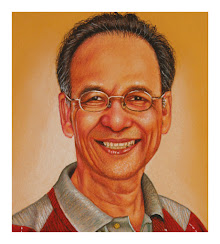
FROM DILIP MUKERJEA

"Genius is in-born, may it never be still-born."

"Oysters, irritated by grains of sand, give birth to pearls. Brains, irritated by curiosity, give birth to ideas."

"Brainpower is the bridge to the future; it is what transports you from wishful thinking to willful doing."

"Unless you keep learning & growing, the status quo has no status."
Showing posts with label Lifescaping. Show all posts

Saturday, April 12, 2014

EXPLORING THE FUTURE WITH LIFESCAPING

One of my most favourite quotes about the future:

"No matter how much you study the future, it will always surprise you. But you don't have to be dumbfounded."

~ Kenneth Boulding (1910 – 1993), economist, educator, peace activist, poet,
religious mystic, systems scientist, and interdisciplinary philosopher;

As I interpret it, it doesn't have to stun us into inaction. We can take massive and consistent action to explore the future.

Strategic tools and strategies like environmental scanning, context mapping, graphic history, SPOT matrix, implications analysis, vulnerability audit, strategic visioning, life-scaping or future-scaping are extremely useful in helping us to understand what's going on around us and what we can do to move forward into the future.

All we need is a sense of wonder and a sense of discovery.

[The following life-scaping graphics are the handiwork of my good buddy, Dilip Mukerjea, in Mumbai, India.]


Monday, November 22, 2010

CHAMPIONING STUDENTS: CULTIVATING VIVID TIME HORIZONS VIA PROPRIETARY 'LIFESCAPING' METHODOLOGY

[continuation from the Last Post ~ in connection with the recent launch of a series of new programs intended for parents as well as their school-going kids/teens, under the auspices of 'The House of Creative Brains'.]


This is my favourite topic, also my strategic forte ~ vision-building.

My real-world experiential understanding of vision-building came from a memorable, though painful, personal encounter from my former "big boss" ~ the late Tan Sri [that's the Malaysian equivalent of "Sir"] Eric Chia, Chairman & CEO of the United Motor Works (UMW) Group during the early eighties, when I had joined them as a manager.

[Readers are welcome to pop into my 'Optimum Performance Technologies' weblog to read about that encounter.]

My working knowledge was subsequently expanded & fine-tuned when I came across the splendid work of futurist/film-maker/author Joel Arthur Barker during the early nineties, especially his acclaimed 'Power of Vision' video-based training program.

As a matter of fact, one of Barker's wise axioms often reverberates in my head, whenever I talk about vision building:

"Vision without action, is but a dream; action without vision just passes the time; vision with action can change the world."

Nonetheless, the latter then led me to the scholarly works of Canadian educational psychologist Dr Benjamin Singer, Dutch futurist & sociologist Dr Fred Polak, & Holocaust survivor & Austrian psychiatrist Dr Victor Frankl, who wrote his magnum opus, 'Man's Search for Meaning', as well as the research work of strategy consultants Jim Collins & Jerry Porras.

Collectively, they drove home the vital point about the power of vision-building:

Nations, organisations, individuals as well as students with vision are powerfully enabled. Those without vision are at risk.

Just as King Solomon had once said, as reported in the Bible of the Old Testament: "Where there is no vision, the people perish."

In the case of students, Dr Benjamin Singer made these startling revelations, back in the sixties:

i) children with vision out-performed their assets;

ii) successful students had one thing in common: a profound belief in their future & their ability in their own efforts to shape it.

Likewise, based on the pioneering research work of Jim Collins & Jerry Porras, visionary organisations out-performed their assets, too.

As a nation, Singapore is a great example! Thanks to the compelling vision - & the strategic foresight - of MM Lee Kuan Yew & his colleagues as well as ministerial stalwarts, Goh Keng Swee, S Rajaratnam, Toh Chin Chye, Eddie Barker, etc., just to name a few of them.

By the way, what is "vision"?

A vision is just a simple idea or mental picture you have in your head about where you want to be in the future.

A clear vision helps one to pursue dreams & achieve goals.

A well-defined vision helps one to focus on the end-state of who you want to be, what you want to have &/or do, & where you want to go.

Generally, it can be applied in two different ways:

1) Inspiration ~ to inspire youself to follow your bliss & pursue your dreams;

2) Anticipation ~ to foresee the changes & improvements you want to have in the future;

When you can envision a future that is better, happier & more productive, you are more likely to make the necessary changes & improvements for yourself to attain that end-state in the future.

To Dr Karl Pribram of Stanford University, who works with sports champions, vision is akin to his "image of achievement".

By the way, what the difference between "vision building" & "goal setting"?

Operationally, they are complementary. A quick one... This is how I look at them:

- vision gives purpose & meaning; goals give direction & power;

- vision comes from the heart; goals come from the head;


At this juncture, I like to share an inspiring quote, to sum up "vision building" & "goal setting":

"If you have a vision and you find that someone doesn't share that vision, you either change the vision or change the people you share it with. We learn and grow one goal at a time. But to set meaningful goals, we need imaginative insight or vision."

~ Dr. Roberta Bondar, the world’s first astronaut-neurologist in space (with Discovery mission, 1992); also, globally recognized for her pioneering contribution to space medicine;

In essence, vision-building is a relatively easy endeavour, if you know how to go about it.

In fact, Dilip will share valuable lessons from the corporate world as well as educational arenas, besides coaching you on how to look at your own life strategically in long-range time-horizons, & also, how to do your own 'lifescape' using his proprietary 'lifescaping' methodology.

[to be continued in the Next Post.]

[For more information about the series of new programs under 'The House of Creative Brains', please get in touch with Ms. Faye Yeoh via her email faye_yeoh@yahoo.com]

Wednesday, November 17, 2010

DILIP'S PROGRAMS FOR THE EDUCATIONAL DOMAIN: DOWNWARD MIGRATION FROM CORPORATE PROGRAMS

[This is essentially a continuation of my earlier post, pertaining to my 'Idea Map' showing the distinctive features of Dilip's programs for the educational domain.

The 'Idea Map' has been crafted in conjunction with the recent launch of a series of new programs intended for parents as well as their school-going kids/teens, under the auspices of 'The House of Creative Brains'.

It serves as an intellectual backbone to the program synopsis for both parties.]

Just like Dilip's programs for the corporate world, under the auspices of the Singapore Institute of Management (SIM) for more than decade, both programs for parents & their school-going kids/teens are custom-designed to help participants towards envisioning & preparing for the future.

Dilip & I believe very strongly that what works in the corporate world works in the educational arena as well.

The world out there has changed, & we must change with it. Dilip will show participants how to do it successfully.

Besides sharing corporate lessons in change mastery, Dilip will also coach participants on how to excel in pathfinding, & plotting their career path.

Fundamentally, the program for both parents & their school-going kids/teens shares (and for teachers, too, in large measures) the same distinctive themes, with the following "exceptions":

for parents & guardians (& teachers, too):

- elaboration of the technological underpinnings of Dilip's body of work, with appropriate instructional & coaching components so that, not only they can apply the tools & metholodologies in their own life, but also coaching their own kids/teens; this is based on the principle that parents are their children's first teachers!

for their kids/teens:

- straight into immediate, multiple applications with total relevance to their school life, & of course, their life after school, with some explanations as to why they are doing it your way;

Hands-on applications, under Dilip's systematic coaching, apply to both programs, interspered by short class lectures, meaningful stories, selective video presentations (where appropriate), self-assessments, discovery games, group interactive exercises, project work, etc.

[Dilip's corporate programs in SIM, renewed for 2011, will include: 'Braindancing', 'Building Business Brainpower', 'Corporate Taleblazers', & 'Strategic Visioning with Lifescaping'.

For more information about the series of new programs under 'The House of Creative Brains', please get in touch with Ms. Faye Yeoh via her email faye_yeoh@yahoo.com.]

Sunday, August 15, 2010

ENCORE: DILIP & THE SUPERBRAINS!


Whenever Dilip Mukerjea takes a coaching class, be it 'Building Brainpower' or 'Braindancing', or 'Lifescaping', under the auspices of the Singapore Institute of Management, there is - always - never a dull moment from the onset, as you can see from the spiritedness of the participating group in the foregoing snapshot.

Besides making learning = fun, Dilip always shares by the end of the day many pragmatic insights, actionable ideas, powerful tools, ready-to-use strategies & practical hints to enable each & every participant in the class to take on the world... by unleashing his or her genius, so to speak... as if telling the world: "Watch out, here I come! Your butt is mine!"

Friday, August 6, 2010

THE 9 I's OF CREATING YOUR FUTURE


Most people spend more time planning their next vacation than they do planning the rest of their lives.

Yet one of the most powerful paths to creating the future you want is choosing it.

You achieve this by setting out long-term/medium-term/short-term goals based on a compelling personal vision.

Dilip Mukerjea has synthesised a powerful visual planning methodology, which he calls "lifescaping", to show you the entire process of committing to creating, creating a vision, constructing a plan, executing the plan, celebrating your journey, & continue creating your future.

If necessary, he will be most happy to design a one-to-one coaching program with "lifescaping" for you.

Interested readers can write to him at dilipmukerjea@gmail.com for more information about coaching fees & scheduling.

For your information, "lifescaping" synergises all the 9 I's.

For corporations, he has a more enhanced version, which he calls "Strategic Visioning with Lifescaping". It's currently available among the suite of corporate training programs from the Singapore Institute of Management. Here's the link, from which you can download a brochure as well as a registration form.

Nonetheless, Dilip also welcomes requests for any on-site or off-site custom-engineering to suit clients' particular requirements.

Monday, June 28, 2010

FROM DIAGRAMMATIC NOTES ON THE FLY TO ELABORATE GRAPHIC ILLUSTRATIONS IN A MONTAGE

Dilip and I have often spent a lot of time together at my place in Jurong West to brainstorm business possibilities.

Last Saturday was no exception. He had wanted to explore how best to put his evolving portfolio of technical expertise & intellectual thoughtware "on a plate", so to speak, to showcase to a small group of potential investors, in a one-day fast-track session to allow them to have a hands-on feel of his offerings in terms of robustness & relevancy.

On Friday evening, while attending the funeral wake of my 98-year-old granny-in-law at the Singapore Casket premises, & during my time-out, I just jotted down some of my preliminary thoughts - in the form of ball-point diagrammatic notes - on two sheets of tissue paper. It took me about ten minutes or so to do that.

I could do it quickly, primarily because I already have an incisive insider's as well as outsider's perspective of his writings and teachings.

Please refer to the first two snapshots as appended below.


On Saturday morning, we met for our scheduled 'pow-wow' after a cuppa in my neighbourhood food-court. Using his faithful Mac Pro and Adobe InDesign software, & coupled with his own professional insights, plus also drawing on his vast digital library of conceptual symbols, Dilip painstaking transcribed my diagrammatic notes on the fly into very elaborate graphic illustrations in a montage.

From time to time, we also deliberated at length on how best to project the essence of each element.

Despite his artistic virtuosity, Dilip took almost twelve hours [including lunch & dinner breaks] to complete the montage.

The first one is what I like to term as a "mandalic display" of graphic illustrations, which essentially captured Dilip's generative portfolio to date. Dilip will print this out on a A0-sized fabric paper for display on the wall.

The second one is more of a lifescape, based on Dilip's 'lifescaping', with self-check questions, to allow the attending investors - through hands-on application - to chart out a possible course of action, based on their reflections & responses to the first one. It will be printed out in probably A3-sized paper for distribution.

The complete and elaborate graphic illustrations are appended below. Resolution-wise, they have to be reduced for easy web viewing.


On top of the foregoing work, Dilip had also completed a slide presentation, using his Apple Keynote software. Vital segments from the elaborate graphic illustrations were transposed into the presentation.

Dilip and I have agreed that the entire Saturday sojourn was worth the massive effort of putting our heads together. He can now use the two graphic productions for presentation to any investor interested in his generative portfolio of technical expertise and intellectual thoughtware, covering both corporate and educational domains.

As an epilogue, I like to sum up the foregoing synergetic outputs as physical manifestations of the following philosophies of ours:

TWO HEADS ARE BETTER THAN ONE!
KNOWLEDGE SHARED IS POWER SQUARED
!

Monday, May 3, 2010

LIFESCAPING SEMINAR @SIM, scheduled 15-17th September 2010


Dilip Mukerjea is scheduled to conduct the next session of his foregoing popular 'Lifescaping' seminar under the auspices of the Singapore Institute of Management (SIM) from 15th to 17th September 2010.

The synopsis of the seminar is outlined as follows:

Introduction:

- Are YOU learning as fast as the world is changing?

- Are YOU agile enough to boost growth and profits?

- Are YOU exploiting opportunities?

- Are YOU living your life out loud?

- Are YOU creative enough to combat corporate challenges?

Savour the exhilaration of your embedded talents via these offerings:

Leadership, Innovation, Fellowship, and Entrepreneurship!

Lifescaping™ helps you to:

• Develop Strategic Response Capabilties for your business

• Design & Develop Projects to move from aspiration to activation to actualisation

• Design blueprints for your life and career

Lifescaping is a unique, visually provocative, highly interactive business (and work *) planning, and personal, life-design tool. It provides a gestalt, large-picture perspective by slashing learning curves normally deployed for preparation and consolidation of plans.

[* Public Sector agencies and non-profit]

Benefits to You:

Fully interactive experience that enables you to amplify your capabilities via INITIATIVE, CREATIVITY, and PASSION, in order to become:

- STRATEGICALLY NIMBLE

- RELENTLESSLY INNOVATIVE and

- IMMEASURABLY ENGAGING

It gets you to define your vision, and chart a course towards it. Achieve this by recognising your needs, determining your values, and crafting your beliefs. Success is inevitable.

Significant enhancement to your sense of motivation. Puts you in control of your life via control of your mind, guided by the purity of your spirit. With power, purpose, and forward direction.

Entrepreneurship and Leadership:

Acquire a range of techniques that give shape and dimension to your life. Create a vision that needs no revision.

Direct your attention to The Triple Bottom Line of: Economic Prosperity, Environmental Well-Being, and Social Justice. Awaken your spirit and allow yourself to experience success.

Programme Outline:

· Identifying lessons from the past

· Envisioning possibilities and scenarios by charting with Lifescapes™

· Preparing for contingencies and risks

· Lessons and exercises in entrepreneurial thinking

· Understanding current realities relevant to markets and competitors

· Developing strategies and SMART goals

· Monitoring progress and growth for continual success

· Multiple insights on leadership across domains

· Conducting ‘vulnerability & opportunity audits’

· Creating game plans

· Creating business plans

· Suite of techniques in creativity & innovation

· Strategic Thinking skills to move ahead from aspiration, to action, to actualisation!

Who Must Attend:

Executives at all levels and from any discipline in the corporate and educational ecosystems. Anyone who desires to leap ahead, from confusion to profitability. People who wish to connect with the symphony of their spirit.

Venue : TO BE ADVISED.

Time : 8:30 - 18:00

Fee : S$1,605.00 (SIM Members) (Inclusive of 7% GST)

Enquiries : 62489407 exec@sim.edu.sg

For more information about seminar, you can download a brochure from this link.

For seminar registration, please proceed to this link.

Monday, November 30, 2009

LIFESCAPING & THE STRATEGY PROCESS

Here's the weblink to an interesting article on 'Facilitating Strategic Execution' by strategist Johan Roos, Director of the Imagination Lab Foundation, based in Switzerland.

As concurred with Dilip Mukerjea, I find that the essence of the article - "turning strategizing into embodied experiences... using your hands to craft sense... " - resonates with or rather accentuates the philosophy of 'Lifescaping', as conceived for his 'Lifescaping' seminars with the Singapore Institute of Management.


[Readers can check out the next 'Lifescaping' seminar schedule at SIM.]

A WISE QUOTE FOR MONDAY MORNING

"Your life is yours to create. It's time to stop struggling, to stop fighting to "make a living". It's time to step to one side, to take a time out, & design the life of your dreams!"

~ Dr Stephen Hudson, success coach;

Say Keng's personal comments:

The 'Lifescaping' methodological tool as envisaged & designed by Dilip Mukerjea for his 'Lifescaping' seminar with the Singapore Institute of Management is one good tool to use in designing the life of your dreams.


Readers can check out the next seminar schedule at SIM.

Thursday, November 12, 2009

RAPID RECAP: SERVANT LEADERSHIP

3M’s chairman and CEO, Livio D. DeSimone described the new role of the leader as “one of creation and destruction~supporting individual initiative while breaking down bureaucracy and cynicism,” essentially removing barriers to progress. Such a leader is in service to his or her followers, not commanding and concussing, but clearing a path for advancement.

SERVANT LEADERSHIP

Servant-Leadership is an expression coined by Robert Greenleaf. In his words:

“The servant leader is servant first… It begins with the natural feeling that one wants to serve, to serve first. Then conscious choice brings one to aspire to lead. He or she is sharply different from the person who is leader first, perhaps because of the need to assuage an unusual power drive or to acquire material possessions.

For such it will be a later choice to serve – after leadership is established. The leader firs
t and the servant-first are two extreme types. Between them there are shadings and blends that are part of the infinite variety of human nature.”

Source: 'The Servant As Leader' published by Robert Greenleaf (1904-1990) in 1970.

Greeleaf goes on to ask whether those served grow as persons and if they, while being served, become healthier, wiser, freer, more autonomous, more likely themselves to become servants?

Furthermore, he expresses concern towards the least privileged in society, whether they will benefit, or, at least, that they not be further deprived.

The concept of traditional autocratic andhierarchical modes of leadership are being phased out. Focus has shifted to the arena of workers and the enhancement of their personal growth.

Through teamwork and community, institutions can become paragons of societal excellence; with uncompromising high standards of ethics, care and compassion, the servant as leader becomes an example of a spiritual guide on the river of life.

“Most people in big companies today are administered, not led. They are treated as personnel, not people.”

~ ROBERT TOWNSEND, American business executive, CEO of Avis car rental group, and author. 'Further Up the Organisation' (Alfred A. Knopf, New York, 1970; revised edition Micahel Joseph, London, 1984)

"While in the past, many managers could succeed by imitating another company’s strategy or organisational model, today’s leaders are forced to invent, not copy: there are no surefire strategies or models to copy. Above all, the adaptive manager today must be capable of radical action ~ willing to think beyond the thinkable: to reconceptualise products, procedures, programs and purposes before crisis makes drastic change inescapable."

~ ALVIN TOFFLER, American scholar, lecturer and author. 'The Adaptive Corporation' (Gower, Aldershot, Hampshire, 1985)

[Excerpted from the 'Lifescaping' seminar participant's manual. The 'Lifescaping' seminar is conducted by Dilip Mukerjea about four times a year under the auspices of the Singapore Institute of Management.]

Tuesday, November 10, 2009

FURTHER THOUGHTS ON LEADERSHIP TRAITS

Consider the difference in styles for these leaders:

LEADER STYLE

Mahatma Gandhi: Frail and softspoken;

Abraham Lincoln: ;Melancholy and thoughtful;

Winston Churchill: Fierce, and an indomitable bulldog;

Margaret Thatcher: Stern and tenacious, tthe “Iron Lady”;

Martin Luther King: Imapassioned and eloquent;

“The key to a leader’s impact is his sincerity. Before he can inspire with emotion he must be swayed by it himself. Before he can move their tears, his own must flow. To convince them he must himself believe.“

~ Sir Winston Churchill

Allowing for Drucker’s perspectives on leadership style, other authors on the subject, such as John Maxwell, Warren Bennis, Warren Blank, Burt Nanus, John Kotter, and numerous others have considered this topic and offer characteristics that cut across all styles; they include:

* authenticity
* decisiveness
* focus
* forward momentum
* personal touch
* people skills
* communicability
* integrity
* perpetual learning
* unflappability


Whilst the style of leadership is unique to every individual, the function must be to catalyse a clear, shared vision for the organisation. This should be inspiring enough to galvanise followers into vigorous commitment and pursuit of that vision.

Sunday, November 8, 2009

LEADERSHIP & VISIONING THE FUTURE: Immortal Vision Statements from Matchless Leaders

[continued from the Last Post.]

“I will build a motor car for the great multitude... It will be so low in price that no man making a good salary will be unable to own one and enjoy with his family the blessings of hours of pleasure in God’s great open spaces...When I am through, everybody will be able to afford one, and everyone will have one.

The horse will have disappeared from our highways, the automobile will be taken for granted [and we will] give a large number of men employement at good wages.”

~ HENRY FORD

“I say to you today, my friends, that in spite of the difficulties and frustrations of the moment, I still have a dream. It is a dream deeply rooted in the American dream.

I have a dream that one day the nation will rise up and live life out the true meaning of its creed: “We hold these truths to be self-evident; that all men are created equal.”

I have a dream that one day on the red hills of Georgia the sons of former slaves and the sons of former slave owners will be able to sit down together at the table of brotherhood.

I have a dream that one day even the State of Mississippi, a desert state sweltering in the heat of injustice and oppression, will be transformed into an oasis of freedom and justice.

I have a dream that my four children will one day live in a nation where they will not be judged by the color of their skin but by the content of their character.

I have a dream today...”

~ MARTIN LUTHER KING JR.

“Hitler knows he will have to break us on this island or lose the war. If we can stand up to him, all Europe may be free, and the life of the world may move forward into broad, sunlit uplands.

But if we fail, the whole world, including the United States, including all we have known and cared for, will sink into the abyss of a new Dark Age, made more sinister and perhaps more protracted by the lights of perverted science.

Let us therefore brace ourselves to our duties and so bear ourselves that if the Bristish Empire and its Commonwealth last for a thousand years, men will still say, “This was their finest hour.”

~ SIR WINSTON CHURCHILL

“The idea of Disneyland is a simple one. It will be a place for people to find happiness and knowledge. It will be a place for parents and children to spend pleasant times in one another’s company; a place for teachers and pupils to discover great ways of understanding and education.

Here the older generation can recapture the nostalgia of days gone by, and the younger generation can savour the challenge of the future.

Here will be the wonders of Nature and Man for all to see and understand.

Disneyland will be based upon and dedicated to the ideals, the dreams and hard facts that have created America. And it will be uniquely equipped to dramatise these dreams and facts and send them forth as a source of courage and inspiration to all theworld.

Disneyland will be something of a fair, an exhibition, a playground, a community center, a museum of living facts, and a showplace of beauty and magic. It will be filled with the accomplishments, the joys and hopes of the world we live in. And it will remind us and show us how to make those wonders part of our lives.”

~ WALT DISNEY

[Excerpted from the 'Lifescaping' seminar participant's manual. The 'Lifescaping' seminar is conducted by Dilip Mukerjea about four times a year under the auspices of the Singapore Institute of Management.]

Saturday, November 7, 2009

EVALUATING YOUR JOY QUOTIENT (JQ)

Answer each of the following twelve questions. Plot them on the grid anywhere between ‘yes’ and ‘no’ on the vertical strips. Then look at the example that follows. It shows the ideal state and also an example of an actual state.


(1) Are you able to choose a state of joy for yourself?

(2) Do you find joy in simplicity?

(3) Regardless of your level of misery, can you radiate joy to others around you?

(4) Are you spontaneously happy, and living in the present?

(5) Are you busy running the Universe or do you have energy enough to live and love life?

(6) Are you childlike, curious, and equipped with a sense of wonder?

(7) Are you able to dance to the rhythms of these fast-changing times?

(8) Do you find pleasure in the company of children?

(9) Do you find pleasure in the company of animals?

(10) Do you find pleasure in nature?

(11) Do you believe that joy can happen anywhere, even in the midst of suffering?

(12) Do you find joy in just being you?


We have power within us to colour our world. Whether we do it in plain shades of grey, or splash it with a million hues, the choice is still ours, and ours alone.

All of us have the capacity to experience durable joy. But do we have the capability? Yes, once again, the choice is ours!

Rip the wrappers off the gift of life!

Let the child within you emerge. Play!

The twelve questions in the foregoing could very easily be amplified to twelve hundred!

Essentially, we need a grand purpose in our lives. Perhaps we should all craft our own Life Mission Statements. It should be descriptive as well as prescriptive. But certainly not restrictive!

[Excerpted from the 'Lifescaping' seminar participant's manual. The 'Lifescaping' seminar is conducted by Dilip Mukerjea about four times a year under the auspices of the Singapore Institute of Management.]

Say Keng's personal comments:

For a quick roundup of interesting ideas & practical actions to boost your JQ (Joy Quotient) , I suggest visiting the following weblinks:

- '10 Life-changing AhAs', from Michelle DeAngelis, author of 'Get a Life That Doesn't Suck';

- 'Don't Prepare, Just Show Up' blogpost in my 'Optimum Performance Technologies' weblog;

LEADERSHIP & VISIONING THE FUTURE

It is impossible to agree on one definition of leadership, but all perspectives on the subject involve an element of vision.

A vision is a concept, expressed as a statement, about what you or your organization aspire to become. If it is for an organisation, the words should resonate with all its members so that they feel proud, excited, and inspired in being a part of something much bigger than themselves.

By stretching the organization’s capabilities, the vision gives shape, dimension, and direction for the organisation to transcend itself. Visions range in length from a couple of words to several pages.

Short vision statements work best: people remember their contents and act in alignment with the values, purpose, and mission embedded within them.

A leader (or group of leaders) must have a vision of the future, perhaps influenced by those of the past or of the present, and must succeed in communicating such a vision to followers.

The language of a Vision Statement might include narratives, metaphors, symbolism, cases of leading by example, and incentives.

In order to be effective, such a vision, should:

• be simple, yet vibrant

• act as a bridge between the current reality and a future desired state

• inspire, in order to energize followers

Leaders must not just see the vision themselves, they must be capable of getting others to see it too.

Today, vision statements are in danger of rapid decay brought on by the disease of cliches proliferating within the marketspace.

Copycat crafting of vision statements create comatose contingents of ‘followers’. The Third Millennium leader must not be embarrassed to show love, be a servant, and inspire a vision for the greater good of life of our planet.

Today’s leader has transitioned from being a strategist to a visionary, from commander to storyteller, and from systems architect to serving as an agent of transformation. Such an entity must be able to craft a vision statement that is imbued with an element of noble purpose and sublime values.

In 'Leadership and the New Science', Margaret Wheatley likens a vision to an intentional force field that permeates the organisation like a wave of energy.

Vision staments can range from just a few words to several paragraphs. Generally, in order to absorb the full power of a compelling vision, the words have to emerge from a deep understanding of the leader’s values, needs, expectations, hopes, and dreams.

The vision statement must start with the leader. Warren Bennis comments that “just as no great painting has ever been created by a committee, no great vision has ever emerged from the herd.”

Impelled by the energy within an impassioned force field, leaders must transcend themselves, from being strategists, to visionaries: traditional strategists define and confine, demand and command, predict and control; visionary leaders enthuse, excite, and entice; they embrace, ennoble, and elevate...through the symphony of their spirits.

Leaders who can communicate their visions are masters of the tools of rhetoric: they are able to cut through the cacophony of commerce and convey their messages via anecdotes, metaphors, and speech patterns that incorporate rhyme, rhythm, and reason, with balance and panache, to ignite emotions and catalyse passions.

On the next two pages, there are some examples of immortal Vision Statements; may they inspire you to become legendary leaders!

[To be continued in the Next Post. Excerpted from the 'Lifescaping' seminar participant's manual. The 'Lifescaping' seminar is conducted by Dilip Mukerjea about four times a year under the auspices of the Singapore Institute of Management.]

Friday, November 6, 2009

SUN TZU'S LEADERSHIP STRATEGEMS

- A leader leads by example not by Force.

- Opportunities multiply as they are seized.

- Know the enemy and know yourself; in a hundred battles you will never peril.

- The general who wins the battle makes many calculations in his temple before the battle is fought.

- The general who loses makes but few calculations beforehand.

- Be extremely subtle, even to the point of formlessness. Be extremely mysterious, even to the point of soundlessness. Thereby you can be the director of the opponent’s fate.

- The best victory is when the opponent surrenders of its own accord before there are any actual hostilities...It is best to win without fighting.

- A military operation involves deception. Even though you are competent, appear to be incompetent. Though effective, appear to be ineffective.

- Victorious warriors win first and then go to war, while defeated warriors go to war first and then seek to win.

- Be extremely subtle, even to the point of formlessness. Be extremely mysterious, even to the point of soundlessness. Thereby you can be the director of the opponent’s fate.

- Strategy without tactics is the slowest route to victory. Tactics without strategy is the noise before defeat.

- Let your plans be dark and as impenetratable as night, and when you move, fall like a thunderbolt.

- What enables the wise sovereign and the good general to strike and conquer and achieve things beyond the reach of ordinary men is foreknowledge.


According to Mark McNeilly, a former US Army officer & strategist, writing in his book, 'Sun Tzu & the Art of Modern Warfare', the following fundamental principles capture the strategic philosophy of Sun Tzu's Leadership Strategems:

1) Win All Without Fighting [how to achieve the objective without destroying it]

2) Avoid Strength, Attack Weakness [strike only where the enemy is most vulnerable]

3) Deception and Foreknowledge [how to win the information war]

4) Speed and Preparation [moving swiftly to overcome resistance decisively]

5) Shaping the Enemy [selecting and preparing the battlefield to your advantage]

6) Character-based Leadership [leading by example]

[Excerpted from the 'Lifescaping' seminar participant's manual. The 'Lifescaping' seminar is conducted by Dilip Mukerjea about four times a year under the auspices of the Singapore Institute of Management.]

Thursday, November 5, 2009

LEADERSHIP

"Leaders articulate their goals and incarnate the behaviour through symbolic conduct to get people to follow. When Cicero spoke, people marveled; when Caesar spoke, people marched. Getting people to march behind your ideas takes courage."

Warren Bennis, Distinguished Professor of Business, USC

"Ultimately, what separates a winner from a loser at the grandmaster level is the willingness to do the unthinkable. A brilliant strategy is, certainly, a matter of intelligence, but intelligence without audaciousness is not enough."

Garry Kasparov, World Chess Champion since 1985

Leadership and the Apes

Chimpanzees are our closest relatives in the animal kingdom; 98.6% of our genes are identical to that of chimpanzees.

Richard Wrangham and Dale Peterson, in 'Demonic Males: Apes and the Origins of Human Violence' present empirical evidence that only humans and chimpanzees share a similar tendency for violence, territoriality, and competition, and for uniting behind the one chief male of the land.

By comparison, bonobos, our second-closest species-relative, do not unite behind the chief male of the land. The bonobos show deference to an alpha or top-ranking female that, with the support of her coalition of other females, is as strong as the strongest male in the land.

If leadership amounts to acquiring the greatest number of followers, then among the bonobos, a female almost always exerts the strongest and most effective leadership.

Some have argued that, since the bonobo pattern inverts the dominant pattern among chimpanzees and men with regard to whether a female can get more followers than a male, humans and chimpanzees both likely inherited gender-bias against women from the ancestors of the chimpanzees; gender-bias features as a genetic condition of men.

And the bias against women having leadership as a position of authority crosses all world cultures.But bias or no bias, women leaders are coming into their own, and there’s no turning back the clock.

A Leadership Metaphor

An effective leader resembles an orchestra conductor in some ways. He or she has to get a group of diverse, talented people — many of whom have strong personalities — to work in harmony.

Can the conductor harness and blend all the gifts the players possess? Will the players accept the range of creative expression on offer? Will the audience enjoy their sound?

The conductor should have a determining influence on all these elements.

Jesse Jackson commented that “leaders do not choose sides but rather bring sides together.”

In the field of interaction, leadership is largely about the dynamic relationship between leaders and followers.

Warren Blank describes this phenomenon as “an undivided wholeness that resembles a dance... the interacting ebb and flow between leader and follower.”

[Excerpted from the 'Lifescaping' seminar participant's manul. The 'Lifescaping' seminar is conducted by Dilip Mukerjea about four times a year under the auspices of the Singapore Institute of Management.]

Tuesday, November 3, 2009

THOUGHTS FROM JOSEPH SCHUMPETER

Joseph Schumpeter (1883-1950), who popularized the term "creative destruction" in economics, is said to have remarked:

“Early in life, I had three ambitions. I wanted to be the greatest economist in the world, the greatest horseman in Austria, and the best lover in Vienna.

Well, I never became the greatest horseman in Austria.”


Schumpeter was also a giant in the history of economic thought. His magnum opus in the area was 'History of Economic Analysis', edited by his third wife, Elizabeth Boody, and published posthumously in 1954.

His major works include 'The Theory of Economic Development, Business Cycles, and Socialism and Democracy'.

In these books, he suggests that in a stationary economy an entrepreneur wishing to make a profit had to introduce an element of change, that is, a new way or a better product.

Entrepreneurs and innovators brought about change: the innovator/inventor provided the idea and the entrepreneur activated it in the marketplace.

In his book, 'Capitalism, Socialism, and Democracy', we see a sparkling defense of capitalism on the grounds that capitalism sparked entrepreneurship.

Indeed, Schumpeter was among the first to lay out a clear concept of entrepreneurship.

He distinguished inventions from the entrepreneur’s innovations.

Schumpeter pointed out that entrepreneurs innovate, not just by figuring out how to use inventions, but also by introducing new means of production, new products, and new forms of organization. These innovations, he argued, take just as much skill and daring as does the process of invention.

Innovation by the entrepreneur, argued Schumpeter, led to “gales of creative destruction” as innovations caused old inventories, ideas, technologies, skills, and equipment to become obsolete.

The question, as Schumpeter saw it, was not “how capitalism administers existing structures,... [but] how it creates and destroys them.”

This creative destruction, he believed, caused continuous progress and improved standards of living for everyone.

Schumpeter felt that businessmen were too conservative and needed to be jolted out of their lethargy by the actions of entrepreneurs.

Once an innovation became successful, abnormal profits were earned and a host of imitators copied the idea.

Eventually, as the markets grew, costs rose, profits diminished, and eventual losses led to deflation and stagnation. Equilibrium was restored until another period of innovation and growth occurred.

Schumpeter wrote:

“Capitalism…is by nature a form or method of economic change and not only never is but never can be stationary…The fundamental impulse that sets and keeps the capitalist engine in motion comes from new consumer goods, the new methods of production or transportation, the new markets, the new forms of industrial organization that capitalist enterprise creates.”

This process “incessantly” destroys the old economic structure, and creates a new one.

Schumpeter concluded:

“This process of Creative Destruction is the essential fact about capitalism…Every piece of business strategy acquires its true significance only against the background of that…perennial gale of creative destruction.”

Schumpeter's Quotes:

“The ballot is stronger than bullets.”

“Entrepreneurial profit is the expression of the value of what the entrepreneur contributes to production.”

“Bureaucracy is not an obstacle to democracy but an inevitable complement to it.”

“Economic progress, in capitalist society, means turmoil.”

“It is not true that democracy will always safeguard freedom of conscience better than autocracy. Witness the most famous of all trials. Pilate was, from the standpoint of the Jews, certainly the representative of autocracy. Yet he tried to protect freedom. And he yielded to a democracy.”

“The religious quality of Marxism also explains a characteristic attitude of the orthodox Marxist toward opponents. To him, as to any believer in a faith, the opponent is not merely in error but in sin. Dissent is unapproved of not only intellectually but also morally.”


[Excerpted from the 'Lifescaping' seminar participant's manual. The 'Lifescaping' seminar is conducted by Dilip Mukerjea about four times a year under the auspices of the Singapore Institute of Management.]

Thursday, October 29, 2009

PROSPECTIVE PATHWAYS TOWARDS DEVELOPING LIFESCAPES


What if? Thinking:

Ponder the possibilities of apparent impossibilities. What if whatever you thought impossible were possible? What then would you think of? Make a random list of such items.

Future Features:

Create imaginative scenarios by writing present fiction as future fact. Play with such themes and creative catapulting will generate vivid pages of future ages: these are templates for vivid scenarios describing future events.

Headlines and Tailends:

Headlines:
Look at headlines in newsprint and see if you can make them more impactful. Then create fresh headlines for events in the future!

Tailends:
Look at articles, stories, reports, from the past, and, via creative reconfigurations, change their endings to create past possibilities. Then step back and see what the whole scenario looks like: could it have occurred? Could it occur in the future?

Trend Mapping:

Scan what’s happening in various domains (e.g. technology, transportation, medicine, agriculture, etc), then link items from these diverse domains and extrapolate them into the future, via Mind Maps, or otherwise.

Media Mining:

Plug into the various media outlets and scoop up stimuli that help to identify trends or generate hypotheses.

Mentorspectives:

These are perspectives of mentors, experts, specialists, and so-called gurus: their opinions from unique vantage points could provide raw material for ripe rewards.

Image-istics:

Play with random images, scattered across large sheets of paper (brain dumping), or onto storyboard panels, sticky notes, and Mind Maps, and combine them with traditional statistical renderings (graphs, charts, grids, etc), to portray a chaotic tapestry of future thinking. Such chaos leads to creative order.

Cut-and-Paste:

Create collages or montages of clippings from diverse newsprint or other such sources, and use random juxtapositions to stimulate ideas for future scenarios.

Timelining:

Create linear, organic (like nature, flowing, as in Lifescapes), or radial, timelines, into which you force fit scenarios to establish a compulsive rhythm between time and space, via constructive pressure. Stipulating timelines can lead to stimulating Lifescapes…and the time of your life!

Lifescapes are not horoscopes or forecasts.

The future remains as unpredictable as ever. If it were not so, we would have no use for our faculties of choice and liberty. Uncertainty and freedom are strange bedfellows. It is precisely because the future is unprecise, indeterminate, that our choices and decisions mean something.

Lifescapes are ecosystem maps that address today’s uncertain world, and help us to to create a dialogue with tomorrow’s uncertainties.

The world is a fabric of elaborate information networks; clear cut answers are elusive, and thus, what matters most is our ability to deal with the nature of relationships among things, phenomena, and forces.

Lifescapes help us to incorporate the myriad aspects of entrepreneurship and leadership, so that our decisions are directed at the Triple Bottom Line: Financial Prosperity, Environmental Well-Being, and Societal Harmony.


[Excerpted from the 'Lifescaping' seminar participant's manual. The 'Lifescaping' seminar is conducted by Dilip Mukerkea about four times a year under the auspices of the Singapore Institute of Management. All the images in this post are the intellectual property of Dilip Mukerjea.]

Wednesday, October 21, 2009

UNDERSTANDING THE HEART IV

[continued from the Last Post.]

Research in the field of neurocardiology has found that the heart is the strongest biological oscillator in the human system. This is very much like the strongest pendulum in a collection of clocks, where the largest pendulum has the strongest rhythm and pulls the other pendulums into sync with it.

This phenomenon is known as entrainment, and has been repeatedly found to be prevalent throughout nature. In the human system, the heart initiates entrainment, whereby the rest of the body’s systems are pulled into harmonising with its rhythms.

The Institute of HeartMath reports that this is typically manifested when we’re in a state of deep love or appreciation. In this condition, it has been seen that the brain synchronises (attains harmony) with the heart’s harmonious rhythms. Amazingly, this state of head-heart entrainment occurs precisely when the heart rhythms complete one cycle every ten seconds (i.e. a frequency of 0.1 Hz).

We therefore come to appreciate that our optimal functioning capacity is experienced when we’re in entrainment. This suggests that we need to constantly strive for a balance between EQ and IQ, by intentionally altering our emotional state via specific techniques. Input from the heart to the brain would thus be modified for attainment of mind-body balance.

Neurocardiology is a new discipline that emerged during the last two decades. It combines the study of the nervous system with the study of the heart.

In ‘Physiological Correlates of Emotion’ (Lacey,J & Lacey, B.) reference is made to some autonomic-central nervous system interrelationships. It has been noted that a burst of neural activity is relayed to the brain in sync with every beat of the heart. This matches Joseph LeDoux’s (The Emotional Brain) report on the work of Dr.J.

Andrew Armour of Dalhousie University in Halofax, Canada, where he introduced evidence of a functioning heart brain ~ the “brain in the heart.” From the perspective of the neuroscience, it has therefore been recognised that the nervous system in the heart is sufficiently sophisticated to qualify as a little brain in its own right.

With every beat of the heart, a burst of neural activity is relayed to the brain. The brain in the heart senses hormonal rate, and pressure information, translates it into neurological impulses, and processes the information internally. It then sends the information back to the brain in the head via the vagus nerve and nerves in the spinal column. These same nerve pathways also carry pain and other feeling sensations to the brain. The nerve pathways flowing from the heart to the brain enter the brain in an area called the ‘medulla’, located at the base of the brain.

[Excerpted from the 'Lifescaping' seminar participant's manual. The 'Lifescaping' seminar is conducted by Dilip Mukerjea about four times a year under the auspices of the Singapore Institute of Management.]