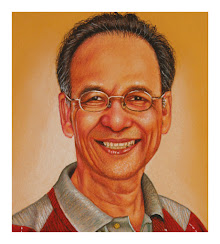
FROM DILIP MUKERJEA

"Genius is in-born, may it never be still-born."

"Oysters, irritated by grains of sand, give birth to pearls. Brains, irritated by curiosity, give birth to ideas."

"Brainpower is the bridge to the future; it is what transports you from wishful thinking to willful doing."

"Unless you keep learning & growing, the status quo has no status."
Showing posts with label Leonardo da vinci. Show all posts

Friday, August 26, 2022

Further to my earlier writings on a series of posts about developing an opportunity-sensitive mindset,  here's my next Viewpoint Strategy:

VIEWPOINT STRATEGY ~ SEEING BEYOND:

It is difficult to predict the long-term future, especially in a world that is rapidly and constantly changing.
However, this should not stop us from considering and playing with some possible, plausible and probable scenarios in the future, in which we plan to play a major role in them.
In the corporate world , we call this scenario planning.

For a young student, it is pertinent for you to take a longer term perspective, at least ten or more years down the road, in terms of what you want to do with your life. This can affect invariably what you do today.

Let me illustrate. Today, you are a secondary school student and your dream is to become a neurosurgeon.

To become and succeed as a neurosurgeon, you need to have adequate working experience in a reputable hospital. To do that, you need to graduate from a top-notch medical university.
For entry to study in a top-notch medical university, you need to score excellent grades in your A Levels, and you also need to do well in your SAT. To attain that, you need to go into a good junior college to mix around with the best, and just to get into one, you need to achieve excellent scores in your O Levels.

So, it is obvious that your planning starts from today, and you will have to start by seeing beyond in order to consider all the educational options open to you!
Once you set this in motion, you will get to see the opportunities along the way that will pave the time-path for you to achieve your ultimate dream!

Be prepared for all the opportunities lurking around you, but first things first, go and enjoy your exploration from different viewpoints!
Frankly, drawing on my own experiences, the goal of "seeing beyond" is not to predict the future but to tell you what you need to know in order to take purposeful, meaningful and productive action in the present.

As a parting shot, I would like to leave this elegant quotation from the Renaissance mestro Leonardo da vinci:

"If you wish to gain knowledge of the form of problems, begin with learning how to see it in many different ways."

That's all folks for today! Stay tuned for my next viewpoint strategy!

Friday, April 20, 2012

WORLD CREATIVITY WEEK, 15TH TO 20TH APRIL 2012


I didn't realise that 15th to 20th April is 'World Creativity Week', which has its humble beginnings from a sort of community event held eleven years ago in Canada, until I have read a blogpost by Lisa Canning today on the 'Innovating Through Artistry' weblog.

By the way, I have also learned that the Renaissance maestro Leonardo da vinci's birthday anniversary also falls on 15th April.

To commemorate the event, here's a short blast, though belated, from braindancing maestro Dilip's writings:

"Creativity is the ability to cast light upon darkness, to see with fresh eyes, to come up with 'silly' solutions to serious problems!

Creativity is having fun with life! 

Creativity is helping the world become a better place for all life on our fragile planet!'

From the foregoing observation, it is evident that creativity comes from within all of us, but it takes personal responsibility, personal initiative as well as personal discipline to get started and to get moving.

The "casting of light" and "seeing with fresh eyes"  perspectives, as mentioned by Dilip, imply that personal creativity, in tactical terms, anchors on two attributes:

- our ability to see the fine details or little things that others overlook in our field of vision;
- our ability to take the big picture or broad view of any scenario that falls withing our field of vision;

Nonetheless, I often cajole Dilip on the point about personal creativity, whereby some folks - Dilip himself is a classic example - are somewhat lucky, with the hot flame on their Aladdin lamps burning bright consistently all the time, despite the wind, whereas other folks have to work much harder to keep on rubbing their seemingly rusty Aladdin lamps, so as to get the flame flickering, so to speak.

Monday, October 26, 2009

LEONARDO'S CLOTHESPIN

What follows is an unique collection of exhibits from small designs submitted by professional designers, artists & educator, under the Leonardo Project organised by the Eli Whitney Museum in May 1995.

They embodied the expression of the craft & creativity defined by Leonardo da vinci's Notebooks.

He explored his world with the eyes of a scientist; he reinvented it with the hands of an artist. he directed students in architecture & landscape design, in fashion & theatre design, in product design & graphic design: all of the creative expressions that surround mankind.

Inspired by Leonardo, the museum invited submissions to demonstrate the transformation of a clothespin into a recognisable character as well as to show design at work.

Personally, I am very impressed by the creativeness & ingenuity of the creators of the following exhibits.


[Source: Eli Whitney Museum & Workshop]

Sunday, April 26, 2009

WHAT DO YOU CHOOSE TO SEE? WHERE DO YOU DIRECT YOUR ATTENTION?

Look closely at the ‘imagery’ below; note down, or draw, at least ten different items that catch your eye.

Tip: Relax. Do not be judgmental. Just look at the square with “soft focus” and let your imagination drift into the surreal imagery of the scene. The answers will soon become obvious.


The mind is easily able to fabricate anything out of anything, whether conceptually or perceptually. When something is set before it, the mind responds to the creative potential of unconscious imagery, often with electrifying brilliance.

Leonardo da Vinci (1452–1519), “universal man,” and arguably the greatest genius of all time, hit upon the potential for creative magic when he stated:

“When you look at a wall spotted with stains, or with a mixture of stones, if you have to devise some scene, you may discover a resemblance to various landscapes, beautified with mountains, rivers, rocks, trees, plains, wide valleys, and hills in various arrangement; or again you may see battles and figures in action; or strange faces and costumes, and an endless variety of objects, which you could reduce to complete and well-drawn forms.”

~ Patrice Boussel;

Leonardo’s ideas equate somewhat with the modern-day Rorschach test, and provide a method for tapping into and exploiting the subconscious for creative accomplishments.

Leonardo often signed himself “disciple of experience” and acquired “experience” via the formidable use of his senses. His astonishing powers of observation led him to uncover many of nature’s secrets.

In “knowing how to see,” which he called sapere vedere, he understood and related to whatever it was that happened to be the object of his scrutiny. He believed that the only way to learn something by heart was by first learning how to draw it accurately.

Subconscious creative processes are propagated by starting with unformed stimuli. These could be random shapes on any surface, features on a person’s face, cloud shapes, wall spots, or patterns cast by shadows.

One simple way of seeing such fuzzy imagery is by squinting your eyes at things. The obvious then becomes ambiguous and permits your mind to drift into making new connections.

Now look at the adjoining page and see what I have seen for the exercise that has been set for you. What you see may or may not be different. Know only that images do exist and that there is no limit to them.

Important points to consider are:

The images perceived need not always be complete. Ideas come ready to refine, not ready to use.

The main benefit of this device is to expose your senses to the “trigger effect” of seeing images on a surface that is otherwise perceived as simply an uneven expanse of rockscape.

Creativity is the new combination of existing elements. Look for what exists, then mix and match as you desire. Finally, convert your perception into reality.


Squint your eyes at the text on this page and see what you can make of it. Shapes are created not just by the text but also by the spaces between the text. I see an entire wonderland of life teeming with activity. What do you see?

Now look at the marketspace: innovation happens at the fuzzy edges, then becomes the core.

The fuzzy edge is where the action is - in terms of growth, innovation and value creation. Master the edge, and you become the puppetmaster!

Four Realms of Human Behaviour That Determine Our Creative Outcomes:

· Social: the dynamic, complex relationships where we establish our individual identities and the forms of social interaction we engage in to shape these identities.

· Enterprise: the ways in which we organize ourselves in order to create economic value and how we construct, and de-construct, the boundaries of these economic entities.

· Market: how we compete and collaborate on local and global scales to create, capture, and deliver economic value.

· Learning: how we learn, applied to what we need to learn, in terms of individual, as well as group, learning.

These four realms overlap and interact with one another. The biggest opportunities will emerge from the interplay at the edges of these realms where tensions will surface and need to be resolved.

[Excerpted from the 'Catalysing Creativity' edition of The Braindancer Series of bookazines by Dilip Mukerjea. All the images in this post are the intellectual property of Dilip Mukerjea.]

Say Keng's personal comments:

What Dilip Mukerjea has touched on in the foregoing essay is, to me, one of the most profound as well as most potent aspect of the creative process I have ever learned: enhancing perceptual sensivitiy.

It is the same point which the Renaissance genius Leonardo da vinci had put forward more than five centuries ago. He said:

"All our knowledge has its origins in our perceptions."

Likewise, creativity guru Edward de bono had argued about the perceptual aspect of thinking when he coined 'Lateral Thinking' in the late sixties. In fact, he once said:

"Everyone is surrounded by opportunities. But they only exist once they have been seen. And they will only be seen if they are looked for."

Other creativity experts like James Adams, Michael Michalko & Roger von oech, to name a few, have also done their individual part to drive home the same point in their respective great works.

Interestingly, even marketing & business innovation strategists have the same beliefs:

"You are surrounded by simple, obvious solutions that can dramatically increase your income, power, influence & success. The problem is, you just don't see them."

~ Jay Abraham, author of 'Getting Everything You Can Out of All You've Got';

"Successful opportunities for innovation & growth are right here, in front of us, & we often can't see them or don't act on them."

~ Erich Joachimsthaler, author of 'Hidden in Plain Sight: How to Find & Execute Your Company's Next Big Growth Strategy';

Most importantly, modern neuroscience research has also in fact substantiated this point, as argued brilliantly by Gregory Berns in his recent wonderful book, 'Iconoclast: A Nueroscientist Reveals How to Think Differently'. Please read my book review in the 'Optimum Performance Technologies' weblog. Here's the link to it.

I like to leave the following apt quote from internationally acclaimed peak performance & success coach Anthony Robbins as food for thought:

"The difference between those who succeed & those who fail isn't what they have - it's what they choose to see & do with their resources & experiences of life."

Tuesday, April 7, 2009

THE SEVEN da vincian PRINCIPLES TO STIMULATE YOUR CREATIVE GENIUS

In this post, I like to share Dilip Mukerjea's perspective about the da vincian Principles, through an excerpt from his book, 'Surfing the Intellect: Building Intellectual Capital for a Knowledge Economy', which drew upon his inspiration from Michael Gelb's 'How to Think Like Leonardo da vinci'.

He writes:

The da vincian Principles could also be seen as multiple concepts, all superimposed upon one another. The essence of these principles is such that their cross-fertilisation is cornucopian.

The seven principles are rendered here in Italian with their explanations in English. Contained within parentheses are comments pertaining to their relevance today.

1) Curiosità:

We must be insatiably curious about life and exude an unrelenting quest towards continuous learning.

(Curiosity equates directly with creativity, as well as with the qualities of present-day leadership. These are invaluable traits in a world that has recognised the value of 'learning how to learn'. We need to cultivate hungry, urgent minds, inspired by a questioning consciousness.);

2) Dimostrazione:

We need to demonstrate a persistent commitment to knowledge. This quality must be tested through experience via an absolute willingness to learn from mistakes.

(We can no longer be armchair intellectuals; we must act on our ideas. Mistakes are not failures. Our 'mistakes' breed successes.);

3) Sensazione:

Enlivened through experience, we must nurture a continual refinement of our senses, especially our sense of vision.

(We see the world through the filter of our senses. However, the conscious development of our senses will sharpen our powers of insight. By extension, this leads to the development of foresight. In today's climate of competitive intelligence, we need insight about the present and foresight about the future.);

4) Sfumato:

Literally meaning 'going up in smoke', this quality calls upon us to willingly embrace ambiguity, paradox, and uncertainty.

(Never before has this been more relevant that the present age where quantum mechanics, and the science of chaos and complexity, constantly shatter the onion-skin like straitjackets that have imprisoned us. they define and determine our realities like never before, revealing order in chaos, chaos in order.);

5) Arte/Scienza:

We must develop and cultivate a sense of balance between our powers of logic and imagination.

(The human brain has 'left' and 'right' mode attributes. We must strive to integrate them in our daily activities in order to enhance ourselves in any discipline. Logic alone is a liability, and imagination without logic is too ephemeral. Thus, we should constantly study the art of science and the science of art.);

6) Corporalita:

We should strive to cultivate fitness, grace, ambidexterity, and poise in all our endeavours.

(The brain is connected to the body. it is not a solitary organ within the skull. There must be a coordination's of mind, body and spirit in all that we are and in whatever we do. This enables us to transcend ourselves from a just a 'body' into a 'being'.);

7) Connessione:

We must recognise that there exists an interconnectedness in all things, in all phenomena.

(Everything connects to everything else. The person that can see connections between seemingly random and disparate items or events, is able to appreciate the gestalt of possibilities ~ formidable qualities in the domains of creativity, leadership and communication skills.);

da vincian PRINCIPLES: PERSONAL PERSPECTIVES III

[continue from the Last Post.]

"Everything is connected to everything else."

To be frank, the first time I had encountered this profound statement from Leonardo da vinci, that was way back into the late seventies or maybe the early eighties, I sort of knew it only intellectually, but did not truly understand it.

That's to say, to paraphrase personal transformation guru Harry Palmer, I had acquired only the "word experience", but not yet the "world experience".

It was probably only towards the end of the eighties that I had a good grasp of its true meaning, especially after I had embarked on a journey to explore learning & creativity as lifelong pursuits, followed by my small entrepreneurial ventures during the early nineties (bookstore, newsletter publishing, & consulting).

Around that time, I had acquired the fascinating book, 'Connections' [followed later by 'The Pinball Effect'] as well as the related wonderful video productions, by scholar & documentary producer James Burke.

He had brilliantly traced the course of many technological innovations from ancient times to the present. In fact, he looked in particular at 8 of them, which maybe most influential in structuring our futures:

- the computer;
- the production line;
- telecommunications;
- the airplane;
- the atomic bomb,
- plastics;
- the guided rocket;
- television;


According to him, each of the 8 was part of a family of similar devices, & was the result of a sequence of closely related events extending from the ancient world until the present day.

In a nut shell, about 12,000 years of history had shown that every person, circumstance, event or invention related in some way to every other.

With my own personal exploration of the field of creativity & innovation, first as a student, then researcher, & finally as a strategy consultant, working with real-world clients, my understanding & knowledge of the foregoing statement went up a couple of notches.

I like to use the following apt quotes to exemplify:

"The crux of creativity resides in the ability to manufacture variations on a theme. If you look at the history of science, for instance, you will see that every idea is built upon a thousand related ideas. Careful analysis leads one to see that what we choose to call a new theme is itself always some sort of variation, on a deeper level, of previous themes."

~ Douglas Hofstadter, quoted in 'Essence of Creativity' by Steven Kim;

"The essence of creation - in all endeavours - is chance connections between ideas & facts that were previously segregated. Entrepreneurship is the direct by-product of chance, of convoluted connections among ideas, needs & people."

~ Tom Peters, 'Liberation Management';

Around the same time, as part of my strategy consulting, in conjunction with my small bookstore, aptly called 'The Brain Resource', I had also indulged in training development & coaching both professionals, managers & entrepreneurs as well as school going kids & teens.

In building up my reference & coaching resources, especially for the kids, I had stumbled upon a wonderful picture book, among many others, by Dr Seuss under his pseudonym, Rosetta Stone: 'Because a Little Bug Went Ka-Choo!'.

In a nut shell: A little bug sneezed & each consequence led to a bigger one, creating in the end total chaos in town, & all because a little bug went ka-choo!

It was certainly a fun way to introduce to the kids the idea that even our smallest actions could have important consequences.

Nonetheless, for me, it was also a brilliant encapsulation of Chaos Theory, which beautifully illustrated the fact that a small event could trigger larger unforeseen events.

Wow! Basically everything is somehow connected to everything else!

Interestingly, I had also meanwhile stumbled upon the Dymaxion Map, or better known as the Fuller Projection, from R Buckminister Fuller, or Bucky as he was affectionately known. He was the man who had created the Geodesic Dome.

Imagine my real shock of realising what I had learned earlier in school, especially with the most widely used Mercator Map, was wrong.

In the Mercator Map, Greenland was shown 3 times its normal size; Antarctica was splayed across the full length of the bottom of the map as a huge long piece of land.

That's to say, the map was badly distorted.

In the case of the Fuller Projection, patented in 1946, the map arrangement puts the North Pole as the centre, thus showing a contiguous land mass & retaining most of the relative proportional integrity of the global map.

That's to say, the map has no or minimal distortion.

In reality, Bucky saw all people on planet earth eventually becoming a one-town world or one-world island in a one-world ocean.

I then knew exactly why Bucky had designated our planet earth as Spaceship Earth. We are all in it together as crew members.

In other words, we are all connected.

Come to think of it, at a deeper level, whenever we find or learn something new in our environment for the first time in our life, doesn't our brain goes into a quick search mode at lightning speed to zip through our entire lifetime inventory of memory traces in order to create a match, so to speak, as if everything in life we have gone through is connected or resonated in some way?

Thursday, March 12, 2009

da vincian PRINCIPLES: PERSONAL PERSPECTIVES II

[continue from the Last Post.] In his wonderful book, entitled 'Building Brainpower: Turning Grey Matter into Gold', Dilip Mukerjea has dedicated 28 pages of elaboration, plus 5 hand-crafted mind-maps on 'Our Amazing Senses', namely, & in order of their appearance in the book, 'Sense of Touch', 'Sense of Taste', 'Sense of Smell', 'Sense of Hearing', & lastly, 'Sense of Sight'. Among the da vincian Principles, as mentioned in my earlier post, our amazing senses constitute an important part of having a complete mind. Why is that so? Our amazing senses are the sensory pathways to what we see, what we hear, what we taste, what we touch, what we smell & in fact what we feel & do in the world out there. The sensory information that we receive through our amazing senses go into a 'combinatory play' - drawing my cues from Albert Einstein - from which we draw our first insights, which lead to our productive thoughts. Using our ingenuity, imagination & creativity, we then turn these thoughts gradually into our ideas. Today, we live in a visual society. Marketers & purveyors certainly know how to exploit our visual culture in order to get to our personal attention. Interestingly, vision happens to be our primary sense. In fact, from birth to death, or womb to tomb as my good friend Dilip Mukerjea likes to put it, we interpret the world through images. Our brains are stimulated more by visual cues than any other senses. As a matter of fact, neuro-scientists have confirmed that, more than three-quarters of our brain structures, especially the occipital cortex & its associated elements, work in tandem to process all the incoming visual information. Particularly for the male species, sexual attraction relies greatly on vision. More importantly, as much as 90% of the learning in our lifetime enters through our eyes. So, Leonardo da vinci was absolutely right when he advocated - remember, more than 500 years ago: "Develop your senses, especially learning how to see." In fact, this was his principal premise: “The eye, which is called the window of the soul, is the principal means by which the central sense can most completely & abundantly appreciate the infinite works of nature.” If you look through all the success literature that has been published over the years, the power of vision is always mentioned as an important attribute to successful living. A case in point: productivity guru Stephen Covey has summarised his brilliant synthesis & accurate analysis of the success literature stretching across more than 200 years of American history in his '7 Habits', especially with #2: Begin with the end in mind! Change & innovation strategist/futurist Joel Arthur Barker has touched on this subject in his wonderful training video production, 'The Power of Vision'. [He talked about the great work of & the influences from Fred Polak, Viktor Frankl, James Collins, Benjamin Singer & Martin Seligman, pertaining to the power of having a positive image of the future, irrespective of nations, societies, children, companies & individuals.] For me, enhancing perceptual sensitivity is always a prerequisite to creativity & innovation. Leonardo da vinci put it best: "If you wish to gain knowledge of the form of problems, begin with learning how to see it in many different ways." So, how does one develop this capability? First, adopt a mindful attitude towards the world we live in. Here are some other practical suggestions: - recognise patterns; - make new connections; - think possibilities or unusual combinations; - challenge assumptions; - break ingrained habits; - seek out novelty; - adopt new perspectives; - develop wide angle vision; - use peripheral vision; - be playful (i.e. be child-like, but don't be childish!); - play with metaphors & analogies; - generate lots of ideas as well as alternatives; - ask naive as well as intentional questions; - take some risks; - learn to notice & respect uncertainty; - embrace ambiguity & paradox; - look at what's not there (& also listen to what's not said); - focus on relationships; - regard for process; In concluding this post, I like to quote from the book, 'Mindfulness', by Dr Ellen Langer of Harvard University: "Learning to see the same old world from different perspectives is the first step toward mindfulness or a mindful attitude. Changing requires two things: learning to think about old situations in new ways, & opening up & enlarging our frames of reference." [To be continued in the Next Post. All the images in this post are the intellectual property of Dilip Mukerjea.]

Sunday, March 1, 2009

da vincian PRINCIPLES: PERSONAL PERSPECTIVES I

I am sure that most readers are already familiar with the 'Principles for the Development of a Complete Mind' often attributed to the Renaissance genius Leonardo da vinci.

Learning Chef & Braindancer Dilip Mukerjea calls Leonardo da vinci 'A Role Model for the New Millennium' in his wonderful book, 'Surfing the Intellect: Building Intellectual Capital for a Knowledge Economy'.

In fact, he even adds a brief history in his book about the polymath: anatomist, architect, artist, botanist, city planner, composer, costume set designer, engineer, instrument inventor, joke teller, mathematician, musician, philosopher, riddler, scientist, sculptor, storyteller, weapon designer, writer, all rolled into one.

To recap in a nut shell, the da vincian prinicples are given as follows:

1) Study the Science of Art;

2) Study the Art of Science;

3) Develop your Senses, especially How to See;

4) Realise that Everything connects to Everything Else;

However, what do they actually mean?

I like to share my personal perspectives on the self-imposed question, to be answered in three parts.

I will cover the first part in this post, which will deal with the first two da vincian principles. This will be followed by the second & third parts in two subsequent posts, tackling the remaining two da vincian principles respectively.

Frankly, science and art are not necessarily opposite. In fact, more than not, they are intertwined as well as interdependent.

Take an automobile, say the Volvo XC90 Sport, for example.

It's definitely a beautiful and powerful car, because I have test-driven one for a good friend.

It is undoubtedly created by the science of engineering. The 3.2 litre V6 turbocharged engine; the 6-speed automatic transmission; anti-skid, active stability, automatic levelling chassis & steering; preventive, protective as well as child safety features, are obviously the results of the scientific method.

But the aerodynamic exteriors, interior leather & panel styling, driver support including the power seat, climatic controls & high-performance audio systems are artistic contributions, at least from my perspective.

One can argue that all cars are about the same: they provide just transportation, at least from the scientific standpoint. But it's the artistic point of view that provides variations & distinctions for the ultimate driving experience.

Next, where science & art meets is in the ancient Japanese art of paper folding, known as origami.

As I understand from origami hobbyists, the goal of this art is to create a representation of an object using geometric folds and crease patterns, preferably without the use of gluing or cutting the paper, and using only one piece of paper.

In fact, origami only uses a small number of different folds, but they can be combined in a variety of ways to make intricate designs.

In a nut shell, as I look into an origami execution, it is obvious that the science of art and the art of science fall between the folds.

Between the folds not only demonstrates the wizardry of ancient masters of origami, it displays the elegance of the underlying mathematics in a way that connects with the heart and soul.

Next again, where science and art meets is in building design.


A simple example is our own 'Esplanade – Theatres on the Bay', sited within Singapore's civic district, just by Marina Bay at the mouth of the Singapore River. It is today one of the world's busiest arts centres.

From an engineering standpoint, it's quite a marvel.

No wonder, we call it affectionately, 'The Durian', reflecting nature's resources and artistic designs, which give rise to an architectural style that not only look great for us, but also make us feel great as Singaporeans.

With the 1,600-seat Concert Hall, plus acoustics by Russell Johnson, and the 2,000-seat theatre, which is an adaptation of traditional European opera houses in horseshoe form, it's certainly a great piece of art on its own, not only attracting over seven million visitors and presenting more than 1,800 performances last year.

Incidentally, for the uninitiated, performances in the theatre, dance & music are originally based on science.

Next again, where science and art meets is in the production of animation or action thriller movies for today's generations.

Just imagine today - I am sure there will be sheer agony - watching 'Transformers', with its story about an ancient struggle re-erupting on Earth between the heroic Autobots and the evil Decepticons, or 'Wall-E', one of the most cutest, lovable characters Pixar ever invented, using cinematographic technology of the fifties or sixties, & relying on painstaking human brush strokes.

Again, as an example, take the award-winning movie, 'The Curious Case of Benjamin Button', now showing in Singapore, starring Brad Pitt & Cate Blanchett, based on a story of a very peculiar man who had started aging backwards with bizarre consequences.

For me, it is difficult to know exactly when or where computer graphics actually intervenes with heavy make-up to show that the character in the movie is going through the timeline of the aging backwards process, as the story unfolds through a diary read by the daughter of his love.

That's to say, the interplay of the science of art and the art of science is blurred in the movie. But it's a poignant love story, & Brad Pitt is definitely in his finest form.

Now, going back to the two key da vincian principles brought up earlier, I can well understand how Leonardo da vinci came to that conclusion, or to be more precise, forethought, which eventually propels us in a way to bring science and art together to yield technological innovations for our lives.

It was Leonardo da vinci who first ventured into oil paintings with the use of light, shadows, proportions & fine details, because of his broad outlook in embracing a wide range of natural sciences & mathematics, as he searched for the scientific rules governing both man and the universe. It was these rules which had ultimately provided the basis for his imaginative reconstruction of nature in great works, such as 'Mona Lisa' & 'The Last Supper'.

He believed that paintings should be considered a liberal art. According to him, it was based on mathematically derived perspective theory, which satisfied the primary sense of sight, as the paintings could achieve a sense or rather illusion of depth, thus drawing viewers into the paintings, wanting to reach or touch them.

Very interestingly, art conservators of today use the tools of modern science to examine & care for paintings of the past.

So, the science of art and the art of science are brought together to merge in a facility that is a cross between an art studio and a forensics laboratory, which helps to uncover secrets hidden in layers of paint.

For example, x'ray machines scan large art works for cracks; needles are used in biopsy fashion to pull tiny clips from paintings for examination under a microscope; infra-red cameras developed originally for night vision warfare look beneath surfaces to see the under-drawings that ancient masters used to plan and prepare their paintings.

To more or less conclude this post, I must point out that the science of art and the art of science have invariably played - and will continue to play - very vital roles in our human culture.

[to be continued in the Next Post, in which I will explore with readers how to leverage on the science of art and the art of science in the pursuit of personal mastery.]