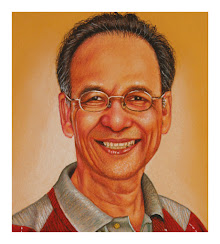
FROM DILIP MUKERJEA

"Genius is in-born, may it never be still-born."

"Oysters, irritated by grains of sand, give birth to pearls. Brains, irritated by curiosity, give birth to ideas."

"Brainpower is the bridge to the future; it is what transports you from wishful thinking to willful doing."

"Unless you keep learning & growing, the status quo has no status."
Showing posts with label Intelligent Learner. Show all posts

Monday, July 25, 2022

[Continue from Part II: HOW TO BECOME AN INTELLIGENT LEARNER] 

Enter the Peak Learning State

According to Paul Scheele, principal developer of the PhotoReading technology, the brain must be adequately prepared in order to study or ready efficiently.

Two mental exercises will accomplish this preparation:

a) Clearly state your purpose, and

b) Generate a resourceful state of mind;

Clearly State Your Purpose

Reading everything many times in order to achieve total comprehension would take a tremendous amount of time. It would also not be worthwhile in most cases. 

Since all reading ultimately serves some purpose, it is best to learn to set a specific purpose.

Here are a few questions which can help you establish a purpose in your reading:

i) What is my ultimate application of this material?

ii) How important to me is what I am reading, and in the long term, how worthwhile is it?

Once these questions are answered, try to narrow down your purpose:

iii) What specifically do I want or need to remember from the material: Is it “global overview” or is it small information I want?

State to yourself the purpose for reading every time you read. 

Get into this reading habit. This tends to engage the brain, to increase your concentration and sharpen your focus. It also reinforces your ability to choose when to make the power of your brain to work for you.

You will undoubtedly find yourself choosing not to read the less important materials. You can then release any sense of guilt about procrastinating or failure to read by default. Instead, you can start affirming, “I can accomplish anything I sincerely set my mind upon.”

Generate a Resourceful State of Mind

Many studies have shown that a relaxed & resourceful state of mind is crucial for efficient reading. When a person is relaxed and alert while reading, he is more likely to be faster, more fluent, and less distracted. He will be more able to comprehend, retain and recall what is read.

I would like to introduce you to ‘The Tangerine Technique’ developed specifically for PhotoReading.

Using the Tangerine technique, a reader can quickly and easily establish a relaxed state of alertness. 

An added feature of this simple technique is that it automatically directs a person’s available unit of attention. The result is an immediate improvement in reading skills.

Further studies have shown that both reading and memory require attention. A person has seven, plus or minus two, units of attention available at a conscious level. 

By fixing one’s attention on a single point, a person can effectively focus his other available units of attention to perform the task at hand.

Research also indicates that the actual location of one’s point of attention is important. For example, when driving a car, the best point of attention is down the road – not on your dashboard or the rear bumper on the car in front of you. 

For the efficient reader, the ideal point of attention is just behind and above the head.

The Tangerine technique helps locate and maintain the ideal point of attention for reading.

Basic Steps to Follow:


i) Hold an imaginary tangerine in your hand. Feel the size, shape, weight, texture, and experience the smell of the tangerine;

ii) Gently close your eyes and place the tangerine so that it delicately balances just behind and above the back of your head. Become aware of the feeling;

iii) Imagine your field of vision opening up;

iv) Open your eyes while maintaining the feeling of the tangerine resting on just behind and above the back of your head. Read;

By playing with this technique, you will navigate reading material with increased speed and fluency. Your ability to concentrate on the information improves and reading becomes more relaxing.

For the first few weeks, you will have to consciously place the tangerine just behind and above the back of your head. Soon it becomes an automatic (unconscious) process so that whenever you approach reading materials, the imaginary tangerine floats into place.

[to be continued in Part IV]


Sunday, July 24, 2022

[continue from Part I: HOW TO BECOME AN INTELLIGENT LEARNER]

Create a Brain-friendly Environment for Work & Learning

Organise your physical environment to support you both at home and at your workplace.

Here are some suggestions:

Establish a learning centre. Have one specific place where you can work or study, helps you get your brain in the habit of getting down to the business of information processing whenever you are there.

Always make sure you have a good light source for reading. Natural light or full-spectrum lighting is best for your eyes.

Also, get comfortable – but not so comfortable – chair. An erect posture in the chair will transmit messages of alertness to your brain.

Keep the room temperature cold. The best temperature for the brain is about 19 degrees Centigrade. This is the temperature that will promote optimum brain performance. It is colder than most people commonly set their thermostats. If it feels too cold, wear a sweater.

Play some Baroque and Classical music softly in the background as you work or study. 

Research has shown that Baroque music from the 17th to 18th centuries can help eliminate physical stress and enhance mental performance. The slow movements in Baroque compositions, generally designated as “Largo” or “Adagio”, have approx, 60 beats per minute. This is close to the rate of the human heart beat in a relaxed state.

Vivaldi’s The Four Seasons and Pachelbel’s Canon in D Major are highly recommended for enhanced mental performance. 

Other recommended Baroque composers include Bach, Corelli, Handel and Telemann.

From my own strategic exploration over the tears, New Age music selections can induce the same effect. My favourite New Age composers include Ray Lynch, Ravi Shankar, Kitaro (just stay away from his drums!), Stephen Halpern, van Gelis and Yanni.

Keep your surrounding environment bright and pleasant.

In addition to a good light source and a cold temperature, the surrounding environment should have an uplifting ambience. 

Subdued pastel colours, beautiful paintings or posters, a window with a view of nature scenes are uplifting for your brain. Choose artwork that is relaxing, but avoid busy scenes that remind your brain of noise and crowds.

It is also good to have some natural green plants around you, and plenty of fresh air with cross-ventilation to keep the air blowing.

Remove visual distractions from your work or study space. Keep food, TV, magazines and other temptations out of sight and out of the room if possible.

Give yourself regular breaks. 

Concentration can deteriorate as a result of mental fatigue. Studies indicate that forty to fifty minutes is about the maximum time most people can effectively concentrate. At the end of that time you begin to experience fatigue and drift out of the peak learning state. A short break will revitalise you.

When you are taking a break, get some exercise, do a body stretch, relax your neck and back muscles, drink some water, or participate in a non-mental activity to clear your mind. 

Personally, I would recommend Brain Gym exercises as highlighted in my weblog.

[to be continued in Part III]


Saturday, July 23, 2022

HOW TO BECOME AN INTELLIGENT LEARNER

According to information experts, 80 to 90 per cent of the information inputs we receive daily comes through visual cues. 

Most of these visual cues are captured by our brain through the process of observation and reading. Therefore, to be able to master information, we must become an intelligent learner.

On these pages, I have synthesised some useful, practical techniques and workable insights to help you become an intelligent learner.

For your quick and easy reference, I have organised them in the following approach:


Develop Powerful Work Habits

According to Robert Ringer, best-selling author of the books, ‘Look Out for #1’ and ‘Million Dollar Habits’, there is only one major difference between successful people and mediocre people, and that is, habits. 

Successful people have simple but powerful habits and these habits can be learned by anyone who is willing to put forth the necessary effort.

So, first make a habit to plan and prioritise your day.

Every morning, or before you go to bed the night before, make a list of tasks for the day ahead. Start by listing every major task you need to take. 

Categorise each task as priority A, B or C, depending on its importance to you. Focus on tasks that are really important. 

(Remember, “urgency” does not equal “importance”) and then, do them, but tackle the C’s only after you have finished the A’s & B’s.

Set goals. 

In order to organise your priorities, you have to know what your goals are. 

Spend some moments off solitude and quietude to think about what you want to accomplish in different but major dimensions of your life (e.g. academic pursuit, career aspirations, physical health, wealth creation, mental development, family relationships, social networking, recreational ventures, spiritual development, entrepreneurial sidegigs, etc.), both in the long term and in the near future. 

Against the foregoing major life dimensions of yours, think about what you want to be, to do, to learn, to change, to improve, where you want to go, who you want to meet, say a few years from now. 

Write down your goals on paper and set out an action plan as well as a time table for completion. This is very important.

Goals will help you to focus on the future, and a compelling vision will always pull you forward towards your desired future.

[
to be continued in Part II
]