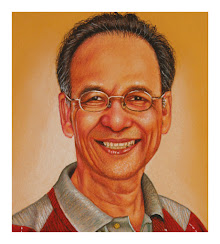
FROM DILIP MUKERJEA

"Genius is in-born, may it never be still-born."

"Oysters, irritated by grains of sand, give birth to pearls. Brains, irritated by curiosity, give birth to ideas."

"Brainpower is the bridge to the future; it is what transports you from wishful thinking to willful doing."

"Unless you keep learning & growing, the status quo has no status."
Showing posts with label Power of Imagination. Show all posts

Sunday, August 28, 2022

These selected pages are excerpted from Dilip Mukerjea's new book, Imagistix:  A Visual Synthesis of Insights, Anecdotes, and Strategies for L.I.F.E. (Leadership, Innovation, Fellowship, Entrepreneurship):


Say Keng Lee's Personal Note: As I read, I am reminded of the following elegant quote: 

"The world can only be grasped by action, not by contemplation. The hand is more important than the eye ... The hand is the cutting edge of the mind."

~Jacob Bronowski, British mathematician, writing in his classic, The Ascent of Mind;

Saturday, July 30, 2022

I like to append below this wonderful story, which exemplified what Dr Maltz talked about the power of imagination and visualisation in PsychoCybernetics:

"James Nesmeth was an average golfer. He generally shot in the mid to low nineties, but dreamed of improving. However, his efforts to raise his golf game were interrupted by the war in Vietnam.
Major Nesmeth was captured and became a prisoner of war, where he spent seven years imprisoned in a cage that was 4 and a half feet long and 5 feet tall.
During his imprisonment, he saw no one, talked to no one and had no physical activity. For the first few months, all he did was hope and pray for release. He soon realized that he had to find some way to occupy his thoughts or he would go insane.
Nesmeth devised a mental program in which he’d play his favorite golf course every day in his mind.
He would visualize the experience to the highest level of detail possible. He imagined the clothes he’d be wearing. He thought about the smell of the freshly cut grass and the feel of the warm sun and gentle breezes on his skin. He’d see every tree, hear the birds singing and squirrels chattering, and envision every slope of the course.
He would then grasp the club, feeling its rough grip on his fingers. He’d imagine his stance and heft the club’s weight in his hands as he started his back swing. He visualized taking his practice swing, addressing the ball and hitting his shot. He’d watch the ball’s arc as it flew beautifully, coming to a soft landing in the center of the fairway.
In the real world, he was never in a rush. Golf was his escape, and he would take his time and enjoy every morning. He did the same in that small cage in Vietnam. He thought through every step and would even stop to get water, just as if he were actually playing a real round.
His imagined golf game took just as long as if he were physically on the course. He hit each shot and played every hole to its conclusion until the ball dropped to the bottom of the cup. He did this every day for 7 years.
Here’s where the story takes an amazing turn. Major Nesmeth was finally released and came back home to America. Physically speaking, his condition had deteriorated as much as you would expect after living in a tiny cage for so long.
Even so, soon after his return, he decided to go and play golf at his favorite course. Amazingly, he shot a 74. He hadn’t swung a real club in 7 years and had undergone indescribable physical deprivation, and yet he had cut 20 shots off of his average."
[Author's Notes: This story is based on my scratchpad notes, captured from stories written and told respectively by Zig Ziglar as well as Dr Denis Waitley, which I have had encountered back in the late seventies or early 80's.]

Tuesday, August 17, 2010

UNLEASH YOUR POWER OF IMAGINATION


"Without this playing with fantasy no creative work has ever yet come to birth. The debt we owe to the play of the imagination is incalculable."

~ famed Swiss psychologist Carl Jung (1875-1961);

I believe Walt Disney once said something like this: "Every child is born blessed with a vivid imagination. But just as a muscle grows flabby with disuse, so the bright imagination of a child pales in later years if he ceases to exercise it."

So, my point: use more of it or lose it!

[All the digital images in this post are the intellectual property of Dilip Mukerjea. Enquiry for outright purchase or design work to meet any client's specific requirements is welcome. Please write to the author at dilipmukerjea@gmail.com]

Saturday, March 27, 2010

UNLOCKING THE DNA OF IMAGINATION TO SEE A MYRIAD OF POSSIBILITIES

I have just finished reading an entertaining book.

It's 'Imagination First' by Eric Liu & Scott Noppe-Brandon, both ardent campaigners for arts & imagination in education.

With the book, the authors introduce a set of universal practices - 28 (and a half) to be exact - to help the reader to get unstuck, & to reframe everyday challenges.

I like the authors' principal premise:

"... The reality is that imagination comes first. It must. Until & unless we have the emotional & intellectual capacity to conceive of what does not yet exist, there is nothing toward which we are to direct our will & our resources... Routinising imagination is... the work belongs to everyone of us... We can all use imagination across every part of our lives - & we can all learn to do it better... "

It is fair to say that the authors have been influenced to some extent by Benjamin & Rosamund Zander, who wrote 'The Art of Possibility: Transforming Professional and Personal Life', which has also been quoted in the book.

The book has been written in three parts:

- the premise, as I have already captured above;

- the practices, which form sort of field manual - I must add that some of them are quite provocative & inspirational;

- the purposes, which form the thematic distillation;


According the the book, one can readily as well as easily think of & express new possibilities by practising the following playful "capacities" (the authors' term for "habits of mind"):

1) Noticing Deeply: identifying & articulating layers of detail through continuous interaction with an object of study;

2) Embodying: experiencing a work through your five senses & emotions, & physically representing that experience;

3) Questioning: asking "why?" & "what if?" throughout your explorations;

4) Identifying Patterns: finding relationships among the details you notice, & grouping them into patterns;

5) Making Connections: linking the patterns you notice to prior knowledge & experience (both your own & others);

6) Exhibiting Empathy: understanding & respecting the experiences of others;

7) Creating Meaning: creating interpretations of what you encounter, & synthesising them with the perspective of others;

8) Taking Action: acting on the synthesis through a project or an action that expresses your learning;

9) Reflecting & Assessing: looking back on your learning to identify what challenges remain & to begin learning anew;

From my personal perspective, the foregoing "habits of mind", even though they are not ground-breaking, serves as my quick takeaways, especially habit #1 & habit #9.

In the end analysis, I like to say that this is still a wonderful book about opening one's minds to a myriad of possibilities, & choreographing the possibilities to work.

For "ideas to cash" (paraphrasing my good friend, Dilip), I would recommend reading this book with 'Turn Your Imagination Into Money: Every Great Business and Innovation Can Be Attributed to One Thing - Imagination', by advertising consultant Ron Klein. In the book, the one chapter about the '22 Springboards to Imagination' alone will kick your imagination into overdrive.

If you are a strategic planner, 'Corporate Imagination Plus: Five Steps to Translating Innovative Strategies into Action', by strategy consultant Jim Bandrowski is worth pursuing.

[My personal fascination with "imagination" actually goes back to the late 70's, when I had first read Alex Osborn's 'Applied Imagination', followed by Michael LeBouef's 'Imagineering' in the early 80's.

I like to consider them real "classics" on the subject, even though both authors had a different slant from Eric Liu & Scott Noppe-Brandon.

The last book I have read not too long ago is Alexander Manu's 'The Imagination Challenge', which is somewhat scholarly, but worth pursuing too, if you have a deep interest like I do.]

Sunday, September 6, 2009

THE FRINGE BENEFITS OF FAILURE, & THE IMPORTANCE OF IMAGINATION

What follows is actually my extract of the Commencement Speech by J K Rowling, author of the best-selling Harry Potter book series, at the Annual Meeting of the Harvard Alumni Association in June last year.

It's entitled 'The Fringe Benefits of Failure, and the Importance of Imagination'.

The entire speech can be viewed at this link.

In a nut shell, her speech was an inspiring look into her own personal life as well as her professional success.

In her address, she has stressed the importance of imagination, not just because imagination was the vital key to her own success as an author, but because it is what enables us to create and make progress in life.

"... So why do I talk about the benefits of failure?

Simply because failure meant a stripping away of the inessential. I stopped pretending to myself that I was anything other than what I was, and began to direct all my energy into finishing the only work that mattered to me.

Had I really succeeded at anything else, I might never have found the determination to succeed in the one arena I believed I truly belonged. I was set free, because my greatest fear had been realised, and I was still alive, and...

... You might never fail on the scale I did, but some failure in life is inevitable. It is impossible to live without failing at something, unless you live so cautiously that you might as well not have lived at all – in which case, you fail by default...

... Failure gave me an inner security that I had never attained by passing examinations.


Failure taught me things about myself that I could have learned no other way...

... The knowledge that you have emerged wiser and stronger from setbacks means that you are, ever after, secure in your ability to survive. You will never truly know yourself, or the strength of your relationships, until both have been tested by adversity. Such knowledge is a true gift, for all that it is painfully won, and...

... I have learned to value imagination in a much broader sense.

Imagination is not only the uniquely human capacity to envision that which is not, and therefore the fount of all invention and innovation. In its arguably most transformative and revelatory capacity, it is the power that enables us to empathise with humans whose experiences we have never shared...

... Unlike any other creature on this planet, humans can learn and understand, without having experienced. They can think themselves into other people’s places..."