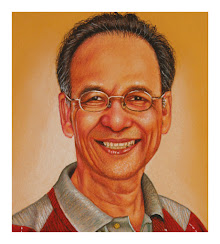
FROM DILIP MUKERJEA

"Genius is in-born, may it never be still-born."

"Oysters, irritated by grains of sand, give birth to pearls. Brains, irritated by curiosity, give birth to ideas."

"Brainpower is the bridge to the future; it is what transports you from wishful thinking to willful doing."

"Unless you keep learning & growing, the status quo has no status."
Showing posts with label Sensuist Mind. Show all posts

Tuesday, August 11, 2009

FROM DILIP MUKERJEA'S ITINERANT TOOLBOX: THE SENSUIST MIND

[continued from the Last Post.]

The root of the word 'absurd' comes from the Latin surdus, ‘deaf or mute,’ a translation of the Arabic jadr asamm, a ‘deaf root.’ To hear, to listen, to pay attention; all valuable skills
in creative communication.

Our vision monopolises our senses. Our eyes are emblems of our status as predators. Prey have eyes at the sides of their heads, for increased peripheral vision and heightened alertness. Most predators have eyes set right on the front of their heads, like owls, and humans. This provides them with binocular vision that enables 3-D imagery to be recognised.

We are now steeped more than ever in a visual culture. The eyes however, are light gatherers; true seeing takes place in the brain. It is the mind’s eye, the sensuist eye, that allows us to picture real as well as imaginary events.

Learn with all your senses. Your memories then become remembrances. In this way, learning and creativity merge to form a union that is illuminated with constant novelty.

The synchrony of our senses helps us discover the beauty of our consciousness.

Synaesthesia is the secret of great artists and scientists. It is the synergy of all our senses. And our senses are the conduits of pleasure, of pain, and the ‘midwives of intelligence.’ We must cultivate our senses. They enable us to exhibit power of persuasion and clarity of expression.

Map your mind with Mind Maps, the brainchild of Tony Buzan. This is a creativity technique that twinkles with life.

Immerse yourself in its radiance.

Further Reading on Mind Maps:

'The Mind Map Book' by Tony Buzan, 'Superbrain', 'Brainfinity', and 'Braindancing' by Dilip Mukerjea, 'Thinking For a Change', by Michael Gelb.

Exercise:

Create a central image that represents an experience you have had, such as falling in love, debating about an issue, working on a project, climbing a mountain, water skiing, etc. Relive in your mind the diverse sensations that correspond to your five senses. Expand the Main Branches, one for each sense.


[Excerpted from 'Surfing the Intellect: Building Intellectual Capital for a Knoweldge Economy', by Dilip Mukerjea. All images in this post are the intellectual capital of Dilip Mukerjea.]

Monday, August 10, 2009

FROM DILIP MUKERJEA'S ITINERANT TOOLBOX: THE SENSUIST MIND

[continued from the Last Post.]

In creativity, the active use of all our senses is invaluable. They have the power to detonate as memories, and more so, as remembrances. Ideas explode forth from such mental activity because emotion in thought leads to motion in ideation.

Smell is the most direct of all our senses; nothing stirs our memories quicker than this sense. As Edwin T. Morris points out in Fragrance, ‘there is almost no short-term memory with odours.’ Just long-term memories. This is a major reason why smell stimulates learning and retention.

Morris goes on to state: “When children were given olfactory information along with a word list, the list was recalled much more easily and better retained in memory than when given without olfactory cues. Perfumes could be considered as liquid memory.”

Touch is a sensory system with unique functions and qualities; most importantly, it is the oldest sense and the most urgent. It can affect entire organisms, shape cultures, and the individuals that experience it.

As Saul Schanberg states: “Those animals who did more touching instinctively produced offspring which survived, and their genes were passed on and the tendency to touch became even stronger. We forget that touch is not only basic to our species, but the key to it.”

Taste is closely connected to smell, yet it is unique, and intensely personal. The word originates from tasten, Middle English for ‘to examine by touch, test, or sample,’ and further back, its roots spring from the Latin taxare, ‘to touch sharply.’ From a trial or a test, we are able to experience good taste and bad taste.

We can lose track of the logic of our lives when our sense of hearing is lost. In fact, the Arabic, ‘not being able to hear’ equates with absurdity. In mathematics, a ‘surd’ is an impossibility, and it is embedded in the word ‘absurd.’

"The five senses are the ministers of the soul.… Yet, the average human ‘looks without seeing, listens without hearing, touches without feeling, eats without tasting, moves without physical awareness, inhales without awareness of odour or fragrance, and talks without thinking.’"

~ Leonardo da Vinci;

[To be continued in the Next Post. Excerpted from 'Surfing the Intellect: Building Intellectual Capital for a Knoweldge Economy', by Dilip Mukerjea. All images in this post are the intellectual capital of Dilip Mukerjea.]

Sunday, August 9, 2009

FROM DILIP MUKERJEA'S ITINERANT TOOLBOX: THE SENSUIST MIND

PURPOSE:

To stimulate the use of your senses when thinking, recalling, and in the process of generating ideas. Formidable in product design, process control, and human interaction.

"Most people think of the mind as being located in the head, but the latest findings in physiology suggest that the mind doesn’t really dwell in the brain but travels the whole body on caravans of hormone and enzyme, busily making sense of the compound wonders we catalogue as touch, taste, smell, hearing, vision."

~ Diane Ackerman

We are the product of sexual union, the primal act of creative coupling.

Creativity propagates creativity, ultimately giving birth to our minds. It has enabled us to become sentient beings, every individual as spectacularly unique as a snowflake.

The word ‘sentient’ comes from the Latin sentire, ‘to feel,’ and also from the Indo-European sent-, ‘to head for,’ ‘go;’ we thus ‘go mentally’ in order to acquire consciousness.

The sensuist is someone who rejoices in sensory experiences. This should not be confused with the sensualist, who is concerned with the gratification of sexual appetites. Our lives pulse along on a fever of consciousness.

Uniqueness emerges from infinite shards of information that travel along the pathways of our senses. The jigsawing of information creates a fluid tapestry that is our identity at any moment.

A true sensuist will have a tapestry that changes dynamically, in real time.

Look at the drawing below. It will help you remember the different senses.

V = Visual (sight)
O = Olfactory or Odile (smell)
T = Tactile (for touch and taste)
A = Auditory (hearing)

[To be continued in the Next Post. Excerpted from 'Surfing the Intellect: Building Intellectual Capital for a Knowledge Economy', by Dilip Mukerjea. All images in this post are the intellectual property of Dilip Mukerjea.]