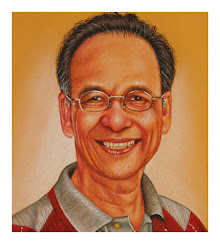
FROM DILIP MUKERJEA

"Genius is in-born, may it never be still-born."

"Oysters, irritated by grains of sand, give birth to pearls. Brains, irritated by curiosity, give birth to ideas."

"Brainpower is the bridge to the future; it is what transports you from wishful thinking to willful doing."

"Unless you keep learning & growing, the status quo has no status."
Showing posts with label Creative Productivity. Show all posts

Tuesday, November 23, 2010

CHAMPIONING STUDENTS: BOOSTING CREATIVENESS & ENHANCING PRODUCTIVITY

[continuation from the Last Post ~ in connection with the recent launch of a series of new programs intended for parents as well as their school-going kids/teens, under the auspices of 'The House of Creative Brains'.]


The '2010 IBM CEO's Survey' has revealed that "Creativity is the most important leadership competency".

Likewise, the 13th Annual Global Survey 2010 by PriceWaterhouse has also revealed that "Innovation... is the cornerstone for future positioning."

Interestingly, the recent 2010 IBM Global Chief Human Resource Officer (CHRO) Study has highlighted three critical workforce imperatives:

1) cultivating creative leaders;
2) mobilising for speed & flexibility;
3) capitalising on collective intelligence;


Creativity & innovation have become more important than ever before for solving real-world challenges & staying competitive in the global economy.

I am sure many readers have seen the insightful TED show on the net where Sir Ken Robinson has made an entertaining & profoundly moving case for creating an education system that nurtures creativity.

He has challenged the way we are educating our children, & has championed a radical rethink of our school system, to cultivate & acknowledge multiple types of intelligence.

[If you haven't yet seen it, here's the link.

I really like the way he has elucidated "creativity" ~ "coming out with something original, & of value, & it comes from many disciplinary ways of seeing things... if you're not prepared to be wrong, you'll never come up with anything original..."]

I am proud to say that creativity & innovation are the distinctive hallmarks in all Dilip's programs, as well as writings, irrespective of whether they are intended for the corporate or academic world.

Dilip holds the steadfast view that creativity is one quality which everyone of us is blessed with. It's our birthright, in fact. If you don't recognise this quality in yourself, you can immediately learn techniques for unleashing & leveraging your creative potential.

Although we believe that our schools are essential in helping our children learn these techniques, we think, right now, they are falling short of our expectations.

As parents, since we are our children's first teachers, we must ensure that our children do not lose their sense of wonder & sense of discovery as they transit the school system during their growing years.

Not only that, parents must also create & nurture a conducive environment in which our children feel safe to take risks & get things wrong. Also, help them develop the habit of looking for more than one right answer to everyday problems, including their own study problems.

As creativity consultant & also, author of 'The Creative Edge', among other wonderful books, Dr William Miller puts it:

"Creativity & productivity are closely linked; by definition & in human motivation. When we are most creative & expressive selves, we are also more productive."

With boosted creativity, it goes without saying that our children can become more productive in their academic as well as other pursuits.

Dilip, drawing from his strategic forte as a creativity & innovation consultant, will use many interesting games & stimulating exercises to bring out your innate creativity.

With creativity & ingenuity, irrespective of whether you are a student or working pro, you will always start to look at the world from a solution-focused, opportunity-sensing approach.

[to be continued in the Next Post.]

[For more information about the series of new programs under 'The House of Creative Brains', please get in touch with Ms. Faye Yeoh via her email faye_yeoh@yahoo.com]

Wednesday, March 24, 2010

CREATIVITY & STRUCTURE

It is quite refreshing for me to read that "creativity is enhanced when it is organised, systematic and based on highly structured processes", which serves as an interesting counterpoint to "the common belief that lack of structure and randomness enhances creative output".

Here's the link to the original article by management consultant Kal Bishop. I certainly like his exemplar from George Lucas' Star War movies.

Somehow, the author's energising ideas remind me of two great works:

1) 'The Houdini Solution: Putting Creativity & Innovation to Work by Thinking Inside the Box', by Ernie Schenck [principal premise: more focused & powerful ideas come from accepting the constraints instead of being controlled by them];

2) 'Get Back in the Box: How being Great at What You Do is Great for Business', by Douglas Ruchkoff [principal premise: the secret of success lies inside the box, by looking at your core competencies, work environments & customer landscapes];

Actually, there is a third book - just came in from Amazon - which I have yet to read.

It's 'Creativity Unlimited: Thinking Inside the Box for Business Innovation', by Prof. Micael Dahlen. I have bought it because of it's catchy structure around three key steps:

- Expanding the box: so that the pieces of the puzzle in it can move around more freely;
- Filling the box: with even more knowledge, and how to get these new pieces of the puzzle to connect with the existing ones;
- Shaking the box: so that the pieces fall into new places and form new patterns;

Please stay tuned!

Tuesday, April 21, 2009

RAPID RECAP: WHY THE NEED FOR CREATIVITY?

Welcome to the Age of Brainware.

Those who do not know this, are victims, not victors. The crucial variable in transforming knowledge into value is ‘creativity.’ Creativity ignites our audacity; it helps us convert pain into progress, and become what we are capable of being.

Incremental evolution has been trumped by quantum revolution. The workscapes of tomorrow have their genesis in the mindscapes of today. Corporate landscapes are littered with the charred remains of burnt-out executives. There is only one ultimatum: innovate or incinerate.

Too many organisations are obsessed with ‘best practices’ when what is needed are ‘revolutionary practices,’ ones that are radically different; the pace of change demands intellectual mutiny vis-à-vis past protocols. Previous success has become irrelevant in today’s fail-fast-leap-ahead quantum dance with competitive innovation.

Japan’s three most innovative companies -- Honda, NTT DoCoMo, and Sony -- are addressing a gargantuan social problem facing them, and also the world’s industrialized nations: the drop in the fertility rate, which has resulted in an escalating aging population. The problem will eventually hit developing nations, since the drop in fertility rates for countries like China and India will pose unheard-of challenges beyond the year 2050.

So will we witness the fruits of creativity in the guise of humanlike robots? These three Japanese companies are working on this new species for our planet.

A goal for these robots is to be ready to challenge the winner of the FIFA World Cup to a soccer match in about 50 years. If they can play soccer, then they surely will be able to do a lot of things for you, both at home -- like wash the dishes, vacuum the floor, baby-sit -- and at work.We know that robots represent the future. We need to start preparing for them. The challenge facing humans is to make sure that these robots behave morally and ethically -- something that we have a hard time doing ourselves.

Exercise: Write down at least 3 ways in which you have demonstrated a good measure of creativity in the past month.

[Excerpted from the 'Igniting Innovation' edition of The Braindancer Series of bookazines by Dilip Mukerjea. All the images in this post are the intellectual property of Dilip Mukerjea.]

Say Keng's personal comments:

Re-reading what Dilip Mukerjea has written reminds me of a National Day Rally 2000 speech by the then Prime Minister Goh Chok Tong, now Senior Minister, during which he had painted the new economic landscape for Singapore (as recorded in my scratchpad notes).

He had even quoted from then visiting consultant Prof Gary Hamel, who wrote 'Leading the Revolution: How to Thrive in Turbulent Times by Making Innovation a Way of Life':

"In the new industrial order, the battle lines don’t run between regions and countries. It's no longer Japan versus the USA versus the EU versus the developing world. Today, it’s the insurgents versus the incumbents, the revolutionaries versus the landed gentry . . . First the revolutionaries will take your markets and your customers . . . Next they’ll take your best employees ... Finally, they’ll take your assets."

With the world changing so radically, naturally it cannot be "business as usual" for us. We have to reinvent ourselves continually.

What Gary Hamel and Goh Chok Tong had put forward still rings true today.

To succeed - and thrive - in an environment of disruptive change, we will have to be more versatile, more ready than ever to anticipate and adapt.

Creativity, as argued by Dilip Mukerjea, is just one avenue. We also have to stay agile & remain nimble, mentally as well as physically.

With greater creativity, versatility and agility, I reckon we can have more options to deal with any insurgency.

Thursday, March 5, 2009

SHREDDING THE STATUS QUO

Innovation is the Bridge to the Future!

In their quest for the best, leaders need insight, creativity, and judgement.

Continual innovation comes from gaining credibility, via commitment towards our capabilities.

Magic happens when we dare to venture into the dark, and pull out possibilities that lie camouflaged within.

Are you able to convert your ideas into cash?

Do you know that it is possible to create fountains of innovation within your organisation?

If not, read on!

We live in perilous, gyrating times. With imperceptible alacrity, today’s core competencies become tomorrow’s core rigidities.

Creative synergy fuels innovative momentum; this is what propels the knowledge ecologies of today.

Corporate learning programmes must cannibalise their Stone Age agendas ~ because they now know this truth:

Creativity or Catastrophe!

Corporations and communities have recognized their need for Creative Commando Units to direct their brains at continual innovation.

Candidates applying for jobs are entering a marketspace of unprecedented turbulence.

The New Millennium is characterized by great flux, featuring the evaporation of obsolete data graveyards. Recruitment scenarios can no longer pay lip service to the contents of dusty manuals. Interview scenes of today demand evidence of brain force.

The status quo is being constantly shredded, and executive challenges demand executive excellence ~ by all members of the organisation.

The choice is clear: Innovate or Incinerate!

Move . . . from Bureau-CRAZY to Bureau CREATIVE!

[Excerpted from the 'Ideas on Ideas' edition of The Braindancer Series of bookazines by Dilip Mukerjea. All the images in this post are the intellectual property of Dilip Mukerjea.]

Say Keng's personal comments:

Dilip Mukerjea is absolulely right when he exhorts earlier in this weblog:

"Unless you keep learning & growing, the status quo has no status."

Tuesday, March 3, 2009

SUSTAINING A BALANCE BETWEEN UNIQUENESS & RELEVANCE

Watching a pendulum swing from one end of the spectrum to the other, what questions come to your mind?

Draw a graphic of your thoughts (on a sheet of paper).

Here are two possibilities:

- How loose can you stay before falling apart?

- Conversely, how tight can you remain before freezing up?

The true nature of the creative process requires a balance between uniqueness and relevance.

Both ingredients must be present for creative productivity.

This ‘delicate balance’ concept is dramatically presented in an illustrated book entitled 'The Dot and the Line' (1963). The synopsis below, by Parnes & Noller (1973) should make you question yourself:

"Am I a rigid line, a chaotic squiggle, or have I discovered my dynamic balance between the two extremes?”

Essentially the book portrays the trials and tribulations of a straight, rigid line as ‘he’ attempts to become more free and open, more uninhibited and spontaneous, in order to win the love of a dot.
We have found that the story has deep meaning for those interested in the study of the creative process and the creative person.

The line in the story learns to bend and twist into all forms of complex and versatile shapes and structures, including complex ellipses, tetragrams, and so on. He breaks the rigidity in his being ~ in his structure ~ into dazzling and profound displays of form that have not only uniqueness but also relevance and meaning.

This, of course, is the true nature of the creative process ~ creating new relationships that are not only unique but relevant and meaningful.

The line’s rival in the little parable is an unruly, wild squiggle (scribble), who is undisciplined, unconventional, uninhibited.

In Juster’s story, the squiggle loses out in his competition with the line after the line has learned to merge his innate freedom and spontaneity with his learned self-discipline and responsibility so as to produce ‘channelled freedom.’ The squiggle does not know how to direct and channel his freedom, and goes on being only a wild, unkempt bit of anarchy.

As the line in the story learned to free his channels, so could the squiggle have learned to channel his freedom. This then becomes the ‘delicate balance’ in creative behaviour ~ freeing channels / channelling freedom, a much needed balance that does not remain static, but one that oscillates constantly so as to allow for the myriad different challenges we face daily.

[Excerpted from the 'Ideas on Ideas' edition of The Braindancer Series of bookazines by Dilip Mukerjea. All the images in this post are the intellectual property of Dilip Mukerjea.]

Say Keng's personal comments:

The way I interpret this beautiful essay by Dilip Mukerjea is this:

The most productive environments for creative thinking, as well as for learning pursuits, synergise and integrate the best of the traditional and progressive approaches:

- Logic and Imagination;

- Discipline and Fun;

- Science and Art;

- Seriousness and Play;

- 'Inside the Box' (working within boundaries) and 'Outside the Box' (playing with boundaries);

In doing so, we naturally become more productive in idea generation and solution finding, as well as knowledge acquisition.

As a matter of fact, creativity consultant Dr William Miller once put it very eloquently, in his classic, 'The Creative Edge':

"Creativity and productivity are closely linked, both by definition and in human motivation. When we are most creative and expressive selves, we are also most productive."

To me, and in some ways, it's also akin to the Chinese two-word description of a crisis situation, where one can actually leverage on the two extremes, 'danger' on one end and 'opportunity' on the opposite end.