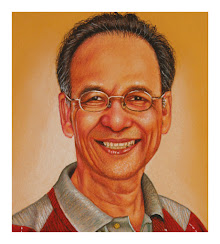
FROM DILIP MUKERJEA

"Genius is in-born, may it never be still-born."

"Oysters, irritated by grains of sand, give birth to pearls. Brains, irritated by curiosity, give birth to ideas."

"Brainpower is the bridge to the future; it is what transports you from wishful thinking to willful doing."

"Unless you keep learning & growing, the status quo has no status."
Showing posts with label Vision of the Future. Show all posts

Monday, November 22, 2010

CHAMPIONING STUDENTS: CULTIVATING VIVID TIME HORIZONS VIA PROPRIETARY 'LIFESCAPING' METHODOLOGY

[continuation from the Last Post ~ in connection with the recent launch of a series of new programs intended for parents as well as their school-going kids/teens, under the auspices of 'The House of Creative Brains'.]


This is my favourite topic, also my strategic forte ~ vision-building.

My real-world experiential understanding of vision-building came from a memorable, though painful, personal encounter from my former "big boss" ~ the late Tan Sri [that's the Malaysian equivalent of "Sir"] Eric Chia, Chairman & CEO of the United Motor Works (UMW) Group during the early eighties, when I had joined them as a manager.

[Readers are welcome to pop into my 'Optimum Performance Technologies' weblog to read about that encounter.]

My working knowledge was subsequently expanded & fine-tuned when I came across the splendid work of futurist/film-maker/author Joel Arthur Barker during the early nineties, especially his acclaimed 'Power of Vision' video-based training program.

As a matter of fact, one of Barker's wise axioms often reverberates in my head, whenever I talk about vision building:

"Vision without action, is but a dream; action without vision just passes the time; vision with action can change the world."

Nonetheless, the latter then led me to the scholarly works of Canadian educational psychologist Dr Benjamin Singer, Dutch futurist & sociologist Dr Fred Polak, & Holocaust survivor & Austrian psychiatrist Dr Victor Frankl, who wrote his magnum opus, 'Man's Search for Meaning', as well as the research work of strategy consultants Jim Collins & Jerry Porras.

Collectively, they drove home the vital point about the power of vision-building:

Nations, organisations, individuals as well as students with vision are powerfully enabled. Those without vision are at risk.

Just as King Solomon had once said, as reported in the Bible of the Old Testament: "Where there is no vision, the people perish."

In the case of students, Dr Benjamin Singer made these startling revelations, back in the sixties:

i) children with vision out-performed their assets;

ii) successful students had one thing in common: a profound belief in their future & their ability in their own efforts to shape it.

Likewise, based on the pioneering research work of Jim Collins & Jerry Porras, visionary organisations out-performed their assets, too.

As a nation, Singapore is a great example! Thanks to the compelling vision - & the strategic foresight - of MM Lee Kuan Yew & his colleagues as well as ministerial stalwarts, Goh Keng Swee, S Rajaratnam, Toh Chin Chye, Eddie Barker, etc., just to name a few of them.

By the way, what is "vision"?

A vision is just a simple idea or mental picture you have in your head about where you want to be in the future.

A clear vision helps one to pursue dreams & achieve goals.

A well-defined vision helps one to focus on the end-state of who you want to be, what you want to have &/or do, & where you want to go.

Generally, it can be applied in two different ways:

1) Inspiration ~ to inspire youself to follow your bliss & pursue your dreams;

2) Anticipation ~ to foresee the changes & improvements you want to have in the future;

When you can envision a future that is better, happier & more productive, you are more likely to make the necessary changes & improvements for yourself to attain that end-state in the future.

To Dr Karl Pribram of Stanford University, who works with sports champions, vision is akin to his "image of achievement".

By the way, what the difference between "vision building" & "goal setting"?

Operationally, they are complementary. A quick one... This is how I look at them:

- vision gives purpose & meaning; goals give direction & power;

- vision comes from the heart; goals come from the head;


At this juncture, I like to share an inspiring quote, to sum up "vision building" & "goal setting":

"If you have a vision and you find that someone doesn't share that vision, you either change the vision or change the people you share it with. We learn and grow one goal at a time. But to set meaningful goals, we need imaginative insight or vision."

~ Dr. Roberta Bondar, the world’s first astronaut-neurologist in space (with Discovery mission, 1992); also, globally recognized for her pioneering contribution to space medicine;

In essence, vision-building is a relatively easy endeavour, if you know how to go about it.

In fact, Dilip will share valuable lessons from the corporate world as well as educational arenas, besides coaching you on how to look at your own life strategically in long-range time-horizons, & also, how to do your own 'lifescape' using his proprietary 'lifescaping' methodology.

[to be continued in the Next Post.]

[For more information about the series of new programs under 'The House of Creative Brains', please get in touch with Ms. Faye Yeoh via her email faye_yeoh@yahoo.com]

Monday, July 5, 2010

VISION AT A QUICK GLANCE

Here's a superb example of a visionary scenario on one single page, as crafted by Dilip Mukerjea.

All salient aspects of the proposed vision - "Making Kids Future-Ready" & "Inspiring a Learning Planet" - are captured in a visually-appealing montage.


Friday, November 20, 2009

SEEING IS BELIEVING: THE POWER OF VISION

[My personal musings, inspired by Page 3 of 'The Brainaissance Program of iCAPitalism Seminars with... The World's Most Powerful Learning Systems for... The Learning Economy', by Dilip Mukerjea]


Where do you see yourself?

What is the significance of the foregoing question posed by Dilip Mukerjea, against the backdrop of a beautiful imaginal brain profile created by him?

He is basically accentuating what author, futurist & film maker Joel Arthur Barker has exhorted in the proprietary 'The Power of Vision' video training program, first released during the early nineties:

'A positive vision of the future is the most powerful motivation for change'.

Citing the research done by Dutch sociologist Fred Polak, American business researcher Jim Collins, Austrian psychiatrist Viktor Frankl & Canadian educator & psychologist Benjamin Singer, respectively on the successes of nations, companies, individuals & even school children, it has been found that, when they began their climb they did not have the right resources & they didn't even have any strategic advantage.

What they all had in common was a positive vision of their future.

The message here is that circumstances do not determine the outcome, only vision does.

Having a vision is imperative to success. Vision is an essential ingredient in living to win.

Even a child building a sand castle on the beach has some sort of picture in his or her head telling them what to do next. It’s vision.

If you want to be successful in any significant endeavor - you first need to have a 'vision of the future'.

From the neurological perspective, I always like to correlate the 'vision of the future' to the 'image of achievement' as postulated by Dr Karl Pribram, Professor Emeritus of Stanford University, one of the prime architects of our modern understanding of the brain.

According to him, all our behavioural actions are governed by our 'image of achievement', & without it, we cannot succeed in our endeavours.

A 'vision of the future' or an 'image of achievement' is a picture that is seen with the mind's eye.

It is not your present reality, but what you believe as your destiny manifest in the present.

It is more than just being able to imagine something in the future. In a nut shell, the 'vision of the future' or 'image of achievement' becomes so powerful that it cause you to step into it, & live your future each day.

I often like to use the personal example of Arnold Schwarzenegger in my training workshops to illustrate the power of vision.

As documented in the book, 'Fantastic: The Life of Arnold Schwarzenegger', by Laurence Leamer, Arnie was interviewed about what he planned to do now that he had retired from body building in 1976. He nonchalantly responded with his thick Austrian accent:

"I'm going to be the #1 box office star in all of Hollywood."

Arnie's first attempt as an actor was a box office flop, but he explained as follows that he would use the same process he had used in bodybuilding. [By the way, Arnie was five times Mr Universe & seven times Mr Europa.]

"What you do is create a vision of who you want to be, & then live into that picture as if it were already true."

Closer to home, a great personal exemplar of the power of vision is Sim Wong Woo, founder, CEO & Chairman of Creative Technology. Readers can go to my earlier post in 'Optimum Performance Technologies' weblog to read about what I had learned from him.

As a successful nation, Singapore is a classic exemplar of the power of vision.

When Singapore was unfortunately kicked out of the Malaysian federation in 1965, most political analysts around the world had seriously thought that Singapore was a gone case.

It was the foresightedness & tenacity of the vision of Lee Kuan Yew & his close team of stalwarts, like Goh Keng Swee, S Rajaratnam, Toh Chin Chye, among others, & his pioneering cohort of dedicated civil servants like Hon Sui Sen, J Y Pillay, Sim Kee Boon, just to name a few, who built Singapore for what she is today.

Throughout the nineties, I had done extensive random surveys of Straits Times interview reports on students who had done remarkably well in their PSLE, 'O' Level, 'A' Level exams, as well as in the presidential scholarship nominations.

I had narrowed down their peak-performing successes to the following common characteristics, in order of priority:

- they are goal-oriented (that's vision! & correlates to Benjamin Singer's research findings);

- they apply study strategies;

- they are passionate & enthusiastic in their academic as well as extra-curricular pursuits;

- they receive parental as well as teacher support;

To end my musings, & I am very confident that Dilip will concur with me that, as long as we have a 'vision of the future' or an 'image of achievement', & we then act upon what we believe or assume will be true of the future or upon our aspirations for the future, our decisive actions in turn will create the future in which we will find ourselves.

Thursday, February 26, 2009

THE LEARNING SOCIETY

[continued from the Last Post.]


Even today, we know more about our phones and automobiles than we do about our own minds.

Despite having attained ‘high intelligence’ and ‘culture’ we remain in a cognitive prison. Our ways of learning and interacting with one another have remained primitive, and principally “user-belligerent.”

From simple bacterium-like organisms to complex eukaryotic cells to large multicellular animals, we have emerged and evolved as a predatory species, to the grief of most preexisting life forms.

We need a fresh consciousness. If not, we remain on course to annihilate our habitat. The solution lies in creating a Learning Society.

We are confronted by the master unsolved problem of biology — how the hundred billion nerve cells of the human brain work together to create consciousness. Yet we have free will to choose our actions, from the infinitude of emotion-charged and symbol-drenched, arbitrary in content, multifarious options on offer.

Why not choose to be a superspecies of learning organisms that blend together to form a Learning Society?

This ‘learning culture’ would apply to infants, families, pensioners, executives, and would be free of the ills that beset the planet today.

Idealistic? Indeed. But all it needs is a will to move: from ideal to intention to illumination ~ an awakening to the truth that we can lead ourselves only through learning continually; our societies can thus stem the rot and salvage the future for our species.

“You can only find truth with logic if you have already found truth without it.”

– G.K.Chesterton

All learning is brain-to-brain, inspired by heart, spirit, mind, body, and soul. When brains connect, illumination dispels darkness, possibilities spark into life. Imagination oxygenates the brain, and ideas flourish: The engine of Intellectual Capital is in motion. The world is alive, and magic must happen.

"Imagine the brain, that shiny mound of being, that mouse-gray parliament of cells, that dream factory, that petite tyrant inside a ball of bone, that huddle of neurons calling all the plays, that little everywhere, that fickle pleasuredome, that wrinkled wardrobe of selves stuffed into the skull like too many clothes in a gym bag."

~ Diane Ackerman

[Excerpted from the 'Leadership, Learning & Laughter' edition of The Braindancer Series of bookazines by Dilip Mukerjea. All the images in this post are the intellectual property of Dilip Mukerjea.]

Say Keng's personal comments:

To help readers in developing a personally relevant 'learning culture', here is my broad recap of the critical skills & attributes for effective managers in the 21st Century [extracted from the 'Optimum Performance Technologies' weblog]:

- inter-personal communication (people skills);

- ability to act with integrity;

- ability to manage change & adapt quickly;

- ability to motivate & counsel people;

- being a strategic thinker/visionary leader;

- analytical as well as creative problem solving skills;

- having a global mindset;

- ability to make informed decisions & take quick actions;

- being able to anticipate & recognise industry trends & market conditions;

- ability to manage & resolve conflicts;

- knowledge of information technology;

- knowledge of financial performance & risk management;

- knowledge of strategic as well as scenario planning;

- influencing & negotiation skills;

- knowledge of multiple languages;

- knowledge of geopolitical & cultural diversity;

- business development & presentation skills;

- having a self development mindset;

- ability to facilitate & manage teams;

- staff recruitment, training, appraisal & mentoring skills;

- ability to manage energy & stress;

- resiliency (able to balance job, family & external demands);

- project management skills;

If you are an educator/parent/student, I suggest dropping by this wonderful link, which provides an excellent roadmap to the skills, knowledge & expertise which all students of today should master in order to succeed in the 21st century.

I reckon, in the end analysis, the most absolutely, fundamentally important aspect of surviving & thriving in the 21st century is learning & acquiring new skills, & more importantly, learning them fast!