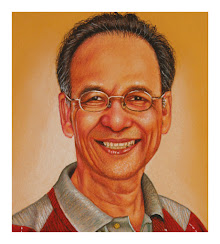
FROM DILIP MUKERJEA

"Genius is in-born, may it never be still-born."

"Oysters, irritated by grains of sand, give birth to pearls. Brains, irritated by curiosity, give birth to ideas."

"Brainpower is the bridge to the future; it is what transports you from wishful thinking to willful doing."

"Unless you keep learning & growing, the status quo has no status."
Showing posts with label Learning. Show all posts

Thursday, August 4, 2022

Tuesday, August 2, 2022

Here's s brief excerpt from Dilip Mukerjea's new book, CREATING A LEARNING PLANET: Emancipating Education, Reinvigorating Teacher Learning, Championing Children:

THE RATIONALE FOR ‘LEARNING’, ‘CREATIVITY’, AND ‘INNOVATION’ IN EDUCATION 

The word “create” is derived from the Greek “kranein,” meaning ‘to accomplish’, and the Sanskrit ‘kar’ ~ ‘to make.’ From the Latin, we have “creare” ~ ‘to make out of nothing.’ 

To create means to originate, to bring into being from what was not there before, to cause to exist.

Creativity may be viewed as the ability to originate with artistic or intellectual inventiveness. The successful creators within a marketspace of competitive intelligences know how to think big, start small, move fast! 

The creative individual is adept at seeing an abstraction in the concrete and the concrete in an abstraction, with the ability to relate one to the other. 

The word “learning” derives from the Indo-European ‘leis,’ a noun meaning ‘track’ or ‘furrow.’ To learn means to enhance capacity and capability through experience gained by following a track or discipline. Learning often leads to profound change, and massive transformation. These are self-reinforcing processes. 

NOTE: The Maori language uses the same word for ‘teaching’ and ‘learning.’ 

The word ‘learn’ also comes from the Old English leornian “to get knowledge, be cultivated, study, read, think about.” The transitive sense (He learned me how to read), now vulgar, was acceptable from c.1200 until the early 19th century, from Old English læran “to teach.” 

In the context of Psychology, ‘to learn’ connotes the modification of behaviour through practice, training, or experience. 

In the most fundamental sense, ‘learning’ connotes the act of bridging the gap between what one knows to what one doesn’t know. This is not merely the act of rote memorisation, but of understanding, and, more deeply, apprehending, the learning material, in order to be comprehending it. 

Thus, learning is not complete unless and until the object of learning (the material or subject that is to be learned) has been absorbed and embodied, so that it effects a transformation in behaviour. 

At its core, learning is a process that results in a change in knowledge or behaviour as a result of experience. Understanding what it takes to get that knowledge in and out (or promote behavioral change of a specific kind) can help optimise learning. 

In each learning experience, we need to 

• link, connect, and associate our focus 

• with what needs to be learned, • so as to absorb and embody the experience, 

• then reinforce it into mind and body memory, 

• and, via repeated usage, come to know what we had set out to learn. 

Creativity and Learning imbue our lives with meaning. Never fear that your life will end; instead, be afraid that it will never begin! 

The word “idea” comes from: late 14c., “archetype of a thing in the mind of God; Platonic `idea,’ from Latin “idea,” and in Platonic philosophy “archetype,” from Greek idea “ideal prototype,” literally “the look of a thing (as opposed to the reality); form; kind, sort, nature,” from idein “to see,” from PIE [Proto-Indo European (linguistics)]*wid-es-ya-, suffixed form of root *weid- “to see”. Sense of “result of thinking” first recorded 1640s. 

Source: Online Etymology Dictionary, © 2010 Douglas Harper

Monday, July 25, 2022

It's very true, joy and enthusiasm are absolutely essential for learning and creativity to happen:


"... The highest-level executive thinking, making connections, and "aha" moments of insight and creative innovation are more likely to occur in an atmosphere of... exuberant discovery, where students of all ages retain that kindergarten enthusiasm of embracing each day with the joy of learning... "


~ Dr Judy Willis, neurologist, teacher and author of 'Teaching the Brain To Read', among others;


Tuesday, July 19, 2022

It's a valid observation, for real learning always takes place upon moments of reflection, contemplation and introspection after the endeavour, and not foregetting to put what you have learned to work in your life, drawing upon my own personal experiences.

Tuesday, December 8, 2009

CHANGE, ON YOUR TERMS, OR BE SHORT-CHANGED ON THE MARKET'S TERMS!

[continued from the Last Post.

My personal musings, inspired by Page 4 of 'The Brainaissance Program of iCAPitalism Seminars with... The World's Most Powerful Learning Systems for... The Learning Economy', by Dilip Mukerjea.]

The following pertinent question from Dilip Mukerjea can be quite scary.


I reckon, the only option for us today, as part of our longer term strategy to survive & thrive, is to keep on learning new things, & at the same time, keep on learning to apply technology-enablement to increase our personal productivity, so that we become more productive, efficient & irreplaceable.

I recall my early exposures as a working professional to what futurist Alvin Toffler has once described as "a turbulent environment filled with revolutionary reversals, surprises, & competitive upsets..." as far back as the late eighties or early nineties.

At that time, I had also just started to indulge myself in the beautiful writings of economist Paul Zane Pilzer.

The following jottings in my ideas scratchpad came from his brilliant work, particularly 'Unlimited Wealth: The Theory and Practice of Economic Alchemy':

"... The overwhelmingly largest determinant of success today for both the individual & the organisation is the speed with which they can accept, learn, & work with technological change... Prosperity today belongs to the person & organisation that learns new thins the fastest..."

"... The key to achieving financial success today, or success in any field for that matter, is being able to learn new things. And the key to having the ability to learn new things, is developing confidence in your ability to learn...'

"Indeed, technology is advancing on so many fronts that the main constraint on innovation today is not so much the capacity of engineers & entrepreneurs to come up with new ideas, but their ability to keep abreast of & integrate the latest developments from fields outside their own particular specialty..."

Just imagine that he wrote all that in the early nineties, & to me, they are still very relevant today.

As a matter of fact, Dilip Mukerjea has recently made a wonderful observation in an expert advisory to a client [actually, an extract from his currently still 'work-in-progress' book, tentatively entitled 'Brainaissance'] as follows:

"Corporations and capital markets differ in their attitudes towards the forces of creative destruction ~ specifically, in the way they enable and manage this phenomenon. Corporations focus on operations. They aspire to function perpetually as ‘going concerns’, and thus work on the assumption of continuity.

Capital markets have no such concerns — they function on the presumption of discontinuity; their focus is on creation and destruction. Whilst corporations may tolerate long-term underperformance, markets have no qualms about annihilating the underperformer.

Outstanding corporations might stand out amongst the downtrodden, but unless they become perpetual learning organisms, the very processes that led them to success will anchor them to failure.

The choice for organisations: change, on your terms, or be shortchanged on the market’s terms!"


The foregoing insightful observation certainly sums up very well what Dilip has originally in mind when he poses the question as outlined in the foregoing imaginal picture.

[to be continued in the Next Post.]

Thursday, March 19, 2009

LEADERSHIP IS LEARNING IS LEADERSHIP

"While in the past, many managers could succeed by imitating another company’s strategy or organisational model, today’s leaders are forced to invent, not copy: there are no surefire strategies or models to copy. Above all, the adaptive manager today must be capable of radical action ~ willing to think beyond the thinkable: to reconceptualise products, procedures, programs and purposes before crisis makes drastic change inescapable."

ALVIN TOFFLER, American scholar, lecturer and author. The Adaptive Corporation (Gower, Aldershot, Hampshire, 1985)

Alvin Toffler’s words, from two decades ago, still ring true, perhaps now more than ever.

Today’s business leader is having to joystick his or her way across a technomystical matrix humming with a plethora of challenges.

Rearranging the letters of ‘leadership’ gives:

“Praise held.” “Idle phrase.” “Phase idler.” “Pile dasher.” “Lips adhere.” “Shared pile.” “Shade peril.” “Dealership.” “Ship dealer.” “Heals pride.” “Leash pride.” “Head perils.”

Any of the above expressions can be a valid objective addressed by a leader. But more than any objective, leadership is a privilege, a charter to chart the course for people being led: with commitment, competence, courage, creativity, and confidence.

The leaders of the past commanded and controlled; those of today must connect and cooperate. Leadership is not a collection of followers, but a connection of spirits inspired towards a worthy vision. The aim of leadership is to ennoble life.

“Most people in big companies today are administered, not led. They are treated as
personnel, not people.”


~ ROBERT TOWNSEND, American business executive, CEO of Avis car rental group, and author. Further Up the Organisation (Alfred A. Knopf, New York, 1970; revised edition Micahel
Joseph, London, 1984)

Leaders who stop learning, stop leading.

Life flows on, and the leader who is not learning in flow, is not leading, but misleading.

In this state, the leader has entered a stage of decay, and poses a danger to the followers . . . unless the followers have awakened to their own credentials, in which case, the ‘lead’ or ‘dominant’ follower assumes the mantle of leadership.

It is possible to have learning without leadership, but not leadership without learning.

Leaders radiate joy, evince laughter, and inspire abundance. They are lightworkers, emitting light and love whilst they heal and help. No matter what, they stay focused on the highest calling:

In good times, leaders speak and seek, to do good; in adverse times, they elocute and enthuse, to do more good.

Leaders bless their resources, and actively search for things to be grateful for. Staying grounded, they cultivate a sense of childlike wonder and amazement: it enables them to move themselves and their followers into higher dimensions of awareness. Thus,leaders are breeders of leaders.

[Excerpted from the 'Leadership, Learning & Laughter' edition of The Braindancer Series of bookazines by Dilip Mukerjea. All the images in this post are the intellectual property of Dilip Mukerjea.]

Thursday, February 26, 2009

THE LEARNING SOCIETY

[continued from the Last Post.]


Even today, we know more about our phones and automobiles than we do about our own minds.

Despite having attained ‘high intelligence’ and ‘culture’ we remain in a cognitive prison. Our ways of learning and interacting with one another have remained primitive, and principally “user-belligerent.”

From simple bacterium-like organisms to complex eukaryotic cells to large multicellular animals, we have emerged and evolved as a predatory species, to the grief of most preexisting life forms.

We need a fresh consciousness. If not, we remain on course to annihilate our habitat. The solution lies in creating a Learning Society.

We are confronted by the master unsolved problem of biology — how the hundred billion nerve cells of the human brain work together to create consciousness. Yet we have free will to choose our actions, from the infinitude of emotion-charged and symbol-drenched, arbitrary in content, multifarious options on offer.

Why not choose to be a superspecies of learning organisms that blend together to form a Learning Society?

This ‘learning culture’ would apply to infants, families, pensioners, executives, and would be free of the ills that beset the planet today.

Idealistic? Indeed. But all it needs is a will to move: from ideal to intention to illumination ~ an awakening to the truth that we can lead ourselves only through learning continually; our societies can thus stem the rot and salvage the future for our species.

“You can only find truth with logic if you have already found truth without it.”

– G.K.Chesterton

All learning is brain-to-brain, inspired by heart, spirit, mind, body, and soul. When brains connect, illumination dispels darkness, possibilities spark into life. Imagination oxygenates the brain, and ideas flourish: The engine of Intellectual Capital is in motion. The world is alive, and magic must happen.

"Imagine the brain, that shiny mound of being, that mouse-gray parliament of cells, that dream factory, that petite tyrant inside a ball of bone, that huddle of neurons calling all the plays, that little everywhere, that fickle pleasuredome, that wrinkled wardrobe of selves stuffed into the skull like too many clothes in a gym bag."

~ Diane Ackerman

[Excerpted from the 'Leadership, Learning & Laughter' edition of The Braindancer Series of bookazines by Dilip Mukerjea. All the images in this post are the intellectual property of Dilip Mukerjea.]

Say Keng's personal comments:

To help readers in developing a personally relevant 'learning culture', here is my broad recap of the critical skills & attributes for effective managers in the 21st Century [extracted from the 'Optimum Performance Technologies' weblog]:

- inter-personal communication (people skills);

- ability to act with integrity;

- ability to manage change & adapt quickly;

- ability to motivate & counsel people;

- being a strategic thinker/visionary leader;

- analytical as well as creative problem solving skills;

- having a global mindset;

- ability to make informed decisions & take quick actions;

- being able to anticipate & recognise industry trends & market conditions;

- ability to manage & resolve conflicts;

- knowledge of information technology;

- knowledge of financial performance & risk management;

- knowledge of strategic as well as scenario planning;

- influencing & negotiation skills;

- knowledge of multiple languages;

- knowledge of geopolitical & cultural diversity;

- business development & presentation skills;

- having a self development mindset;

- ability to facilitate & manage teams;

- staff recruitment, training, appraisal & mentoring skills;

- ability to manage energy & stress;

- resiliency (able to balance job, family & external demands);

- project management skills;

If you are an educator/parent/student, I suggest dropping by this wonderful link, which provides an excellent roadmap to the skills, knowledge & expertise which all students of today should master in order to succeed in the 21st century.

I reckon, in the end analysis, the most absolutely, fundamentally important aspect of surviving & thriving in the 21st century is learning & acquiring new skills, & more importantly, learning them fast!

THE LEARNING PLANET

[contined from the Last Post.]

This realm will glisten with design outcomes, where creators of art and science, storytellers, caregivers, pattern recognisers, and big picture envisioners, will becomethe architects of social evolution.

In an ideal state, we will witness the marriage of beauty and utility, of an awareness that is sententious and masterful. At least, this is my hope in a world gone mad!

Solutions lie in creating what I call, a Learning Planet. We must dare to opt for a better world.

Our species is the only one that can imagine the invisible, the impossible, and the inevitable. It is thus our moral responsibility to establish a learning consciousness.

As perpetual learning organisms, we can undo the yarns of ignorance, and shift our focus from warring to caring. Or else, this will be our Last Millennium! And with it, our Lost Millennium!

“Your vision will become clear only when you can look into your own heart. Who looks outside, dreams; who looks inside, awakens.”

~ Carl Gustav Jung

[To be continued in the Next Post. Excerpted from the 'Leadership, Learning & Laughter' edition of The Braindancer Series of bookazines by Dilip Mukerjea. All the images in this post are the intellectual property of Dilip Mukerjea.]

THE LEARNING REVOLUTION

The Learning Era is upon us.

In the grand scheme of human evolution, generally accepted learning procedures have been unable to keep pace with the high-velocity transformations that most enterprises now face.

Most prevailing learning systems are still rooted firmly in the industrial era, where capital was seen as financial and physical, not intellectual.

The antiquity of our current learning systems is critical. These systems tend to perpetuate the status quo, within which, there is little status. Transforming and correcting this scenario calls for much individual resolve, and collective action.

New dimensions of learning have unfolded with stunning speed … either we move ahead, or stay dead! The preceding half-century has been defined by computer programmers, lawyers, and MBAs.

Their time is passing.

The world is waking up to the need for a fresh approach to the future. In this scenario, we will see the emergence, prominence, and dominance of an invigorating, modern consciousness, where the players are meaning makers, their collective consciousness the very pith of brilliance.

[To be continued in the Next Post. Excerpted from the 'Leadership, Learning & Laughter' edition of The Braindancer Series of bookazines by Dilip Mukerjea. All the images in this post are the intellectual property of Dilip Mukerjea.]

Say Keng's personal comments:

What Dilip Mukerjea has written so eloquently is very true.

In fact, I recall vividly, way back into the early nineties, having come across the work of the American philosopher Eric Hoffer (1902-1983), who gave this small piece of great advice:

"In times of change, learners inherit the earth, while the learned find themselves beautifully equipped to deal with a world that no longer exists."
Just reflect on the following forecasted future scenarios, which I have read not too long ago [from the book, 'What I Learned from Frogs in Texas: Saving Your Skin with Forward-Thinking Innovation' by futurist/business strategist Jim Carroll]:


- 65% of pre-school children today will be employed in careers & jobs that don't yet exist;

- most people will find themselves not only in 4 or 5 different jobs in their lifetime, but in 4 or 5 different careers;

- the half-life of an engineer 's knowledge is about 5 years, & as low as 2 to 3 years for a computer pro (*);


(*) In a separate slideshare presentation available on the net, which I can't recall the source, the presenter has mentioned that "by 2020, 1/2 of what you know in the first year (of university) will be out of date by the third year".