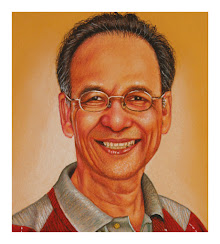
FROM DILIP MUKERJEA

"Genius is in-born, may it never be still-born."

"Oysters, irritated by grains of sand, give birth to pearls. Brains, irritated by curiosity, give birth to ideas."

"Brainpower is the bridge to the future; it is what transports you from wishful thinking to willful doing."

"Unless you keep learning & growing, the status quo has no status."
Showing posts with label Psycho-Cybernetics. Show all posts

Tuesday, September 20, 2022

Dr Maxwell Maltz shared this fascinating observation back in the early sixties when he wrote Psycho-Cybernetics.

Interestingly, America's Greatest Prosperity Teacher Bob Proctor had reinforced Dr Maltz's point:

"You don't have to know how to get it. You just have to know that you can."

He added:

"Want is the only prerequisite to get what you want. Do you really want it?"

Bob's partner, Sandy Gallagher, CEO of the Proctor Gallagher Institute, went on to create a 32 minute video on YouTube, entitled Visioneering.

She shared her brilliant insights on the art of Visioneering, including a checklist which you can even download.

For the corporate and business world, author-filmmaker-futurist Joel Arthur Barker had introduced his half-hour long Power of Vision video, which demonstrated that "having a positive vision of the future is the most forceful motivater for change and success".

You can watch it for free at the StarThrower Distribution corporate website.

In a nut shell, it's fair to say, Dr Maltz was far ahead of his time.

I am taking the opportuniy to recap - and refresh - my own understanding of the operating mechanics of the goal striving mechanism as envisaged by Dr Maxwell Maltz in Psycho-Cybernetics.

As I have had already mentioned, this servo-mechanism, as Dr Maltz defined it, is encapsulated within the Reticular Activating System or RAS located in the thalamus region of our Reptilain core, which in turn sits on top of our spinal chord.
It's basically our Central Sensory Awareness Controller.
“Servo-mechanisms are divided into two general types:
(1) where the target, goal, or answer is known and the objective is to reach it or accomplish it, and
(2) where the target or answer is not known and the objective is to discover or locate it.
The human brain and nervous system operate in both ways.”
“An example of the first type is the self-guided torpedo, or the interceptor missile.
The target or goal is known—an enemy ship or plane. The objective is to reach it. Such machines must “know” the target they are shooting for. They must have some sort of propulsion system that propels them forward in the general direction of the target. They must be equipped with “sense organs” (radar, sonar, heat perceptors, etc.), which bring information from the target.
These “sense organs” keep the machine informed when it is on the correct course (positive feedback) and when it commits an error and gets off course (negative feedback).
The machine does not react or respond to positive feedback. It is doing the correct thing already and “just keeps on doing what it is doing.”
There must be a corrective device, however, that will respond to negative feedback.
When negative feedback informs the mechanism that it is “off the beam,” too far to the right, the corrective mechanism automatically causes the rudder to move so that it will steer the machine back to the left.
If it “overcorrects” and heads too far to the left, this mistake is made known through negative feedback, and the corrective device moves the rudder so it will steer the machine back to the right.
The torpedo accomplishes its goal by going forward, making errors, and continually correcting them. By a series of zigzags it literally gropes its way to the goal.
Dr. Norbert Wiener, who pioneered the development of goal-seeking mechanisms in World War II, believes that something very similar to the foregoing happens in the human nervous system whenever you perform any purposeful activity—even in such a simple goal-seeking situation as picking up a pen from a desk.”
“1. Your built-in Success Mechanism must have a goal or “target.” This goal, or target, must be conceived of as “already in existence—now” either in actual or potential form.
It operates by either (1) steering you to a goal already in existence or (2) “discovering” something already in existence.
2. The automatic mechanism is teleological, that is, it operates or must be oriented to “end results” goals. Do not be discouraged because the “means whereby” may not be apparent.
It is the function of the automatic mechanism to supply the means whereby when you supply the goal. Think in terms of the end result, and the means whereby will often take care of themselves.
The means by which your Success Mechanism works often take care of themselves and do so effortlessly when you supply the goal to your brain. The precise action steps will come to you without stress, tension, or worry about how you are going to accomplish the result you seek.
Many people make the mistake of interfering with their Success Mechanism by demanding a how before a goal is clearly established.
After you’ve formed a mental image of the goal you seek to create, the how will come to you—not before. Remain calm and relaxed and the answers will arrive. Any attempt to force the ideas to come will not work.
As Brian Tracy wrote, “In all mental workings, effort defeats itself.”
3. Do not be afraid of making mistakes, or of temporary failures. All servo-mechanisms achieve a goal by negative feedback, or by going forward, making mistakes, and immediately correcting course.
4. Skill learning of any kind is accomplished by trial and error, mentally correcting aim after an error, until a “successful” motion, movement, or performance has been achieved.
After that, further learning, and continued success, is accomplished by forgetting the past errors, and remembering the successful response, so that it can be imitated.
5. You must learn to trust your Creative Mechanism to do its work and not “jam it” by becoming too concerned or too anxious as to whether it will work or not, or by attempting to force it by too much conscious effort.
You must “let it” work, rather than “make it” work. This trust is necessary because your Creative Mechanism operates below the level of consciousness, and you cannot “know” what is going on beneath the surface.
Moreover, its nature is to operate spontaneously according to present need. Therefore, you have no guarantees in advance. It comes into operation as you act and as you place a demand on it by your actions.
You must not wait to act until you have proof—you must act as if it is there, and it will come through.
“Do the thing and you will have the power,” said Emerson.”
In retrospect, I must say, with my training background in engineering, this is truly an intellectual masterpiece of Dr Maltz.
Going back to the late seventies, when I first encountered the classic, following my participation in the Paul J Meyer's Dynamics of Goal Setting program, I am truly indebted for what they have had brought me to who and where I am today, especially in terms of being future-focused, goal-directed and action-oriented.


Just sharing my musing:

Examine and reevaluate your beliefs

To eliminate beliefs, we only have to ask “why?” Why do we believe we can’t?
Then ask yourself, “Is this belief based on an actual fact or on an assumption—or a false conclusion?”
Then ask yourself the questions:
  1. Is there any rational reason for such a belief?
  2. Could it be that I am mistaken in this belief?
  3. Would I come to the same conclusion about some other person in a similar situation?
  4. Why should I continue to act and feel as if this were true if there is no good reason to believe it?
And go back to the source: is this belief based on real facts or on a supposition and a false conclusion?

Interestingly, Dr Bobbe Sommer, who has had taken on much of the Maltz legacy, wrote in Psycho-Cybernetics 2000, that's easy to remember the steps of deprogamming or reprogramming the negative beliefs, using the C.R.A.F.T. strategy:
  1. CANCEL: Become aware of your negative beliefs and develop the habit of challenging them;
  2. REPLACE: Replace your old , negative beliefs with new ones. By playing back images of inadequacy and failure, you program yourself to fail; by consciously challenging such images and replacing them with pictures of competence and success, you can cancel your negative beliefs and replace them with positive ones;
  3. AFFIRM: Reinforce your new self-image repeatedly, through affirmations (or afformations, which are my personal preference), positive self-talk, avoidling listening to and verbalising negatives, and acting "as if";
  4. FOCUS: Focus your daydreams, by vividly imagining success, which allows your subconscious mind to respond as though you had actually being successful. Since the human brain works naturally in images or pictures, visualisation is crucial to your deprogamming endeavour;
  5. TRAIN: Meanwhile, do your best to act "as if". You don't break a habitual pattern but you form a new one through your exercise of will power. You do it by creating clear mental images of a desired outcome, and by acting as if it has already been achieved.
Well, your belief engine can make it so!
Godspeed!

Saturday, September 17, 2022

The Psycho-Cybernetics classic by Dr Maxwell Maltz is not just about the operating  mechanics and the significant impact of self-imge psychology and the goal striving mechanism.

It also touches on the imperativeness and urgency of developing opportunity sensitivity mindset, as exemplied in these astute observations of the author:

“What is opportunity, and when does it knock? It never knocks. You can wait a whole lifetime, listening, hoping, and you will hear no knocking. None at all. You are opportunity, and you must knock on the door leading to your destiny. You prepare yourself to recognize opportunity, to pursue and seize opportunity as you develop the strength of your personality, and build a self-image with which you are able to live - with your self-respect alive and growing.”

“Live in the present. The past is gone; the future is unknown – but the present is real, and your opportunities are now. You must see these opportunities; they must be real for you.

The catch is that they can't seem real if your mind is buried in past failures, if you keep reliving old mistakes, old guilts, old tragedies. Fight your way above the many inevitable Traumatizations of your ego, escape damnation by the past, and look to the opportunities of the present.
I don't mean some vague moment in the present – next week or next month, perhaps. I mean today, this minute.”


A brisk lesson on dealing with crises from Dr Maxwell Maltz, writing in his classic, Psycho-Cybernetics: 

"Successful people are able to rise above crises by relaxing no matter what the external situation.

Their believe in themselves, the strength of their self-image is impenetrable armour, which protects them against shattering events."


Interestingly, Dr Maltz added these astute observations:

"Stand up to crises. Don't let them throw you. Fight to stay calm... even surmount the crisis completely and turn it into an opportunity. Refuse to renounce your self-image. No matter what happens, you must keep your good opinion of yourself. No matter what happens, you must hold your past successes in your imagination, ready for showing in the motion picture screen of your mind. No matter what happens, no matter what you lose, no matter what failures you must endure, you must keep faith in yourself. Then you can stand up to crises, with calm and courage, refusing to buckle then you will not fall through the floor. You will be able to support yourself."

“Close scrutiny will show that most 'crisis situations' are opportunities to either advance, or stay where you are.”

I often enjoy re-reading many of the astute observations in the Psycho-Cybernetics classic by Dr Maxwell Maltz.

To recap, here's one of them: 

"To accelerate your determination to get more out of life, you must learn to use your great creative mechanism as a success mechanism, not as a failure mechanism.

You must develop new ways of thinking and imaging so that you will build a strong, reality-oriented self-image, which will give nourishment to your success mechanism, leading the way to happiness."

Wednesday, September 7, 2022

Dr. Maxwell Maltz, writing in his Psycho-Cybernetics classic, demonstrates how our brain and nervous system (or subconscious) work together as a goal-striving mechanism that operates automatically to achieve any goal we set before it, automatically making directional corrections as needed, much like a self-guided torpedo operates.

I like to recap the basic principles by which the Creative Success Mechanism works, as put forward by Dr Maltz:'

"1. Your built-in Creative Success Mechanism must have a goal or target. It must be conceived of as “already in existence now,” either in actual or potential form.
Your Creative Success Mechanism either steers you toward a goal already in existence (like a torpedo) or it ‘discovers’ something already in existence.

2. Your Creative Success Mechanism is teleological, that is, it operates or must be oriented to ‘end results.’ Do not be discouraged if the means to the solution are not apparent.

It is the function of the automatic mechanism (sub-conscious) to supply the means for the goal we set. Think of the goal, and means will often take care of themselves.
But be cautioned, many people interfere with or defeat their Creative Success Mechanism by demanding a how before a goal is clearly established. Once the mental image of the goal is clearly established, the how will come to you.
I have experienced this reality quite recently as I set a goal to eliminate a nettlesome business debt.
Once the goal was truly imagined and embraced, creative ways to eliminate that debt tumbled into my consciousness like never before. Progress has been remarkable.

3. Do not be afraid of making mistakes or temporary failures. It’s the way servo mechanisms work – on negative feedback, or by going forward, making mistakes and immediately correcting course.

4. Skill learning is accomplished by trial and error, mentally correcting aim after an error, until a ‘successful’ motion, movement, or performance is achieved.
After that, continued success is accomplished by forgetting the past errors, and remembering the successful response, so that it can be imitated.

5. You must learn to trust your Creative Success Mechanism to do its work and not “jam it” by becoming too concerned or too anxious as to whether it will work or not, or by attempting to force it by too much conscious effort. You must “let it” work rather than “make it” work.
The Creative Success Mechanism operates below the level of consciousness, so you cannot ‘know’ what is going on beneath the surface. Moreover, its nature is to operate spontaneously according to present need.
There are no guarantees in advance. It comes into action as you act and as you place demand on it by your actions."

Monday, August 22, 2022

In retrospect, and apart from the angle of understanding the significance of image psychology, the vital lessons I have had gotten out of this classic was appreciating the imperativeness and urgency of embracing goal striving (particularly, Nostalgia for the Future) and opportunity sensitivity when I first read it in the late seventies.

Tuesday, August 9, 2022

Yep! Matt Furey, President of the Psycho-Cybernetics Foundation, has been absolutely correct! 

Just as Sifu Dr Maxwell Maltz put it so eloquently:
"Thus man of all creatures is more than a creature, he is also a creator. Man alone can direct his success mechanism by the use of imagination, or imaging ability."
This harsh reality has also been echoed by master motivator Zig Ziglar, who said:
"You were designed for accomplishment, engineered for success, and endowed with the seeds of greatness."
So did the late Bob Proctor, often acknowledged as America's Greatest Prosperity Teacher, who convinced America with his classic:
"You were Born Rich!" 
(and you're going to stay rich, for being rich is not about money; it's about being fulfilled in all areas of your life as well as having a clear vision for what you want to do with your time on this planet).
Interestingly, journalist and success researcher Napoleon Hill, who wrote the classics, The Law of Success and Think & Grow Rich, added:
"You are the master of your destiny. You can influence, direct and control your own environment. You can make your life what you want it to be."
Bravissimo!

Sunday, July 31, 2022

Here's a nice piece of witticism  from the Psycho-Cybernetics classic by Dr Maxwell Maltz for you to ponder:
"... I failed once in the past, so I will probably fail in the future" is neither logical nor rational.
To conclude "I can't" in advance, without trying, and in the absence of any evidence to support the inevitability of failure, is not rational.
We should be more like the man who was asked if he could play the piano.
"I don't know," he said.
"What do you mean you don't know?" he was, asked.
"I have never tried," he replied... "
On a contemporary note, just think about what billionaire entrepreneur Elon Musk once said:
"If something's important enough, you should try. Even if - the probable outcome is failure. 
I'd rather be optimistic and wrong than pessimistic and right. If you get up in the morning and think the future is going to be better, it is a bright day."

Interestingly, as mentioned in the Psycho-Cybernetics classic, martial artist and movie actor Chuck Norris, a close friend of the late martial artist and philosopher Bruce Lee, took Bruce Lee's exercise (which I have had already described in an earlier post) even further.

In his book, The Secret Power Within You, Chuck Norris wrote:

"I actually write down on a scrap of paper whatever negative thoughts I have and then burn them.

When I dispose of the ashes, the thoughts, too, are removed from my mind."


Because of my natural curiosity streak and passion for learning, I am always exploring new angles in recapping and reviewing what I have learned before.
Here is a random collection of astute observations from the Psycho-Cybernetics classic, pertaining to what I often like to call "You-niquesness":
  • “You” as a personality are not in competition with any other personality simply because there is not another person on the face of the earth like you, or in your particular class. You are an individual. You are unique. You are not “like” any other person and can never become “like” any other person. You are not “supposed” to be like any other person and no other person is “supposed” to be like you.”
  • “... in finding in oneself an individuality, uniqueness, and distinctiveness that is akin to the idea of being created in the image of God.”
  • “Inferiority and superiority are reverse sides of the same coin. The cure lies in realizing that the coin itself is spurious. The truth about you is this: You are not “inferior.” You are not “superior.” You are simply “You.” “You” as a personality are not in competition with any other personality simply because there is not another person on the face of the earth like you, or in your particular class. You are an individual. You are unique. You are not “like” any other person and can never become “like” any other person. You are not “supposed” to be like any other person and no other person is “supposed” to be like you.”
  • “Stop measuring yourself against “their” standards. You are not “them” and can never measure up. Neither can “they” measure up to yours—nor should they. Once you see this simple, rather self-evident truth, accept it, and believe it, your inferior feelings will vanish.”
  • “Dr. Norton L. Williams, a psychiatrist, addressing a medical convention, said that modern man’s anxiety and insecurity stemmed from a lack of self-realization, and that inner security can only be found “in finding in oneself an individuality, uniqueness, and distinctiveness that is akin to the idea of being created in the image of God.” He also said that self-realization is gained by “a simple belief in one’s own uniqueness as a human being, a sense of deep and wide awareness of all people and all things, and a feeling of constructive influencing of others through one’s own personality.”
  • “If he feels bad because he is inferior, the cure is to make himself as good as everybody else, and the way to feel really good is to make himself superior. This striving for superiority gets him into more trouble, causes more frustration, and sometimes brings about a neurosis where none existed before. He becomes more miserable than ever, and “the harder he tries,” the more miserable he becomes.”
  • “... your mental picture of yourself (is) “the strongest force within you.”
The essential message that permeates all these statements is, at least from my personal perspective:

Just be yourself. You were born original. Don't die a copy.

Your unique self is empowered and powerful. Your You-niqueness is what makes you unstoppable.

Also, bear in mind, comparison is the thief of joy.

If you continuously compete with others, you become bitter, but if you continuously compete with yourself, you become better.

In summing up, I reckon the legendary martial artist and philosopher Bruce Lee said it best: