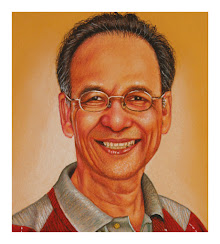
FROM DILIP MUKERJEA

"Genius is in-born, may it never be still-born."

"Oysters, irritated by grains of sand, give birth to pearls. Brains, irritated by curiosity, give birth to ideas."

"Brainpower is the bridge to the future; it is what transports you from wishful thinking to willful doing."

"Unless you keep learning & growing, the status quo has no status."
Showing posts with label Mental Rehearsal. Show all posts

Wednesday, August 31, 2022

Think about it!

The image of achievement in your headspace is real, especially when you vividly imagine it, ardently desire it, and sincerely believe it, with all your sensory impressions.
When you euthusiastically act upon it, it must inevitably come to pass.
To sports psychologists and competitive sportsmen, this is the essence of creative visualisation and mental rehearsal.
This is based on the research work of neuroscientist Dr. Karl Pribram of Stanford University.

Saturday, July 30, 2022

Again, this is my musing of this morning.

I just happen to round up these astute observations of Dr Maxwell Maltz in one quick-for-reference compendium, to form some kind of recipe for mentally preparing oneself prior to conducting a creative visualisation and mental rehearsal exercise.
  1. "It was as if personality itself had a 'face'. This non-physical face of personality seemed to be the real key to personality change. It remained scarred, distorted, 'ugly' or inferior the person himself acted out this role in his behaviour regardless of the changes in physical appearance. If this 'face of personality' could be reconstructed, if old emotional scars could be removed, then the person himself changed, even without facial plastic surgery."
  2. “As soon as the error has been recognized and corrections made, it’s equally important that the error be forgotten and the successful attempt remembered and dwelt upon.”
  3. “Begin to imagine what the desirable outcome would be like. Go over these mental pictures and delineate details and refinements. Play them over and over to yourself.”
  4. “When we consciously and deliberately develop new and better habits, our self-image tends to outgrow the old habits and grow into the new pattern.”
  5. “Why not imagine yourself successful?”
  6. “Failure feelings – fear, anxiety, lack of self-confidence – do not spring from some heavenly oracle. They are not written in the stars. They are not holy gospel. Nor are they intimations of a set and decided fate which means that failure is decreed and decided. They originate from your own mind.”
  7. "We act, we behave, and we feel the vibration that we're in at the present time according to what we consider our self image to be. And we do not deviate from that pattern. The image you hold of yourself is a premise, a foundation (idea) on which your entire personality is built. This image, not only controls your behavior but your circumstances as well."
  8. “Admit your mistakes but don't cry over them. Correct them and go forward.”
  9. "Faith, courage, optimism, looking forward, bring us new life and more life. Futility, frustration, living in the past are not only characteristic of 'old age'; they contribute to it."
  10. "It doesn't matter how many times you have failed.... What matters is the successful attempt."
  11. “Your automatic mechanism, or what the Freudians call the “unconscious,” is absolutely impersonal. It operates as a machine and has no “will” of its own. It always tries to react appropriately to your current beliefs and interpretations concerning environment. It always seeks to give you appropriate feelings, and to accomplish the goals that you consciously determine. It works only on the data that you feed it in the form of ideas, beliefs, interpretations, opinions. It is conscious thinking that is the “control knob” of your unconscious machine. It was by conscious thought, though perhaps irrational and unrealistic, that the unconscious machine developed its negative and inappropriate reaction patterns, and it is by conscious rational thought that the automatic reaction patterns can be changed.”
  12. "Your present negative beliefs were formed by thought PLUS feelings. Generate enough emotion, or deep feeling and your new thoughts and ideas will cancel them out."
  13. “To really ‘live,’ that is to find life reasonably satisfying, you must have an adequate and realistic self-image that you can life with. You must find yourself acceptable to ‘you.’”
  14. “Do your worrying before you place your bet, not after the wheel stops turning.”
Enjoy your reading, exploration and assimilation!

I like to append below this wonderful story, which exemplified what Dr Maltz talked about the power of imagination and visualisation in PsychoCybernetics:

"James Nesmeth was an average golfer. He generally shot in the mid to low nineties, but dreamed of improving. However, his efforts to raise his golf game were interrupted by the war in Vietnam.
Major Nesmeth was captured and became a prisoner of war, where he spent seven years imprisoned in a cage that was 4 and a half feet long and 5 feet tall.
During his imprisonment, he saw no one, talked to no one and had no physical activity. For the first few months, all he did was hope and pray for release. He soon realized that he had to find some way to occupy his thoughts or he would go insane.
Nesmeth devised a mental program in which he’d play his favorite golf course every day in his mind.
He would visualize the experience to the highest level of detail possible. He imagined the clothes he’d be wearing. He thought about the smell of the freshly cut grass and the feel of the warm sun and gentle breezes on his skin. He’d see every tree, hear the birds singing and squirrels chattering, and envision every slope of the course.
He would then grasp the club, feeling its rough grip on his fingers. He’d imagine his stance and heft the club’s weight in his hands as he started his back swing. He visualized taking his practice swing, addressing the ball and hitting his shot. He’d watch the ball’s arc as it flew beautifully, coming to a soft landing in the center of the fairway.
In the real world, he was never in a rush. Golf was his escape, and he would take his time and enjoy every morning. He did the same in that small cage in Vietnam. He thought through every step and would even stop to get water, just as if he were actually playing a real round.
His imagined golf game took just as long as if he were physically on the course. He hit each shot and played every hole to its conclusion until the ball dropped to the bottom of the cup. He did this every day for 7 years.
Here’s where the story takes an amazing turn. Major Nesmeth was finally released and came back home to America. Physically speaking, his condition had deteriorated as much as you would expect after living in a tiny cage for so long.
Even so, soon after his return, he decided to go and play golf at his favorite course. Amazingly, he shot a 74. He hadn’t swung a real club in 7 years and had undergone indescribable physical deprivation, and yet he had cut 20 shots off of his average."
[Author's Notes: This story is based on my scratchpad notes, captured from stories written and told respectively by Zig Ziglar as well as Dr Denis Waitley, which I have had encountered back in the late seventies or early 80's.]

Monday, March 29, 2010

INSPIRING TALES: LESSONS IN CREATIVE VISUALISATION & MENTAL REHEARSAL

While browsing the Amazon online catalog, I came across a book entitled 'Golfing with Your Eyes Closed: Mastering Visualization Techniques for Exceptional Golf', by two sports science enthusiasts Erin Macy & Tiffany Wilding-White.

One tag line caught my personal attention:

"The body achieves what the mind believes."

Also, as I grokked through some of the pages, an anecdote from the great golfer of all time Jack Nicklaus astutely summed up the essence of the book's contents:

"I never hit a shot, not even in practice, without having a very sharp, in-focus picture of it in my head. It's like a color movie. First, I see the ball where I want it to finish, nice and white and sitting up high on the bright green grass. Then the scene quickly changes and I "see" the ball going there: its path, trajectory, and shape, even its behavior on landing. Then there's sort of a fade-out, and the next scene shows me making the kind of swing that will turn the previous images into reality. Only at the end of this short, private, Hollywood spectacular do I select a club and step up to the ball."

I had often used the foregoing anecdote in my peak performance training workshops during the early years to help illustate the power of creative visualisation & mental rehearsal, besides drawing upon my own personal experiences.

[My first exposure to the mindfulness practices actually dates back to the late eighties, when I had attended one of the 'Alpha Dynamics' weekend retreats.

Readers can go to this link in my 'Optimum Performance Technologies' weblog to read about one of my real-world applications, which was featured in the local 'Business Times' during the nineties.]

In fact, I also like to share with readers two other inspiring anecdotes:

One came from master motivator Zig Ziglar, who had first mentioned about it in his book, 'See You at The Top', during the seventies or so.

Major James Nesmeth had spent seven years as a prisoner of war in North Vietnam. During those seven years, he was imprisoned in a cage that was approximately four and one-half feet high and five long.

[Just try to recall the Vietnam War movie, 'Hanoi Hilton', to get the picture.]

During almost the entire time he was imprisoned he saw no one, talked to no one and experience no physical activity. In order to keep his sanity and his mind active, he used the art of visualisation.

Everyday in his mind, he would play a game of golf. A full 18-hole game at his favourite green.

In his mind, he would create the trees, the smell of the freshly trimmed grass, the wind, the songs of the birds. He created different weather conditions – windy spring days, overcast winter days and sunny summer mornings.

He felt the grip of the club in his hands as he played his shots in his mind. The set-up, the down-swing and the follow-through on each shot. Watched the ball arc down the fairway and land at the exact spot he had selected. All in his mind.

He did this seven days a week. Four hours a day. Eighteen holes. Seven years.

When Major Nesmeth was finally released, he found that he had cut 20 strokes off his golfing average without having touched a golf club in seven years.

Appended below is another inspiring anecdote, from peak performance consultant Charles Garfield, who wrote the two classics during the late eighties, 'Peak Performers' & 'Peak Performance':

In 1959, the world-class Chinese pianist Liu Chi Kung - he had won the second prize in the Tchaikovsky Piano Competition in Vienna just one year earlier - was imprisoned during the Cultural Revolution, during which time he had no access to a piano.

Worst still, he was all alone in a cell for seven years.

When he was released, he almost immediately played a series of highly acclaimed concerts. The public was amazed that none of his virtuosity had been lost, despite seven years without a piano.

When asked how he had retained such a high level of skill with no piano to practice on, he replied:

“I did practice every day. I rehearsed every piece I had ever played, note by note, in my mind.”

In summing up, I like to quote psychologist William James who once said:

"There's a law in psychology that if you form a picture in your mind of what you would like to be, and you keep and hold that picture long enough, you will soon become exactly what you are thinking."

A word of caution, though, just in case you may get carried away:

According to peak performance consultant Don Greene, writing in 'Performance Success: Performing Your Best Under Pressure':

There are 7 essential skills for optimal performance on the track, court, links or slopes:

1) Determination;
2) Poise;
3) Mental Outlook;
4) Emotional Appraisal;
5) Attention;
6) Concentration;
7) Resilience;

Wednesday, November 18, 2009

HOW FAR CAN YOU TURN?

I have found the following interesting exercise on the net.

I have had the experience of learning a variation of the exercise during the late eighties, when I had attended a mind power seminar, which eventually gave me a good understanding about the mental rehearsal technique often used by peak performers.

"Here is a short AWARENESS THROUGH MOVEMENT lesson for you to enjoy.

By doing it, you will demonstrate to yourself that your body has a potential far different from what you normally think.

NOTE: This lesson involves turning the head. It is important that you turn slowly and gently, stopping if you get any signals of strain, discomfort or pain.

If you have pain in turning, turn only so far that you are pain-free. A very small turn is OK.

To begin, sit comfortably on the edge of a chair with your hands relaxed in your lap.

1. Gently turn your head to the left. Notice a point on the wall that is the furthest point you can comfortably see. Return to the centre.

Repeat a few times.

If you had pain in turning, turn only so far that you DO NOT have pain. A very small turn is OK.

Gently turn your head to the right a few times and return to the centre. Each time, notice a point on the wall that is the furthest point you can comfortably see.

Turn gently, only so far as you have no pain.

2. Feel which side you would like to improve.

The other side is the better functioning side.

3. Cradle your head with the palms of your hands, so that the heel of your hands is at your jaw line, and the fingers may rest around your eyes. Notice that your elbows rest on your chest.

Keeping your elbows glued to your chest and your hands cradling your head, gently turn to the better functioning side as far as is comfortable and back to centre. Notice that the whole upper body turns.

4. TEST: drop your hands and turn to the side you wanted to improve. Notice the improvement!

Take a moment to realize how organic learning does not happen mechanically in the muscles, but in some higher faculties of the nervous system.

Isn't this more interesting?"

[Source: Issue #1 of SENSEABILITY, A Quarterly Newsletter of the FELDENKRAIS METHOD®, produced by The FELDENKRAIS GUILD®;]

Wednesday, March 4, 2009

FROM DILIP MUKERJEA'S ITINERANT TOOLBOX: VISUAL GYM

When you are feeling mentally blocked, stressed out and unable to generate ideas,'Visual Gym' is the way to go, according to Dilip Mukerjea, writing in his wonderful book,'Brain Symphony: Brain-blazing Practical Techniques in Creativity for Immediate Application'.

This technique stimulates the creative process by involving your subconscious mind in a dance of the senses. There are no rules that rigidly bind your imagination.

Start off by setting the scene for your mind to attain a state of total relaxation. This could be established through a comfortable seating, loose clothing, soft music, an infusion of aromatherapy essences, dimmed lighting and other elements that contribute to a state of well being.

Set off by thinking positive thoughts; it will help you enter a state of relaxed alertness. Negative thoughts work just a powerfully, but against us. We must thus be careful not to let them dominate.

Major inventions and discoveries have emerged from the infinite mindscapes of the subconscious.

The technique is entirely playful (but formidable), and can be used whenever you feel stress building up inside you. The setting could be at the office, at home, in a public area, or when you are alone; it does not matter. What is essential is that you give yourself permission to vent your imagination and create scenes that delight you.

The following passage has been created as I think. In other words, it is spontaneous.

"Get comfortable, slow down your breathing till it is even and deep, then gradually allow yourself to drift into a state of easy dreaming. Let your body release its tension by consciously permitting your muscles to relax.

Without any strain, let your mind open itself to seeing a bonfire. The flames are dancing rhythmically, attracting your gaze, and its warmth enfolds you.

As soon as you are able to picture this scene with total clarity, change the colour of the flames from orange to light blue. This is happening very gradually.

Once the bonfire has changed colour totally, watch it slither to the ground. It now looks cold, and liquid, but not wet. It is moving towards you. The bonfire has metamorphosed into a creamy blue pool; an unknown organism.

As you watch it approach, you smell the scent of lemon emerging from it. The organism slowly rises, and takes on a shape like a silken handkerchief drifting in a breeze.

It had reached you. You touch it and sense absolute peace. Your body feels a pulsing current just as you see the organism vanish into a mist of rainbow hues.

The mist enters your eyes, travels along the nerves to your brain. It floods your brain with light and warmth. You sense yourself, for the very first time, feeling so alive!"

Allow yourself to keep making variations, and use all your senses. Do not feel reticent about being outrageous. Give yourself space and time to view and feel your dance of your senses.

This is an example of a creative experience. The more you create, the easier it is to create more. Never worry about how relevant or irrelevant your thoughts are. There is a relevance to all things in life and we only need to discover the connections.

Numerous inventors, writers, poets, teachers, managers and gourmets of creative cuisine have commonly used this sensation of "wandering off". Children use it all the time. As I said before, it is essential for adults to be childlike when seeing creative solutions. Strangely enough, many adults behave childishly, and there are children who, though childlike, are extremely mature.

Children tend to view issues very differently from adults and should be encouraged to express themselves openly when offered such exercises. The corporate community would have its collective intelligence significantly enhanced if they called on children to contribute their ideas.

[Excerpted from the book, 'Brain Symphony: Brain-blazing Practical Techniques in Creativity for Immediate Application', by Dilip Mukerjea. All the images in this post are the intellectual property of Dilip Mukerjea.]

Say Keng's personal comments:

Actually, my first personal encounter with the operational mechanics of 'Visual Gym' was while attending a meditation retreat during the mid-eighties or so. It was then called 'creative visualisation', based on the work of then popular New Age teacher, a pioneer in the field of personal growth, Shakti Gawain.

In contrast, physicist Albert Einstein & inventor Nikola Tesla often conducted what are now known as "thought experiments", which are essentially 'Visual Gym' practices.

In the case of Albert Einstein, his "thought experiments" through which he had visualised himself riding on a beam of light, eventually gave him the necessary cues to formulate the award-winning scientific equation for relativity.

As mentioned in the 'Brain Symphony' book, Nikola Tesla claimed to have mentally (virtually) tested all his devices. He could test run them for weeks following which he would "inspect" them for signs of wear. By this means, he could pinpoint areas trhat were working well and those where problems existed.

In the world of competitive sports & golf championships, sportsmen play a variation of 'Visual Gym', known as 'mental rehearsal', which allows them to excel in the real world, by first visualising a perfect performance sequence in their imagined world.

'Mental rehearsal' was reportedly first used by national sportsmen from East Germany & Russia during the Cold War.

Today, our Singapore Sports Council (SSC) has engaged full-time sports psychologists to coach our many national sportsmen along the same lines.

[During the early nineties, I had met Dr Peter Usher from Canada, who was engaged by SSC to establish the popular 'mental rehearsal' practice for our national sportsmen.

I recall vividly one particular case, in which a Taekwan-do sportsman (Joe Ng) was recalled to represent Singapore in the SEAP Games. He was out of action for two years, & officials were initially quite skeptical of his chances. With only six months' training under Dr Peter Usher, he went to secure a Gold Medal for Singapore.

Among Dr Usher's first few local coaches under his wing, was Dr Edgar Tham, whom I had also first met when he was just a young SuperTeen graduate.

Today, Dr Edgar Tham runs his own consultancy outfit, SportPsych Consulting. I have read that he has even gone to the schools to share the 'mental rehearsal' techniques with students on how to use them to relieve exam stress.]

Operationally, as I see it, 'Visual Gym' is also akin to the powerful 'image streaming' technique originally conceived by Dr Win Wenger, who wrote the classic, 'How to Increase Your Intelligence'.

Incidentally, he is also the man behind the 'underwater brainstorming' technique, as regularly practised by Japanese inventor extraordinaire, Dr Yoshiro Nakamatsu, or more popularly known as Dr Nakamats.

Interestingly, creativity consultants William Gordon & George Prince, who pioneered the Synectics creative problem solving process in the sixties, coined 'mental excursion' to denote a similar process in their proprietary methodology.

In the corporate world, where today's strategic planners practise 'scenario planning', a forward planning & foresight building methodology, originally made popular by the Royal Dutch/Shell Group during the oil crises of the mid-seventies, which draws on man's innate ability to craft "memories of the future".

From a personal perspective, at least in formulating strategy & initiating actions to produce results, I reckon "memories of the future" constitute 'Visual Gym' at its best. But in a corporate setting, where the focus is inherently geared towards more conscious, logical processing to suit a conventionally left-brain oriented world, I believe the execution may probably require a more subtle & discerning approach.