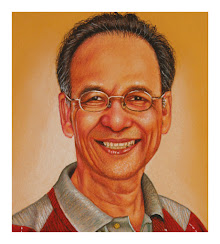
FROM DILIP MUKERJEA

"Genius is in-born, may it never be still-born."

"Oysters, irritated by grains of sand, give birth to pearls. Brains, irritated by curiosity, give birth to ideas."

"Brainpower is the bridge to the future; it is what transports you from wishful thinking to willful doing."

"Unless you keep learning & growing, the status quo has no status."
Showing posts with label Action to Take. Show all posts

Wednesday, September 30, 2009

ACTION POINTS FOR YOU & YOUR BRAIN V

[continued from the Last Post.]

Dilip Mukerjea, writing in his book, 'Building BrainPower: Turning Grey Matter into Gold', offers the following Action Points for Your Reading:

1) Develop your reading program. Improve the general quality, breadth and depth of your reading. Strive to read at least a book a week.

2) Use established techniques (such as 'visual guide') to attain acceleration and smoothness in your reading.

3) Build your vocabulary, with at least 3 new words per day. Use these words actively, in speech as well as in writing.

4) Seek out key words within text. Equate this information with mental Mind Mapping (no paper and no pens) and other memory techniques, so as to monitor your progress in Mental Literacy.

5) Study about, and exercise, your eyes e.g. Bates Method, Yoga techniques, and so on.

6) Enhance your reading environment in line with the Mental Matrix. Consider reading in full-spectrum lighting so as to eliminate eye fatigue.

7) Learn to 'deep read' material that needs to be absorbed at a more philosophical level.

8) Monitor your reading speeds on a regular basis.

9) Teach other people to acquire these skills and to apply this process to their studies and work assignments.

10) Create and run 'High Eye Cue' Society! Remember, Readers Make Leaders!

[to be continued in the Next Post: Actions Points for Your Mind & Body.]

Monday, September 28, 2009

ACTION POINTS FOR YOU & YOUR BRAIN IV

[continued from the Last Post.]

Dilip Mukerjea, writing in his book, 'Building BrainPower: Turning Grey Matter into Gold', offers the following Action Points for Your Mind-Mapping:

1) Make regular Mind Map notes, even if they are crafted solely in the mind.

2) Spot key words in lectures, notes, and books. Endeavour constantly to convert them into images.

3) Create a colour code for your notes and in your activities.

4) Develop 3D symbols and codes.

5) Use Mini Mind Maps on a regular basis.

6) Build your vocabulary and strive to understand meanings at diverse levels.

7) Mind Map all aspects of yourself. Create a Life Plan Mind Map and monitor your progress.

8) Review a book with a Mind Map. Then review several books and distill the contents onto One Mind Map.

9) Make a group Mind Map for a holiday, party, project, or subject.

10) test your memory with elaborate Mind Maps to see if your ability to retain vast amounts of information is being developed on a continuing basis.

[to be continued in the Next Post: Actions Points for Your Reading.]

Saturday, September 26, 2009

ACTION POINTS FOR YOU & YOUR BRAIN III

[continued from the Last Post.]

Dilip Mukerjea, writing in his book, 'Building BrainPower: Turning Grey Matter into Gold', offers the following Action Points for Your Creativity:

1) Recognise your uniqueness and build on your strengths. You DO NOT have poor memory, you CAN learn how to remember because it is one your natural strengths.

2) Make and maintain your own Creative Thinking Zone.

3) Break your own moulds - new clothes, persona, activities and so on.

4) Play with children - and rediscover (recover) the child within yourself.

5) Create spaces and times (spacetimes) to rest. Catnap regularly if nighttime sleep is a problem.

6) radiate out on notes - use colour, imagery and symbolism.

7) Set memory targets on a daily basis, and very soon, incremental improvements will metamorphose into quantum accomplishments.

8) Pose hypo-problems and work at solving them. Try this without pen and paper, play Creative Mind Games to provoke synaptic connections. This will also help build your spatial intelligence.

9) Read widely, and deeply. Become polymathic. Readers make Leaders!

10) Meet new peoples, experience unfamiliar cultures, and keep observing with a fascination towards life.

[to be continued in the Next Post: Actions Points for Your Mind Mapping.]

Thursday, September 24, 2009

ACTION POINTS FOR YOU & YOUR BRAIN II

[continued from the Last Post.]

Dilip Mukerjea, writing in his book, 'Building BrainPower: Turning Grey Matter into Gold', offers the following Action Points for Your Memory Management:

1) Inject colour and diversity into your life.

2) Look, think, link, and ink the stimuli of life; it will build your memory muscle.

3) Make dramatic beginnings and entrances (start starts!).

4) Dare to imagine, unleash your sense of fun! Risk it and realise what you have been missing!

5) Observe with a purpose, then link, connect, and realise whatever you wish to remember.

6) Take regular breaks between prolonged learning sessions.

7) Apply your memory skills to numbers, data, names and faces.

8) Use the Memory Principles constantly.

9) Review constantly - see things again, preferably using Mind Maps, Imagination techniques, and interactive discussions; this practice embeds information into long term memory.

10) Ensure that your diet is healthy; remember that three-quarters of the word 'diet' is terminal ('die') if what you ingest is unhealthy.


[to be continued in the Next Post: Actions Points for Your Creativity.]

Wednesday, September 23, 2009

ACTION POINTS FOR YOU & YOUR BRAIN

Dilip Mukerjea, writing in his book, 'Building BrainPower: Turning Grey Matter into Gold', offers the following Action Points for Your Brain:

1) Establish goals to develop your brain. Link it to a vision that is real and vibrant. Match them both to your purpose in life and to your calling, which is your embedded destiny.

2) Apply the mental matrix (left & Right Brain Hemispheric specialties) to your life, family, learning, and relationships so as to achieve cognitive balance, and thereby boost your creative output.

3) Put more colour in your life, personality, conversations, dress, notes, and the people you meet.

4) Increase your day-dreaming time.

5) Develop your imagination; look for a 'Return on Imagination' (ROI).

6) Look for the connections between things, events, and phenomena in life.

7) Take up your dream hobby (music, art, languages, sports, etc.), and live it at a molecular level.

8) Find role models such as the "Great Brains" throughout history; allow them to inspire your efforts in life.

9) Keep physically healthy to remain mentally healthy; these two qualities are indispensable in becoming spiritually healthy. Take up aikido.

10) Think in metaphors and analogies, and equate them with every aspect of your life; they provide wisdom and are the ingredients of 'brain song'; the music of your inherent genius.

[to be continued in the Next Post: Action Points for Your Memory.]

Monday, May 25, 2009

RAPID RECAP: QUESTIONS TO PONDER (Q2P), FOLLOW BY, ACTION TO TAKE (A2T)


Ask yourself the following questions:

• In what ways am I a business innovator? What expertise have I gained? What tools am I equipped with?

• Do I have access to innovation role models? Are there any innovation mentors in my organisation who will nuture me, and help me to ignite innovation?

• Does my company culture encourage experimentation? If so, how feasible is it for me to get financial support to pursue my ideas? How many levels of bureaucracy would I have to go through?

• Is expertise in innovation a core component of my job description? Does a part of my compensation depend on my innovation performance?

• Do my organisation’s management processes support my efforts as an innovator, or hinder it?

• Can I confidently declare that my organisation has established an all-encompassing, corporatewide innovation system?

If your answer is NO to any of these questions, start doing something about it, and integrate the above steps into a business strategy for continual returns on innovation!

[Excerpted from The Braindancer Series of bookazines by Dilip Mukerjea. All the images in this post are the intellectual property of Dilip Mukerjea.]