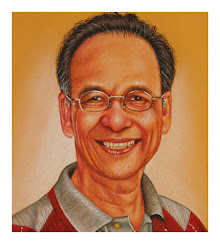
FROM DILIP MUKERJEA

"Genius is in-born, may it never be still-born."

"Oysters, irritated by grains of sand, give birth to pearls. Brains, irritated by curiosity, give birth to ideas."

"Brainpower is the bridge to the future; it is what transports you from wishful thinking to willful doing."

"Unless you keep learning & growing, the status quo has no status."
Showing posts with label Improvisational Creativity. Show all posts

Monday, October 26, 2009

A LESSON IN ENTREPRENEURSHIP... & IMPROVISATIONAL CREATIVITY

[continued from the Last Post.]

Entrepreneurial Characteristics

The general characteristics of an entrepreneur are:

• Willing, perhaps eager, to live with the fear of failure.

• Stimulated by a feeling of elation and aliveness when confronting risk.

• Able to perceive risk as common sense, as he or she has weighed the pros and cons of the issues in question.

• Impelled by the certainty of success, an entrepreneur is happy to accept the occasional, or repeated failure; this is considered the price of eventual success, “failing forward to success” as stated by Mary Kay Ash.

• Failure = Learning, and moving on

• Not primarily motivated by money, since the pursuit of money per se would create an unwillingness to take the (calculated) financial risks from which real wealth flows.

• Work = Fun in accomplishing worthwhile aims

• Devoted to business, often at the expense of their personal lives. No job is too menial for them, and laserlike focus on the goal is their raison d’ĂȘtre.

• Passionate belief in a quest for the best. Negativism in/from others = Positivism, and optimism, within themselves. They are driven by confidence in their resolve to attain their objectives. Ignorance is an asset, and thus, they succeed because they don’t know what can’t be done.

• Constantly on the lookout for products and services that that might satisfy genuine needs in the marketspace.

• Churn problems into opportunities with the idea of turning them into profit.

• Persist in checking out the competition, in order to determine what they might be doing right, or wrong.

• Expect frequent rejection when they seek funding, as they have a different mentality to bankers and investors

• For really new products, an entrepreneur tends to go with his or her instincts, and creates a market by educating the consumer, as follows:

- Creating buy-in for the product by demonstrating how it solves a problem or delivers a benefit.
- Repositioning the product in the consumers’ minds by illustrating its uniqueness, and superiority over competing products.

- Flipping a perceived liability into an asset.


• They invest in advertising, promotions, and publicity (via good press relations, for example) to create and amplify market awareness of their presence. The objective is to build sales and establish a strong brand image; that is, to attract customers.

Add your own contributions:

•

Some Notable Entrepreneurs:

- Richard Branson, Virgin empire
- Bill Gates, Microsoft
- David G. Neeleman, JetBlue Airways
- P. Diddy, Bad Boy Entertainment
- Ben Cohen, Ben & Jerry’s
- Steve Jobs, Apple and Pixar
- Henry Ford, Ford Motor Company
- Walt Disney

These entrepreneurs exhibit the following common characteristics:

- They crave thrill, excitement and speed;
- They are highly creative problem solvers;
- They are impulsive;
- They are ambitious and industrious;
- They have tons of energy;
- They love being the hero in emergencies;


NOTE:

It is NOT my intention to portray entrepreneurs as being of a certain fixed ‘tupe’. History has enough evidence of entrepreneurs coming in all flavours. The above are just the common characteristics of the category of entrepreneurs given as examples.

[Excerpted from the 'Lifescaping' seminar participant's manual. The 'Lifescaping' seminar is conducted by Dilip Mukerjea about four times a year under the auspices of the Singapore Institute of Management.]

Sunday, October 25, 2009

A LESSON IN ENTREPRENEURSHIP... & IMPROVISATIONAL CREATIVITY

Successful entrepreneurship is characterised by persistent dogged determination.

This is how entrepreneurs surmount recurring obstacles through their improvisational creativity.

Jay Van Andel, cofounder of Amway, featured in a set of experiences that typify the entrepreneurial persona. Just after the end of the Second World War, Van Andel and two friends opted to ride the airplane craze and launch an enterprise.

This is their story:

For a down payment of $700, they purchased a two-seat Piper Cub in Detroit. Not knowing anything about flying, they hired a pilot to fly their new acquisition from Detroit to Grand Rapids.

As they state: “The next difficulty was making enough money to pay off and fly the airplane we just bought.”

So they opened a flying service, naming it Wolverine Air Service. They still didn’t know how to fly, and thus hired two veteran pilots, whilst they did what was necessary on the ground: their mainstay was flying instruction, but they also offered passenger rides, group transportation, and sales and rentals of airplanes.

They recall: “We were counting on being able to use the new Grand River Air Park in Comstock Park, which was under construction when we started.

When the airport project ran out of money, we attached pontoons to the bottom of our airplane and used the Grand River for our airstrip.

This was a lesson to us in improvisation, and we learned a few more like it during our air service days…[We] employed the services of an old chicken coop for an office…”

On a trip to Florida to deliver a plane, they hit on the idea of opening a drive-in restaurant, similar to ones they’d seen elsewhere.

With $300 to invest, they opened the “Riverside Drive-Inn Restaurant” on May 20, 1947. It was the first of its kind in the area. Their knowledge of running a restaurant was no better than what it was forflying an airplane, but they pressed on.

Their story continues:

“[We] built a diminutive wooden structure there at the air park, laying the foundation and nailing the clapboards ourselves. It took several months to get electricity hooked up properly, so we bought a generator. We also had no water for some time, so every evening we would fill up jugs at the nearest place that had plumbing and carry them to the restaurant.”

They kept the restaurant open from 5 P.M. until midnight. Like all good entrepreneurs, they functioned on overdrive. They kept conjuring up ways to provide additional services to their customers at the air park.

At one point, they started offering canoe rides down the Grand River, and fishing excursions on that lake. Within two years in this business, they were operating a flight school, charter service, repair service, an aircraft and gasoline sales organization, as well as the boat rental and charter business, not to mention the restaurant!

During these years, they gained business wisdom the hard way: the primary lesson was to persist with their persistence in spite of an unending series of unexpected problems.

As they conclude: “When the air park didn’t open on time, when the electricity and water weren’t hooked up for our restaurant on time, when several of our airplane engines were destroyed after we used the wrong lubricating oil, when hail and wind seriously damaged several of our airplanes, we didn’t give up.

Winter snows forced us to put skis on all the airplanes, but it seemed that as soon as the skis were on, the snow would melt, and as soon as we removed them, the snow would fly.

But the first year, we flew two million passenger miles and earned $50,000."

Entrepreneurial Improvisations:

• No landing strip? They used the river.

• No office? The chicken coop would suffice.

• No electricity? Locate a generator.

• No water? Haul it in.

• Ground covered with snow? Put skis on the plane.

Adapted from Source: Joseph H. Boyett & Jimmie T. Boyett

[to be continued in the Next Post. Excerpted from the 'Lifescaping' seminar participant's manual. The 'Lifescaping' seminar is conducted by Dilip Mukerjea about four times a year under the auspices of the Singapore Institute of Management.]