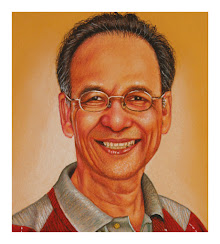
FROM DILIP MUKERJEA

"Genius is in-born, may it never be still-born."

"Oysters, irritated by grains of sand, give birth to pearls. Brains, irritated by curiosity, give birth to ideas."

"Brainpower is the bridge to the future; it is what transports you from wishful thinking to willful doing."

"Unless you keep learning & growing, the status quo has no status."
Showing posts with label Viewpoint Strategy. Show all posts

Sunday, August 28, 2022

In continuation of what I have had posted earlier about developing an opportunity mindset, here's my next viewpoint strategy, particularly within the context of my proposition:
"Be curious about the world around you and learn to see it from many different perspectives."
Viewpoint Strategy ~ SEEING BEHIND:

This is essentially learning from your past experiences.
The past does not guarantee the future, but you can certainly learn a lot from it, if only you spend time and make effort to evaluate it:
This is how best to go about it:
Questions to Ask and Ponder:
1) What worked?;
2) What didnt work?
3) Could I have explored a different course of action?
4) Did I have adequate support and/or resources? If not, what were the shortcomings?
5) What would work better, or faster, or smarter, the next time around with a little bit of tweaking?
6) What course corrections do I need to make in my life in order for me to move forward from here?;
In the field of project management, where I have had been involved for several decades of working in the corporate world, there is a proven methodology to use in reviewing past work, called Postmortem Analysis.
A quick one: 
It's just an opportunity for all the people involved to get together and discuss how the project went:
  • was it a success?
  • did the outcome meet your goals?
  • was the project easy to achieve?
  • were there any roadblocks or inefficiencies?
  • what are the opportunities for improving in the future?
These discussions are imperative for continued growth in any organisation and improving the way your team works together.

To sum up, the viewpoint strategy of seeing behind essentially gives us the capacity and capability to explore opportunities, while drawing from our hindsight, so to speak! 

Continuing from my earlier posts pertaining to developing an opportunity-sensitive mindset, building on what I have had learned from Dr Maxwell Maltz in the late seventies, and then throughout the ensuing years while riding on the shoulders of other giants before me, here's my next Viewpoint Strategy:

VIEWPOINT STRATEGY ~ SEEING THROUGH DIFFERENT LENS:

Albert Einstein, acknowledged by Time Magazine as the Smartest Person of the 20th Century, demonstrated to us in the early twentieth century that if we look at anything through a different lens, what we perceive will be different.
It's actually called REFRAMING!
Although reframing may have its origins in neuro-linguistics programming or NLP, it is actually just a simple process of changing the context or representation of a problem or issue at hand.
In reality, it is "shifting the meaning of" or "changing the way we think about" the problem or issue at hand.
That is to say, the meaning of anything is found essentially in the mental frame within which we view it.
According to NLP experts, when we perceive something as a problem, that's the message we send to our brain.
Then, the brain produces states in our body that make it a reality.
When we change our frame of reference by looking at the same problem from a different viewpoint, we can change our response to it.
More precisely, we can change our perception and/or representation about anything – object, event or process, situation, circumstance, people, idea – by according it a different meaning, and thus, allowing us to take a different approach & giving us new possibilities for the actions that we might take & the responses we might execute.
This is what reframing is all about.
For a better understanding, I like to point out that reframing is about changing perception.
However, since I am not an NLP junkie, I will approach reframing from a slightly different perspective.
I want to use reframing as a strategy for problem solving and opportunity discovery.
Over the years, I have learned more than a dozen possible ways – remember, I rode on the shoulders of giants before me - to see an issue or a problem or a challenge through diffferent lens or reframing, and would like to share them with readers:
1) Personality Frame:
- Just imagine that you are the issue or problem or challenge and adopt the personality of a particular person, and then explore how you would feel and act exactly within the issue or problem or challenge;
- In Synectics brainstorming methodology, we call this the 'personal analogy' approach;
2) Opposite Frame:
- Look at contrasting possibilities of the issue or problem or challenge;
- Our mind tend to look at only "similarities", and often "contrasts" can add another dimension to our viewpoint;
3) Flex Frame:
- Change the attributes of the issue or problem or challenge to see how you can flex it at will, say with the help of the well-known SCAMPER methodology;
- Explore the problem by shifting from pessimistic to optimistic, and then back to neutral standpoints;
4) Future Frame:
- Play with futuristic scenarios to see how the issue or problem or challenge can be addressed, especially when you have unlimited power, money, time, and resources;
- Your futuristic scenarios can take the form of global, regional, industry, market, product, organisational or personal levels;
5) Failure Frame:
- Approach the issue or problem or challenge from the standpoint of “failing forward faster”, by viewing the potential consequences as "opportunities";
- Our mind tend to look at "success" only, whereas looking at "failure" brings many possibilities to the issue or problem or challenge, often not recognised from looking the other way;
6) Fun Frame:
- Approach the problem from the standpoint of a curious child, with awe, joy and wonder at your disposal;
- Just imagine: When we could see the world through the eyes of a child, we would see the magic in everything!
7) Friends Frame:

- Get as many viewpoints as possible about the problem from your friends, especially those who aren't afraid to be honest with you, or even family members or colleagues;

- This approach will certainly help to remove some of your own blind spots;

8) Fame Frame:

- Imagine you are Einstein or Edison or Tesla, & explore how your new self would solve the problem;

- You can also include celebrities &/or renowned thought leaders like Peter Drucker or even MM Lee Kuan Yew;

9) Fiction Frame:

- Imagine your are Sherlock Holmes or Dick Tracy or Columbo, & then explore how they would
tackle the problem;

- Try MacGyver;

10) Fantasy Frame:

- Go to the extremes, or out of this world, into 'Fantasyland', to explore the problem;

- Just imagine how 'Alien' &/or 'Predator' would tackle the problem & come up with a solution;

11) Flip-side Frame:

- Look at the upside & the downside or reverse side of the problem;

12) Whole-Brain Frame:

- Explore the problem by walking around the 'rational bottom-line', 'conservative procedural', 'emotional people-oriented', & 'intuitive big-picture', viewpoints;

13) Five Senses Frame:

- Explore the problem using all the five physical senses, e.g. seeing, listening, smelling, tasting & touching;


Saturday, August 27, 2022

Continuing my intellectual journey on building and exanding my earlier lessons on opportunity recognition from Dr Maxwell Maltz, starting in the late seventies and traversing throughout the ensuing years of riding on the shoulders of giants before me, here's my next piece of advice:

VIEWPOINT STRATEGY  ~ SEEING THROUGH:
Basically, this is exercising perseverance and persistence in the face of adversity.
Many of us tend to give up easily when we fail in something.
For example, in school, when we got an F in the Chinese Language test or flunked the O Levels, we thought it was the end of the road.
There is no such thing as failure, only feedback.
When we made a horrendous mistake in some parts of our life, we just wanted to give up.
According to numerous motivational experts, there are no such things as mistakes, only learning experiences. But please, don't make the same mistake twice!

In fact, I like what R Buckminster Fuller, recognised as Planet Earth's Friendly Genius & inventor of the geodesic dome, once said:

"There are no failed experiments; only unexpected results!"

If Thomas Edison had not persevered and persisted in experimenting with some ten thousand filament alternatives, we would probably still be using large candles today!
As a matter of fact, Thomas Edision exemplied this "seeing through" phenonemon extremely well, as his wife once observed that, "Mr. Edison worked endlessly on a problem, using the method of elimination. If a person asked him whether he were discouraged because so many attempts proved unavailing, he would say:

'No, I am not discouraged, because every wrong attempt discarded is another step forward.''

[Thanks to community member Chad Alexander for highlighting this fact to me!]
Drawing on my own personal experiences while having navigated the Highway of Life for more than seven decades, I like to sum up the best approach, at least from the standpoint of goal setting and goal achieving:
  • to have an umbrella of long-range strategic goals, covering all the major life dimensions,
  • followed by a game plan, with a porfolio of specific, prioritised and executable tasks, that you need to accomplish daily, weekly, monthly, quarterly, and even annually, with your end in mind.
Naturally, you stay focused on your strategic goals, but remain adaptable and flexible in your tactical execution.
At the end of the day:

The ultimate fire test comes from your sweat equity in following up and following through what you have set out to do in your game plan.

This is how your "seeing through" works!
That's all folks for today! Stay tuned for my next Viewpoint Strategy!

Further to my numerous earlier posts about developing an opportunity-sensitive mindset, in particular reference to a series of viewpoint strategies:

This is Viewpoint Strategy ~ SEEING UNDER:
Oftentimes, when we look at an issue, or a problem, or a challenge, we tend to look at only the surface and jump quickly to conclusions, without even looking at the underlying reasons or factors.
When we look at issues, problems or challenges, we must also go under the surface and examine the root causes.
For example, in addition to asking what has happened, who did it, and why it had happened, we should proceed further by asking:

  • what did not happen;
  • who did not do it; and
  • why something else did not happen, and so on;

Like icebergs, root causes of problems - hidden possibilities or opportunities - are always deeply submerged!
In the field of project management, where I have had been involved while working in the corporate world, there is a proven methodology known as Root Cause Analysis (RCA).
In a nut shell, a root cause is defined as a factor that caused a nonconformance and should be permanently eliminated through process improvement.
The root cause is the core issue—the highest-level cause—that sets in motion the entire cause-and-effect reaction that ultimately leads to the problem(s).
Root Cause Analysis is thus defined as a collective term that describes a wide range of approaches, tools, and techniques used to uncover causes of problems.
Some RCA approaches are geared more toward identifying true root causes than others, some are more general problem-solving techniques, and others simply offer support for the core activity of Root Cause Analysis.
Readers may want to explore it via Google for more insights.
Stay tuned for the next Viewpoint Strategy !
Godspeed!


Friday, August 26, 2022

In my earlier posts, I have had already introduced several viewpoint strategies on developing an opportunity sensitive mindset, particularly within the context of what I have outlined in terms of "Be curious about the world around you and learn to see it from many different perspectives."

Here's my Viewpoint Strategy ~ SEEING AHEAD!
Essentially, this means planning ahead, just as Dr Maxwell Maltz had already captured it brilliantly.
To me, you must set an overarching umbrella of long-range strategic goals covering all your major life dimensions, from academic pursuits career aspirations, mental development, through physical health, wealth creation, family relationships and social development, to recreational ventures, spiritual development and entrepreneurial sidegigs, if any. 
That's the Wheel of Life, so to speak!
Naturally, you also need to establish a portfolio of specific, prioritised and executable tasks that you need to accomplish daily, weekly, monthly, quarterly, and even annually, with your end in mind. 
In essence, this is your game plan!
Last but not least, the fire test actually comes from your sweat equity of intense effort and focused execution, in following up and following through whatever you have set out to do in your game plan!
In summing up: 
Once you have all these planned initiatives in place to help you see and plan ahead, you can witness all the important things a.k.a. opportunities, that will make your dreams come true!
As my parting shot, I like readers to think about what Benjamin Franklin, reportedly the founding father of USA, said.
Stay tuned for my next viewpoint strategy!


This is in continuation of my numerous earlier posts about developing an opportunity-sensitive mindset, in particular reference to a series of viewpoint strategies:

This is Viewpoint Strategy ~ SEEING (FROM) ABOVE:
The founding father of Singapore Lee Kuan Yew called this phenomenon as 'having the helicopter ability'.
It means having the ability to rise above and to see the entire forest, instead of seeing only one or two trees.
Oftentimes, we are too close to an issue, or problem or challenge, we just don't see the opportunities lurking inside it. 
Therefore, we must learn to rise above the issue and learn to see the larger picture of what is happening around us, and not get bogged down by trivial stuff.
The ability to see not only the forest and the trees, but also a big picture view is what’s important for a growing business or even a professional on the rise.
It is sometimes referred to as “systems thinking”, a concept which was first implemented in the 20th Century by Royal Dutch Shell Company, who had noticed that their most successful managers all possessed this skill.
Being able to see the wholes, to spot the inter-relationships, to view things with a wide perspective and a larger context is extremely important for planning a strategy and, even more, for executing it properly.
So how does one develop the helicopter view skill?
Well, it takes a bit of imagination and climbing a ladder of abstractions.
First of all, “zoom out” from the current situation – step back from short-term and urgent problems and concentrate on seeing the whole project view.
Second, think about the present situation from a five or ten-year perspective. Imagine different scenarios for the future, and draw strategies around them.
Finally, repeat the previous steps regularly. This helps you keep the right course during your strategy formulation process, while still keeping the details in sight.
Godspeed, and stay tuned, folks, for the next Viewpoint Strategy!
[Interesting Note: One consultant even coins a 'Space Shuttle Perspective' for a more expansive and extensive view from above.]

Further to my earlier writings on a series of posts about developing an opportunity-sensitive mindset,  here's my next Viewpoint Strategy:

VIEWPOINT STRATEGY ~ SEEING BEYOND:

It is difficult to predict the long-term future, especially in a world that is rapidly and constantly changing.
However, this should not stop us from considering and playing with some possible, plausible and probable scenarios in the future, in which we plan to play a major role in them.
In the corporate world , we call this scenario planning.

For a young student, it is pertinent for you to take a longer term perspective, at least ten or more years down the road, in terms of what you want to do with your life. This can affect invariably what you do today.

Let me illustrate. Today, you are a secondary school student and your dream is to become a neurosurgeon.

To become and succeed as a neurosurgeon, you need to have adequate working experience in a reputable hospital. To do that, you need to graduate from a top-notch medical university.
For entry to study in a top-notch medical university, you need to score excellent grades in your A Levels, and you also need to do well in your SAT. To attain that, you need to go into a good junior college to mix around with the best, and just to get into one, you need to achieve excellent scores in your O Levels.

So, it is obvious that your planning starts from today, and you will have to start by seeing beyond in order to consider all the educational options open to you!
Once you set this in motion, you will get to see the opportunities along the way that will pave the time-path for you to achieve your ultimate dream!

Be prepared for all the opportunities lurking around you, but first things first, go and enjoy your exploration from different viewpoints!
Frankly, drawing on my own experiences, the goal of "seeing beyond" is not to predict the future but to tell you what you need to know in order to take purposeful, meaningful and productive action in the present.

As a parting shot, I would like to leave this elegant quotation from the Renaissance mestro Leonardo da vinci:

"If you wish to gain knowledge of the form of problems, begin with learning how to see it in many different ways."

That's all folks for today! Stay tuned for my next viewpoint strategy!