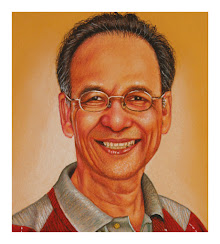
FROM DILIP MUKERJEA

"Genius is in-born, may it never be still-born."

"Oysters, irritated by grains of sand, give birth to pearls. Brains, irritated by curiosity, give birth to ideas."

"Brainpower is the bridge to the future; it is what transports you from wishful thinking to willful doing."

"Unless you keep learning & growing, the status quo has no status."
Showing posts with label 21st Century Skills. Show all posts

Wednesday, September 7, 2022

ARE YOU KILLING YOURSELF

. . . OR SKILLING YOURSELF?

This beautiful catchphrase comes from my good friend, Dilip Mukerjea, which he uses to promote his innovative iCAPsule program in his latest Brainaissance product and service catalog.
To be able to survive and thrive in the 21st Century, you must be skilled. To be precise, multi-skilled.
Otherwise, at the end of the road, you will bump into 'Extinction', instead of making a 'Distinction' for yourself.
Drawing on my own personal and professional experiences, I like to share with readers what are some of the most important skillsets, toolsets, actionsets and even mindsets to master for the 21st Century.

i) MindMapping & Other Visual Tools:
Even though Mindmapping has its own limitations, it is still a good skill to learn and master.
You can pick up the learning journey with books from Tony Buzan, Joyce Wycoff as well as Nancy Marguiles.
Of course, you can also go and attend one of the MindMapping workshops available in the marketplace.
Besides MindMapping, learn to explore other visual tools and graphic organisers.
If you are techno-savvy, MindManager and/or SmartDraw (excellent for creating rich pictures) and/or Inspiration (great for flow charts and concept mapping) are other available learning possibilities.

ii) Creative Problem Solving:
The best skill set in this respect is the proven CPS methodology from Alex Osborne and Sidney Parnes.
You can learn more about it from the Creative Education Foundation as well as the Creative Problem Solving Institute (CPSI).
Several books have been written on this subject.
One good one that quickly comes to my mind: Min Basadur's 'Simplex'.
A recently released creativity book, 'Think Better', covering a slight variation of the original CPS method, by Tim Hurson is worth reading.
For the more adventurous explorers in problem solving, I reckon the Synectics approach is the real kingpin.
You can read about it from the classic works from the two masters (William Gordon and George Prince)', e.g. 'Synectics: The Development of Creative Capacity' and 'The Practice of Creativity', respectively.
Since the above two classics may be out of print, I would suggest reading 'Big Ideas: Putting the Zest into Creativity & Innovation at Work' by Jonne Ceserani and/or 'Creativity, Inc.,' by Jeff Mauz.
Also get hold, if available, Vincent Nolan's 'The Innovator's Handbook'.

iii) Lateral Thinking:
In the field of creativity, lateral thinking from the late creativity maestro Dr Edward de Bono stands out, undoubtedly.
I like lateral thinking because the techniques help to break your dominant patterns and enhance your perceptual sensitivity to the world.
The author's brilliant approach is to provoke and/or restructure insights, as opposed to the traditional approach of having sudden insights.
You can learn more about lateral thinking from Dr Edward de bono's earlier books, e.g. 'Uses of Lateral Thinking', 'Lateral Thinking for Management' and 'Serious Creativity'.
You can also attend one of his workshops available in the marketplace.

iv) The 7 Habits:
The skill sets as embodied in the '7 Habits' from productivity strategist Stephen Covey are worth acquiring, especially the first three that pertains to securing a personal victory, i.e. 'Be Proactive', 'Having the End in Mind' and 'Think Win-Win'.
First of all, learn to understand the paradigm shifting perspectives as explained and illustrated by him in the book, '7 Habits of Highly Effective People'.
In a nut shell, and at the end analysis, the quest for excellence boils down to embracing powerful habits.

v) The 7 Levels of Change:
I like the painstaking way which the author Rolf Smith had taken in breaking down the personal change process in terms of specific actionable routines.
He uses the mountaineering expedition as a metaphor.
The skill sets as embodied in the author's book, entitled '7 Levels of Change' are worth acquiring and emulating.

vi) Systems Thinking:
Peter Senge started the ball rolling with regard to his ground-breaking methodology, as originally embodied in his wonderful book, 'The Fifth Discipline'.
Besides understanding the systems thinking perspectives, I like the skill set under 'Personal Mastery', at least from the personal standpoint.
I reckon the rest of them will fall nicely if you are in an organisational setting.
Nonetheless, for me, and to cut to the chase, personal mastery is the foundation of peak performance in any human endeavours.
It is pertinent for me to point out that the 'Fifth Discipline Fieldbook' gives more application possibilities.

vii) Strategic Thinking:
Readers will concur with me that thinking critically & strategically are the hallmarks of a business leader in the 21st century.
In other words, strategic thinking gives you the future competitive edge.
In this respect, and from the personal perspective, I choose the brilliant work of Stuart Wells, who wrote 'Choosing the Future'.
In the business arena, there are a few excellent authors, like William Rothschild and Rich Horwath.

viii) Strategic Exploration:
To me, strategic exploration is simply moving out of the comfort zone and venturing into new territories and/or exploring uncharted territories.
Author-filmmaker-futuirst Joel Arthur Barker has had outlined four powerful tools for strategic exploration in his pioneering book, 'Discovering the Future: The Business of Paradigms'.
Obviously, his four tools resonate beautifully with the those coming under 'Creative Problem Solving', 'Lateral Thinking', and 'MindMapping'.
I like Joel Arthur Barker's brilliant insights:
i) The three critical challenges facing all of us are:
- Anticipating the Future;
- The Pursuit of Innovation at all levels;
- The Quest for Excellence in whatever we do;
ii) The way to g about the above challenges is to embrace paradigm pliancy.
In simple language, adopt fresh, multiple perspectives and fluidity in our perception about the world.
Do you see the connection with Dr Edward de Bono's Lateral Thinking?

ix) Personal Strategic Planning:
Planning your life is the key to mastering yourself in the long run.
In this respect, there are many good books.
I would single out George Morrisey as he has excellent planning stuff that applies to both personal ('Getting Your Act Together: Goal Setting for Fun, Health & Profit' and/or 'Creating Your Future: Personal Strategic Planning for Professionals') as well as organisational settings ('Morrisey on Planning Trilogy').
Paul Levesque's 'Breakaway Planning' is another good one from the corporate angle.
Another good one is the one written by Simon Wootton, especially pertaining to the use of a series of provoking questions to probe your thinking behind your planning.

x) Opportunity Discovery:
The 21st century is actually the 'Idea Economy' from the standpoint of physical manifestations.
In other words, it is the ideas that make the difference in most respects, personally, professionally, organisationally as well as entrepreneurially.
The skill sets as embodied in Dr Edward de Bono's 'Opportunities' and Michel Robert's 'Innovation Formula' are definitely worth acquiring and emulating, as they provide the systematic methodologies to help you convert ideas into cash.
Don't forget to read Robert Tucker and Denis Waitley's 'Winning the Innovation Game' as they shared superb ideas on trend and/or opportunity spotting.

xi) Critical Thinking:
With so much wishy washy and mumbo jumbo stuff out there in the world, one also really needs the ability to think critically, analyse emerging issues, and make appropriate value judgments at the end of the day.
In this respect, I admire the work of the 'Foundation of Critical Thinking' and find many of their published thoughtwares very useful for learning, acquisition, mastering and emulation.
One quick way to understand critical thinking skill sets is to read the founders Richard Paul and Linda Elder's wonderful book for a start.
It's entitled 'Critical Thinking: Tools for Taking Charge of Your Learning and Your Life'.

xii) Decision Making & Potential Problem Analysis:
As Anthony Robbins once said: "It is in your moment of decision that you destiny is shaped."
Unfortunately, our success coach did not offer a methodology to go about it.
One of the best skill sets I have picked up in the early years of exploration to help me make better decisions in life and business is the well-known Kepner-Tregoe Problem Solving and Decision Making methodology.
The pioneering book, 'The Rational Manager' by the two founders is worth exploring, as it details the methodology with crystal clarity for readers.
Better skill, you can also go and attend one of their many workshops available in the marketplace, and have the opportunity to test ride through some case studies with like-minded professionals.
Happy reading, exploring and assimilation!

Thursday, September 19, 2013

This is Part II, also the final part, in continuation of an earlier post, illustrating an excellent piece of intellectual cogitation from Dilip Mukerjea.

An excellent piece of intellectual cogitation from Dilip Mukerjea to share with readers. This is Part 1. Part II follows in the next post.

Monday, December 10, 2012


This is a hi-res graphic rendition of the 21st Century Workplace, illustrating the six Disruptive Drivers and the ten Essential Skills, by Dilip Mukerjea.

Friday, November 19, 2010

CHAMPIONING STUDENTS: FOCUSING ON FUTURE-READINESS

[continuation from the Last Post ~ in connection with the recent launch of a series of new programs intended for parents as well as their school-going kids/teens, under the auspices of 'The House of Creative Brains'.]


Understanding "life skills" must always come first before one can really excel in "study skills".

Our rationale is that, once a student is exposed to "life skills" training, whereby he learns to exercise self-responsibility for his own personal life ["Do not lay blame"; 'Do not justify"; "Do not whine & wimp out!"], & also learn to take control of the future to make it happen for himself or herself, he or she is then more inclined to view "studying" as part & parcel of the journey of life.

The necessary "study skills" which he is expected to acquire will, thus fall in place very nicely, within the larger picture of his overall skills repertoire.

In his myriad programs, Dilip's "life skills" training incorporates developing future-readiness, building personal resiliency & understanding the imperatives of "Fail to Plan, Plan to Fail' philosophy.

A broad spectrum of '21st Century Learning Skills' as defined by leading educational experts & thinkers with the support of several large corporate sponsors (including Apple, Dell, Microsoft) permeates all Dilip's programs.

In a nut shell, it encompasses:

i) Learning & Innovation Skills;

[(a) Creativity & Innovation: thinking creatively; working creatively with others; implementing innovation; (b) Critical Thinking & Problem Solving: reasoning effectively; using systems thinking; making judgments & decisions; solving problems; (c) Comunication & Collaboration: comunicating clearly; collaborating with others;]

ii) Information/Media/Technology Skills;

[(a) Information Literacy: accessing & evaluating information; using & managing information; (b) Media Literacy: analysing media; creating media products; (c) Information, Comunication & Technology: applying technology effectively;]

iii) Life & Career Skills;

[(a) Flexibility & Adaptability: adapting to change; being flexible; (b) Initiative & Self-Direction: managing goals & priorities; working independently, being self-directed learners; (c) Social & Cross-Cultural Skills: interacting effectively with others; work effectively in diverse teams; (d) Productivity & Accountability: managing projects; producing results; (e) Leadership & Responsibility: guiding & leading others; being responsible to others;]

Learning the mechanics of the above will help you to understand better why you should always take an investment approach to your own education:

~ Your Future is in Your Hands;

I like to share with readers an axiom which I had picked up - I can't recall from whom - during the early years of my career in the corporate world. It goes something like this:

"There is no future in any job out there; the only future lies in you."

I think it sums up very well what I want to say here.

Nonetheless, I also like to throw in another axiom from American statesman Benjamin Franklin who once shared his wise thoughts about the value of investing in one's own education, as follows:

"An investment in knowledge pays the best interest."

~ Your Habits Determine Your Future!

Frankly, I can't seem to find the source of the following adage, but it sums up very well what I want to say here too:

"Watch your thoughts, for they become words; choose your words, for they become actions; understand your actions, for they become habits; study your habits, for they become your character; develop your character, for it becomes your destiny."

In his wonderful book, 'Unleashing Genius', Dilip shares a fascinating technique - he calls it, 'Thought Streaming'. Go & read the book.

[to be continued in the Next Post.]

[For more information about the series of new programs under 'The House of Creative Brains', please get in touch with Ms. Faye Yeoh via her email faye_yeoh@yahoo.com.

Readers can also pop into the US-based 'Partnership for 21st Century Skills' for more detailed information about 21st century readiness for every student.

Additionally, I recommend readers to read '21st Century Skills: Learning for Life in Our Times', by Bernie Trilling & Charles Fadel.]

Friday, March 13, 2009

WHAT ARE THE REQUISITE 21ST CENTURY SKILLS?

Here they are:

• Global Awareness
• Financial, Economic, Business and Entrepreneurial Literacy
• Civic Literacy
• Health Literacy
• Creativity and Innovation
• Critical Thinking and Problem Solving
• Communication and Collaboration
• Information Literacy
• Media Literacy
• ICT (Information, Communications and Technology) Literacy
• Flexibility and Adaptability
• Initiative and Self-Direction
• Social and Cross-Cultural Skills
• Productivity and Accountability
• Leadership and Responsibility


[Source: Partnership for 21st Century Skills]

Thursday, February 26, 2009

THE LEARNING SOCIETY

[continued from the Last Post.]


Even today, we know more about our phones and automobiles than we do about our own minds.

Despite having attained ‘high intelligence’ and ‘culture’ we remain in a cognitive prison. Our ways of learning and interacting with one another have remained primitive, and principally “user-belligerent.”

From simple bacterium-like organisms to complex eukaryotic cells to large multicellular animals, we have emerged and evolved as a predatory species, to the grief of most preexisting life forms.

We need a fresh consciousness. If not, we remain on course to annihilate our habitat. The solution lies in creating a Learning Society.

We are confronted by the master unsolved problem of biology — how the hundred billion nerve cells of the human brain work together to create consciousness. Yet we have free will to choose our actions, from the infinitude of emotion-charged and symbol-drenched, arbitrary in content, multifarious options on offer.

Why not choose to be a superspecies of learning organisms that blend together to form a Learning Society?

This ‘learning culture’ would apply to infants, families, pensioners, executives, and would be free of the ills that beset the planet today.

Idealistic? Indeed. But all it needs is a will to move: from ideal to intention to illumination ~ an awakening to the truth that we can lead ourselves only through learning continually; our societies can thus stem the rot and salvage the future for our species.

“You can only find truth with logic if you have already found truth without it.”

– G.K.Chesterton

All learning is brain-to-brain, inspired by heart, spirit, mind, body, and soul. When brains connect, illumination dispels darkness, possibilities spark into life. Imagination oxygenates the brain, and ideas flourish: The engine of Intellectual Capital is in motion. The world is alive, and magic must happen.

"Imagine the brain, that shiny mound of being, that mouse-gray parliament of cells, that dream factory, that petite tyrant inside a ball of bone, that huddle of neurons calling all the plays, that little everywhere, that fickle pleasuredome, that wrinkled wardrobe of selves stuffed into the skull like too many clothes in a gym bag."

~ Diane Ackerman

[Excerpted from the 'Leadership, Learning & Laughter' edition of The Braindancer Series of bookazines by Dilip Mukerjea. All the images in this post are the intellectual property of Dilip Mukerjea.]

Say Keng's personal comments:

To help readers in developing a personally relevant 'learning culture', here is my broad recap of the critical skills & attributes for effective managers in the 21st Century [extracted from the 'Optimum Performance Technologies' weblog]:

- inter-personal communication (people skills);

- ability to act with integrity;

- ability to manage change & adapt quickly;

- ability to motivate & counsel people;

- being a strategic thinker/visionary leader;

- analytical as well as creative problem solving skills;

- having a global mindset;

- ability to make informed decisions & take quick actions;

- being able to anticipate & recognise industry trends & market conditions;

- ability to manage & resolve conflicts;

- knowledge of information technology;

- knowledge of financial performance & risk management;

- knowledge of strategic as well as scenario planning;

- influencing & negotiation skills;

- knowledge of multiple languages;

- knowledge of geopolitical & cultural diversity;

- business development & presentation skills;

- having a self development mindset;

- ability to facilitate & manage teams;

- staff recruitment, training, appraisal & mentoring skills;

- ability to manage energy & stress;

- resiliency (able to balance job, family & external demands);

- project management skills;

If you are an educator/parent/student, I suggest dropping by this wonderful link, which provides an excellent roadmap to the skills, knowledge & expertise which all students of today should master in order to succeed in the 21st century.

I reckon, in the end analysis, the most absolutely, fundamentally important aspect of surviving & thriving in the 21st century is learning & acquiring new skills, & more importantly, learning them fast!