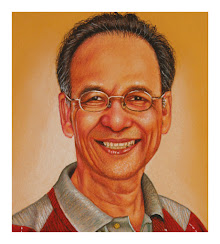
FROM DILIP MUKERJEA

"Genius is in-born, may it never be still-born."

"Oysters, irritated by grains of sand, give birth to pearls. Brains, irritated by curiosity, give birth to ideas."

"Brainpower is the bridge to the future; it is what transports you from wishful thinking to willful doing."

"Unless you keep learning & growing, the status quo has no status."
Showing posts with label Visual Thinking. Show all posts

Sunday, October 23, 2022

Here's a quick excerpt from Dilip Mukerjea's new book, Visual Magic for Business Brain Capital Creation:

THE VALUE OF VISUAL THINKING IN GOVERNANCE, BUSINESS, AND EDUCATION

As the challenges we face become more complex, visual thinking is emerging as an effective strategy to help us to solve them. Here are some initial and immediate benefits that we gain from visual thinking:

1. EXTRACT CLARITY FROM CLUTTER: Moving from Complexity to Perplexity to Clarity

A blizzard of words in pedestrian official documents can concuss the average analyst. In order to exterminate the confusion, the primary process must be to

| take a panoramic view of what needs to be scrutinised, just to get a quick feel of the document

| recognise, and mark the key words, and topic sentences, paragraph by paragraph

| convert the key works and themes into simple images

| link the images with a logic that shows the flow of what connects to what, and why

| create a visual map of your preferences one page, to represent the gist of the theme being addressed

VISUAL MAPS reduce complexity, accelerate learning, extract clarity from clutter, convert extensive information into intensive insights, recognise design beneath disorder, and are ideal for note-taking and note-making via interaction with oral and printed information.

2. ENVISION AND COMMUNICATE IDEAS AND ASPIRATIONS

In order to transport what you wish to communicate, you must create a mind-to-market conveyor belt that can depict the essence of your pitch; you need to break the idea down into its essential basics:

* Here’s what it is:

* Here’s who it’s for:

* Here’s whom we compete with:

* These are the benefits to you:

Visual thinking complements your words and with a pitch configured in this manner, it energises and amplifies your ability to communicate what you have envisioned. It shows how to enact strategy conception and development, and then its successful execution. This way, you have taken your great idea and been able to sell it to people who can support, fund and help to nurture it.

3. EXPEDITE DECISION-MAKING

Visually representing a challenge helps us to deconstruct it and understand the factors and issues that make it up. The use of simple imagery helps us see the anatomy of a situation or scenario. This process can be done manually or on a computer; I prefer using both approaches, as computing horsepower helps us to make better, more informed decisions, faster, but the manual approach enables us to immediately squiggle, sketch, and scribble, our free-floating thoughts and feeling, before they get hijacked by short-term memory.

4. CATALYSE GLOBALISED DISTRIBUTED TEAMS TO BECOME AGILE, ADAPTABLE, AND EFFECTIVE

By harnessing the magic within evolving digital technology, individuals and teams are interactively exposed to instant visual contact with one another and with their projects. This slashes the learning curve, obliterates confusion, and enables rapport to be established between elements from diverse cultures, and disciplines. The benefits that accrue are felt rapidly via accelerated decision-making and action-taking.


Introducing Dilip Mukerjea's new book, Visual Magic for Business Brain Capital Creation!


Sunday, August 8, 2010

SEEING & CREATIVITY: THE VISUAL CONNECTION

We are constantly solicited by visual images. But in looking, what do we really see?

This is one of the fundamental areas in learning how to draw and we thus should know how important it is to recognise the link between seeing and creativity.

Research conducted by Dr Betty Edwards has highlighted the vital need to equate vision with the brain. She addresses the issue that seeing here refers to not merely using one’s eyes, but one’s brain, which is what we really see with.

In using the “mind’s eye” to see, we permit ourselves to open up to a wonderful world of spontaneous ideas that manifest themselves in “Illumination,” the fourth phase of “Creativity”.

The sensation of “Illumination,” at the moment of “Inspiration,” is defined in the dictionary as “throwing light on a subject in order to see it better.”

Dr Edwards has identified two terms that are often used interchangeably with such Illumination: intuition and insight. Both words reveal more clues hidden within their origins.

The root of “intuition” is intuitus, the past participle of the Latin verb intueri, to look at, and the word is defined as “the power or faculty of attaining direct knowledge or cognition without rational thought and inference” – seeing something directly, or, in other words, “getting the picture” without having to figure it out.

Insight is a sibling to intuition. Yet, a paradox emerges.

Insight refers directly to seeing and vision but means seeing something not necessarily visible, such as “seeing into” something, or “apprehending” something.

To apprehend, “to grasp with understanding,” and discernment, a synonym of insight, “to detect with the eyes (or with other senses),” or “to come to know or recognize mentally,” directs us towards the nexus between seeing and understanding – in essence, grasp of meaning, a key element in creativity.

Variations of the same idea can be observed in the terms foresight, hindsight and clear-sightedness. The emphasis is subtly shifted by other phrases to differentiate specifically the kind of “seeing” or grasp of meaning that is taking place.

Dr Edwards breaks this down into the following areas: to see in perspective, to see in proportion, to see things differently, to see through someone (or some deception), to see the light, to get things in focus.

In fact, when a person has struggled to understand something, and “daylight breaks,” or “the light dawns,” the most commonly heard expression is “I see it now!”

To quote Kimon Nicolaides, “learning to draw is really a matter of learning to see – to see correctly – and that means a good deal more than merely looking with the eye. The sort of “seeing” I mean is an observation that utilises as many of the five senses as can reach through the eye at one time.

Although you use your eyes, you do not close up the other senses – rather, the reverse, because all the senses have a part in the sort of observation you are about to make.”

"Logical, systematic thinking is surely essential for survival in our culture, but if our culture is to survive, understanding of how the human brain moulds behaviour is our urgent need."

Dr Betty Edwards;

One night, during the darkest period of the revolutionary war, George Washington gave instructions to his orderly not to be disturbed. Not wishing to rush into making a decision, Washington turned his deep problems over to the creative, intuitive part of his mind.

By his own testimony, George Washington used that kind of insight to guide his decisions throughout his presidency. So did Abraham Lincoln, among others.

This was considered to be such an imperative feature in the decision-making process that the founding fathers used a clever means to remind us of it on the back of the dollar bill.

There you will find an unfinished pyramid with an eye over the top of it. The symbol was not chosen at random. Its meaning is thousands of years old. The structure is not complete, whether it is the individual’s life or the nation, until the all-seeing eye is in the capstone position.

Completion is totally dependent upon this creative, intuitive part of our mind that is constantly playing a major role in guiding our decisions.

Dr Edwards’ great work in teaching Perceptual Skills in Drawing to all ages is based on her close affinity with the creative process through the development of visual intelligence.

If insight, intuition and illumination are what the roots of the word indicate – grasp of meaning through special perception – preliminary training in perceptual skills might be an appropriate means of attaining greater understanding of the whole creative process.

It is important at this point to emphasise that “art” and “thinking” are very closely related to one another, as well as to “creativity.” When one considers the very creation of life, the evolution of the human mind, the conception of thoughts, our investigation receives illumination from the mythologies of diverse cultures.

When Jupiter, the king of the Gods, and Mnemosyne, the Goddess of Memory, spent nine days and nights together, their union resulted in humanity being graced by the Nine Muses – the Goddesses of the Creative Arts.

This is the tale according to Homer, though his predecessors amongst the ancient Greeks believed that there were three Muses.

Regardless of the arithmetical computation, what emerges as fascinating is that the word “muses” equates with “thinkers” (Greek).

The Muses presided over the production of artistic works. This naturally led to the term “music” which encompassed all the arts, and through its connection with “thought,” it concerned the development of the human mind – complementing “gymnastics” where one focused on the parallel development of the human body.

Perhaps this inspired the subsequent observation in Latin: mens sana in corpore sano.

Music, the arts, imagery in its manifold manifestations, they all equate with thinking – and creativity.

In every age, drawing was based on the assumption that the true reproduction of nature was the aim of the accomplished artist, and that this formed the basis of his creative activity.

Apelles, who worked as court painter to Alexander the Great, was the most famous painter in Antiquity.

Among the many anecdotes concerning him is one illustrating his high regard for perfect naturalism. He once engaged in a public competition with a colleague; each was to paint a picture.

Apelles’ contemporary produced a picture of grapes, which looked so real that the birds came to eat them. After due admiration of this feat the audience called on Apelles to unveil his picture.

This he could not do, for the veil was all he has painted. Thus, Apelles succeeded in deceiving even the human eye.

[Excerpted from 'Brain Symphony: Brain-blazing Practical Techniques in Creativity for Immediate Application', by Dilip Mukerjea;

All the digital images in this post are the intellectual property of Dilip Mukerjea.]

Say Keng's personal comments:

If readers have followed this weblog, you will note that I have responded quite extensively with regard to this "seeing" phenomenon, which also happens to be a personal fascination of mine.

All I know from the experts is that, more than three-quarters of our brain (the occipital cortex & its associated areas) are dedicated to visual processing.

Also, as much as 90% of what we learn in a lifetime often come to us via visual cues.

The genius of all geniuses, Leonardo da vinci, knew about this apparently more than 500 years ago. No wonder he once said, with his astute understanding of the human brain, "The eye is the window of the human body through which it feels its way & enjoys the beauty of the world."

Interestingly, I have always noted from my own exploration that words which we often connect to creativity, like "perception", "perspective", "insight", "illumination", "enlightenment", "envisioning", "viewpoint or point of view", "imagination", "inspection", "spectacles", "foresight", "hindsight", "farsighted", share a common denominator that has a lot to do with "seeing".

After all, words don't just pop up like that; they go through evolution.

As Dilip has rightly pointed out, even the word "intuition" has some connections to "seeing", at least at the metaphysical level from my perspective.

As a matter of fact, I understand that the word "idea", which has its origins from the Greek Language, is also related to "seeing".

Come to think of it, what about the word "seer"?

In the larger scheme of things, as a sage advice goes, "without a vision, the people perish".

I like to leave this beautiful quote from French novelist & critic Marcel Proust (1871–1922) as food for thought:

"The real voyage of discovery consists of not in seeking new landscapes but in having new eyes."

Monday, July 5, 2010

VISION AT A QUICK GLANCE

Here's a superb example of a visionary scenario on one single page, as crafted by Dilip Mukerjea.

All salient aspects of the proposed vision - "Making Kids Future-Ready" & "Inspiring a Learning Planet" - are captured in a visually-appealing montage.


Friday, May 7, 2010

MAKING THOUGHTS VISIBLE, A LESSON FROM ALBERT EINTSEIN

According to creativity expert, Michael Michalko, writing about his 'A Theory about Genius' in the wonderful book, 'Cracking Creativity: The Secrets of Creative Genius', creative geniuses in science, art, and industry throughout history often relied on their visual thinking approaches to make important breakthroughs.

One great example came from Albert Einstein.

"One of the most complete descriptions of Einstein's philosophy of science, was found in a letter to his friend, Maurice Solovine. In the letter, Einstein explained the difficulty of attempting to use words to explain his philosophy of science because, as he said, he thinks about such things schematically.

The letter started with a simple drawing consisting of (1) a straight line representing E (experiences), which are given to us, and (2) A (axioms), which are situated above the line but not directly linked to the line.


[Note: This is an approximation. Einstein's original sketch is in the Albert Einstein Archives, the Hebrew University of Jerusalem, Israel.]

Einstein explained that psychologically the A rests upon the E.

There exists, however, no logical path from E to A, but only an intuitive connection, which is always subject to revocation. From axioms, one can make certain deductions (S), which may lay claim to being correct.

In essence, Einstein was saying that it is the theory that determines what we observe. Einstein argued that scientific thinking is speculative, and only in its end product does it lead to a system that is characterized as "logical simplicity."

Unable to satisfactorily describe his thoughts in words, Einstein made his thought visible by diagraming his philosophy's main features and characteristics."

What intrigues most about the Einstein Sketch is the "intuitive connection" from 'E' to 'A'. That's the fuzzy part, which I like to know more about. Dilip Mukerjea likes to call it, 'Junction Dynamics'.

Tuesday, March 23, 2010

VISUAL PRESENTATION OF INVISIBLE PROCESSES

Here's another wonderful collection of conceptual symbols - all hand crafted & digitally enhanced - from Dilip Mukerjea:


IDEA DEVELOPMENT


IDEA GENERATION


RIDING THE WAVE OF CHANGE


IDEAS TO CA$H


IMAGINATION IS REALITY


THRIVING IN THE LEARNING ECONOMY


PROFIT GENERATOR


RE-ENGINEERING


SOCIETY OF INNOVATION CHAMPIONS


THOUGHT LEADERSHIP

[All the images in this post are the intellectual property of Dilip Mukerjea. Digital image libraries are available for outright purchase from Brain Dancing International. Sales enquiries are welcome.]

Saturday, March 20, 2010

EMPOWERING YOUR COMMUNICATION MESSAGE WITH CONCEPTUAL SYMBOLS

Here's another collection of conceptual symbols - hand crafted & digitally enhanced - from Dilip Mukerjea.

In line with the axiom, a picture speaks a thousand words, conceptual symbols can readily help to drive home the communication message quickly & efficiently, especially during a presentation.


Complex Tasks

Grab Big Picture


Ideas Galore


[All the images in this post are the intellectual property of Dilip Mukerjea. Digital image libraries are available for outright purchase from Braindancing International. Enquiries are welcome.]

Tuesday, December 8, 2009

CHANGE, ON YOUR TERMS, OR BE SHORT-CHANGED ON THE MARKET'S TERMS!

[continued from the Last Post.

My personal musings, inspired by Page 4 of 'The Brainaissance Program of iCAPitalism Seminars with... The World's Most Powerful Learning Systems for... The Learning Economy', by Dilip Mukerjea.]

The following pertinent question from Dilip Mukerjea can be quite scary.


I reckon, the only option for us today, as part of our longer term strategy to survive & thrive, is to keep on learning new things, & at the same time, keep on learning to apply technology-enablement to increase our personal productivity, so that we become more productive, efficient & irreplaceable.

I recall my early exposures as a working professional to what futurist Alvin Toffler has once described as "a turbulent environment filled with revolutionary reversals, surprises, & competitive upsets..." as far back as the late eighties or early nineties.

At that time, I had also just started to indulge myself in the beautiful writings of economist Paul Zane Pilzer.

The following jottings in my ideas scratchpad came from his brilliant work, particularly 'Unlimited Wealth: The Theory and Practice of Economic Alchemy':

"... The overwhelmingly largest determinant of success today for both the individual & the organisation is the speed with which they can accept, learn, & work with technological change... Prosperity today belongs to the person & organisation that learns new thins the fastest..."

"... The key to achieving financial success today, or success in any field for that matter, is being able to learn new things. And the key to having the ability to learn new things, is developing confidence in your ability to learn...'

"Indeed, technology is advancing on so many fronts that the main constraint on innovation today is not so much the capacity of engineers & entrepreneurs to come up with new ideas, but their ability to keep abreast of & integrate the latest developments from fields outside their own particular specialty..."

Just imagine that he wrote all that in the early nineties, & to me, they are still very relevant today.

As a matter of fact, Dilip Mukerjea has recently made a wonderful observation in an expert advisory to a client [actually, an extract from his currently still 'work-in-progress' book, tentatively entitled 'Brainaissance'] as follows:

"Corporations and capital markets differ in their attitudes towards the forces of creative destruction ~ specifically, in the way they enable and manage this phenomenon. Corporations focus on operations. They aspire to function perpetually as ‘going concerns’, and thus work on the assumption of continuity.

Capital markets have no such concerns — they function on the presumption of discontinuity; their focus is on creation and destruction. Whilst corporations may tolerate long-term underperformance, markets have no qualms about annihilating the underperformer.

Outstanding corporations might stand out amongst the downtrodden, but unless they become perpetual learning organisms, the very processes that led them to success will anchor them to failure.

The choice for organisations: change, on your terms, or be shortchanged on the market’s terms!"


The foregoing insightful observation certainly sums up very well what Dilip has originally in mind when he poses the question as outlined in the foregoing imaginal picture.

[to be continued in the Next Post.]

Monday, December 7, 2009

WHAT DO THESE CONCEPTUAL SYMBOLS MEAN TO YOU? VII

Following is another selective sampling of rudimentary conceptual symbols from Dilip Mukerjea's 'work-in-progress' book, tentatively entitled 'Brainaissance'.

In a nut shell, a concept symbol encapsulates the essence of 'A Picture Speaks a Thousand Words'.

Take a quick look at them, & for the fun of it, explore what they mean to you.

Possible representations as envisaged by Dilip are given at the bottom of this post.


[Possible Representations: Laughter; Leadership; Lost; Love; Loving Relationship; Making Choices; Manipulation. All images in this post are the intellectual property of Dilip Mukerjea.]