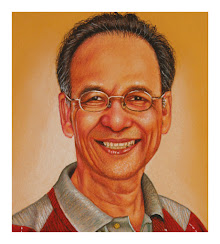
FROM DILIP MUKERJEA

"Genius is in-born, may it never be still-born."

"Oysters, irritated by grains of sand, give birth to pearls. Brains, irritated by curiosity, give birth to ideas."

"Brainpower is the bridge to the future; it is what transports you from wishful thinking to willful doing."

"Unless you keep learning & growing, the status quo has no status."
Showing posts with label Group Brainstorming. Show all posts

Monday, June 28, 2010

FROM DIAGRAMMATIC NOTES ON THE FLY TO ELABORATE GRAPHIC ILLUSTRATIONS IN A MONTAGE

Dilip and I have often spent a lot of time together at my place in Jurong West to brainstorm business possibilities.

Last Saturday was no exception. He had wanted to explore how best to put his evolving portfolio of technical expertise & intellectual thoughtware "on a plate", so to speak, to showcase to a small group of potential investors, in a one-day fast-track session to allow them to have a hands-on feel of his offerings in terms of robustness & relevancy.

On Friday evening, while attending the funeral wake of my 98-year-old granny-in-law at the Singapore Casket premises, & during my time-out, I just jotted down some of my preliminary thoughts - in the form of ball-point diagrammatic notes - on two sheets of tissue paper. It took me about ten minutes or so to do that.

I could do it quickly, primarily because I already have an incisive insider's as well as outsider's perspective of his writings and teachings.

Please refer to the first two snapshots as appended below.


On Saturday morning, we met for our scheduled 'pow-wow' after a cuppa in my neighbourhood food-court. Using his faithful Mac Pro and Adobe InDesign software, & coupled with his own professional insights, plus also drawing on his vast digital library of conceptual symbols, Dilip painstaking transcribed my diagrammatic notes on the fly into very elaborate graphic illustrations in a montage.

From time to time, we also deliberated at length on how best to project the essence of each element.

Despite his artistic virtuosity, Dilip took almost twelve hours [including lunch & dinner breaks] to complete the montage.

The first one is what I like to term as a "mandalic display" of graphic illustrations, which essentially captured Dilip's generative portfolio to date. Dilip will print this out on a A0-sized fabric paper for display on the wall.

The second one is more of a lifescape, based on Dilip's 'lifescaping', with self-check questions, to allow the attending investors - through hands-on application - to chart out a possible course of action, based on their reflections & responses to the first one. It will be printed out in probably A3-sized paper for distribution.

The complete and elaborate graphic illustrations are appended below. Resolution-wise, they have to be reduced for easy web viewing.


On top of the foregoing work, Dilip had also completed a slide presentation, using his Apple Keynote software. Vital segments from the elaborate graphic illustrations were transposed into the presentation.

Dilip and I have agreed that the entire Saturday sojourn was worth the massive effort of putting our heads together. He can now use the two graphic productions for presentation to any investor interested in his generative portfolio of technical expertise and intellectual thoughtware, covering both corporate and educational domains.

As an epilogue, I like to sum up the foregoing synergetic outputs as physical manifestations of the following philosophies of ours:

TWO HEADS ARE BETTER THAN ONE!
KNOWLEDGE SHARED IS POWER SQUARED
!

Sunday, November 15, 2009

WHAT ROLE DO YOU PLAY IN TEAM INNOVATION?

Creativity guru Roger von Oech, & also author of two great classics, namely, 'A Whack on the Side of the Head' & 'A Kick in the Seat of the Pants', among many others, propounds 4 important role-playing personnas, in team innovation so to speak:

- explorer;
- artist;
- judge;
- warrior;

Likewise, creativity guru Edward de bono, & also progenitor of 'Lateral Thinking', has his own version of six important role-playing personnas, using the analogy of wearing coloured hats.

Interestingly, his one-time protege, Michael Hewitt-Gleeson, from Down Under, has seemingly a competitive version of seven important role-playing personnas, using the analogy of wearing coloured sports caps.

The award-winning industrial design firm, IDEO, has shared their perspectives of important role-playing personnas more specifically in team innovation in the wonderful book, 'Ten Faces of Innovation: IDEO's Strategies for Defeating the Devil's Advocate & Driving Creativity Throughout Your Organization', by Tom Kelley, General Manager.

[Please refer to my earlier post, entitled 'Becoming More of an Innovator in Your Daily Life', of this weblog.]

In a nut shell, & as I see it, based on my own personal & professional experiences, the real purpose of all these role-playing personnas is to generate shifting perspectives in one's mind, to ride on the cross-functional synergies of different departments or business units, & to leverage on the diversity & the intellectual capital of all the people in, within as well as outside the organisation (e.g. customers, suppliers, facilitators, competitors).

Needless to say, human ingenuity is such that no one plays a single role. It's always a multitude of roles, or may even be composite roles when raw ideas take birth in human minds.

What follows is Dilip Mukerjea's version, visually speaking, of role-playing personnas in team innovation:

TEAM INNOVATION


DESIGNER

EVALUATOR

GENERATOR

IMPLEMENTOR

PROMOTOR
So, what role or multitude of roles do you play in team innovation?

[All images in this post are the intellectual property of Dilip Mukerjea.]

Tuesday, June 9, 2009

FROM DILIP MUKERJEA'S ITINERANT TOOLBOX: BRAINSTORMING

[continue from the Last Post]

Method 2

This time, select a two-word expression for your problem, theme, or targeted idea. For example, you could use the words in this technique, chain and reaction as the starting and ending words respectively. Now create intermediate idea bouncers (stepping stones) say, five in number.

We could proceed as follows:

Chain-------------------------- Reaction

The intervening words can then be, for example: links, shirt, anger, relationship, and chemistry. That is, chain makes me think of links which reminds me of shirt (because of cuff links), and so on, when finally, chemistry reminds me of reaction.

Let us now apply this technique to a problem, using an institution’s initials as the starting ‘word’:


Once the intervening words have been supplied, we take each word in the verbal chain and associate it with our problem, that is, for ITE to make a breakthrough.

The example shown above is by no means all that can be spun off; the associations are limitless. Now you try it with a real life situation that needs attention.

For example, you could get going with:

Marital................................................ Relationship or

Office...................................................Politics or

Power...................................................Vacuum etc.

[Excerpted from 'Surfing the Intellect: Building Intellectual Capital for a Knowledge Economy', by Dilip Mukerjea. All the images in this post are the intellectual property of Dilip Mukerjea.]

Monday, June 8, 2009

FROM DILIP MUKERJEA'S ITINERANT TOOLBOX: BRAINSTORMING

[continue from the Last Post]

THE CHAIN REACTION:

PURPOSE:

Swift thought association leads to a rapid stream of insights that unravel the hidden facets of a situation. Incredibly simple, yet formidable in stimulating an explosion of creativity.

Method 1

Select a random word and spin off a series of associations, in effect, a chain reaction. Then select each word in turn, and link it literally or symbolically to the situation under scrutiny.

Example:

Let us say that the random word is kite. We now incite the chain reaction as follows:

kite • sky • sunshine • water • swimming • sharks • teeth • face • chicken • kangaroo • candle • lavender

So we started with kite and ended with lavender, a total of 12 words.

Now we array these words vertically, and associate each of them with our problem, which is, say:

How can we unite and focus our diverse ways of thinking so as to realise our vision for achieving breakthrough in organisational innovation?


[To be continued in the Next Post. Excerpted from 'Surfing the Intellect: Building Intellectual Capital in a Knowledge Economy', by Dilip Mukerjea. All the images in this post are the intellectual property of Dilip Mukerjea.]

Sunday, June 7, 2009

FROM DILIP MUKERJEA'S ITINERANT TOOLBOX: BRAINSTORMING

[continue from the Last Post]

Brainwriting Record Sheet

Challenge:

In what ways might we be able to . . . (e.g. reduce the high turnover in our Organisation)?


1) Write or sketch 3 ideas across the top row… one idea per box: 1A, 1B, and 1C.

2) As soon as you’ve done this, place the form in the middle of the exercise zone or pass it on to a facilitator of the session. Immediately pick up a form someone else has completed.

Don’t continue on the form you have just used.

3) If you are finishing real quick, put your form in the middle and pick up an extra blank form … Go for quantity!!! The quality will emerge soon enough.

4) Write 3 more ideas across the second row (2A, 2B, and 2C). These ideas can be your ‘originals’ or ones that have been sparked off by others in the first row.

Similarly, when you get a sheet with the top two rows completed, fill in the third row, so as to complete the sheet.

5) Eventually, everyone should have completed a form each, plus any additional blank forms, as in Step ‘3’ above.

NOTE : This exercise can be done at high speed, say within 5 minutes flat, or at a leisurely pace, with advantages to both scenarios.

Advantages of this Technique:

■ Fast;

■ Democratic ~ everyone gets to participate;


■ No loss of ‘face’ for ‘stupid’ answers;

■ Participants remain incognito ~ they do not have to reveal their names against their entries;
■ No time for criticism ~ process encourages ideation through adrenalin flow!


[To be continued in the Next Post. Excerpted from 'Surfing the Intellect: Building Intellectual Capital for a Knowledge Economy', by Dilip Mukerjea. All the images in this post are the intellectual property of Dilip Mukerjea.]

Saturday, June 6, 2009

FROM DILIP MUKERJEA'S ITINERANT TOOLBOX: BRAINSTORMING

PURPOSE:

To unleash a stream of ideas within minutes, through individual or group synergy.

Brainstorming is often a group problem-solving process. The term was coined by Alex Osborn, one of the legendary pioneers in the field of creativity.

Osborn was an advertising executive in the 1930s, with a modest goal: bring business meetings to life!

He was frustrated by the inefficiency of the meetings; they seemed to produce poor decisions, and were frequently a waste of time.

In his best-selling book, 'Applied Imagination', Osborn described how the name ‘brainstorming’ was born:

It was in 1938 when I first employed organised ideation in the company I then headed (an advertising agency). The early participants dubbed our efforts ‘Brainstorming Sessions’; quite aptly so because, in this case, ‘brainstorm’ means using the brain to storm a problem.

Apparently, Osborn linked 'brainstorming' to creativity only as an afterthought. Perhaps even he did not see this connection in the beginning.

In his magnum opus, 'Applied Imagination', he reveals that the concept and practice of brainstorming was common in India for more than 400 years as a strategy used by Hindu teachers when working with religious groups.

The Indian term for this methodology is Prai-Barshana; Prai means ‘outside yourself’ and Barshana means ‘question’. Thus, in these sessions, prejudgement, analytical discussion, or
criticism, was not permitted. The group would evaluate ideas only at a later stage, most likely after a suitable incubation period.

Rules of Brainstorming:

■ Suspend judgement;

■ Allow all suggestions, even absurd and impractical ones;

■ Consider every idea and person as valuable;

■ Free-wheel; be outrageous;

■ Aim for quantity of ideas; this will lead to quality;

■ Write down every idea;

■ Combine, piggy-back, refine the ideas;

Some rules, created principally by Osborn, have been established over time. They eliminate ego dominance, suspend judgement, and involve all participants in a democratic process.

The standard group size varies from five to ten people. However, in the ‘brainwriting’ method described on the following page, the process has been used successfully on groups of 50 to 70 people.

Theoretically, the numbers could go higher. In the methods described on the following pages, the author has repeatedly witnessed wonderfully successful outcomes with the following attributes:

Time limit for a group of 30 participants: 5 minutes

Total number of ideas generated: from 350 to 380

% duplication of ideas: from 20% to 50%

% of similar ideas after eliminating duplicates: from 10% to 30%

Number of top quality ideas after distilling the balance: from 1 to 20.

Now, even if there were one brilliant idea out of this exercise, it was a result of top class group synergy, and obtained in only 300 seconds!

If in the end, there is a shortlist of several options, they could be mind mapped by teams of, say, five people.

If the total group size is 30 people, this makes six teams. Ten minutes later, they come together with their respective Mind Maps, and distill their collective outpourings.

The group then spends another ten minutes, making a Master Mind Map. This serves as the reference chart from which decisions can be made.

Total processing time from Brainstorming to Mind Mapping to arriving at a final decision: 30 minutes, maximum!

[To be continued in the Next Post. Excerpted from 'Surfing the Intellect: Building Intellectual Capital for a Knowledge Economy', by Dilip Mukerjea. All the images in this post are the intellectual property of Dilip Mukerjea.]