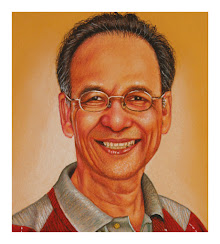
FROM DILIP MUKERJEA

"Genius is in-born, may it never be still-born."

"Oysters, irritated by grains of sand, give birth to pearls. Brains, irritated by curiosity, give birth to ideas."

"Brainpower is the bridge to the future; it is what transports you from wishful thinking to willful doing."

"Unless you keep learning & growing, the status quo has no status."
Showing posts with label Happiness Factor. Show all posts

Thursday, March 12, 2009

THE HAPPINESS FACTOR II

[continued from the Last Post]


The verb “laugh” comes from the Old English hliehhan, an onomatopoeic word (soundimitating).

Note some of the origins of words that represent such sunny sentiments:

HAPPINESS (noun) Origin: Middle English (in the sense ‘lucky’): from the noun HAP + -Y where HAP (archaic) = a mass noun meaning luck or fortune.

LAUGHTER (mass noun) Origin: Old English hleator, of Germanic origin; related to German Gelächter, and to Origin of ‘laugh’ ~ Old English hlaehhan, hliehhan, of Germanic origin; related to Dutch and German lachen. Gelotology = the science of laughter (gelos is Greek for “laughter”)

SMILE (noun or verb, depends on context) Origin: Middle English: perhaps of Scandinavian origin; related to SMIRK (Origin: Old English sme(a)rcian, from a base shared by ‘smile’. The early sense was ‘to smile’; it later gained a notion of smugness or silliness).

JOY (mass noun) Origin: From Middle English: from Old French joie, based on Latin gaudium, from gaudere ‘rejoice’.

COMEDY (mass noun) Origin: Late Middle English(as a genre of drama, also denoting a narrative poem with a happy ending, as in Dante’s Divine Comedy): from Old French comedie, via Latin from Greek kômôidia, from kômôidos ‘comic poet’, from kômos ‘revel’ + aoidos ‘singer’.

FUN (mass noun) Origin: Late 17th c. (denoting a trick or a hoax) from obsolete fun ‘to cheat or hoax’, dialect variant of late Middle English fon ‘make a fool of, be a fool’ , related to fon ‘a fool’, of unknown origin. Can be compared with FOND, Origin late Middle English (in the sense ‘infatuated, foolish’): from obsolete fon ‘a fool, be foolish’, of unknown origin.

ECSTASY (mass noun) Origin: late Middle English (in the archaic sense of an emotional or religious frenzy or trancelike state, originally one involving an experience of mystic self-transcendence) from Old French extasie, via late Latin from Greek ekstasis ‘standing outside oneself’ , based on ek- ‘out’ + histanai ‘to place’.

Sources: The New Oxford Dictionary of English © Oxford University Press 1998, 1999, and Chambers English Dictionary, © 1988

[Excerpted from the 'Leadership, Learning & Laughter' edition of The Braindancer Series of bookazines by Dilip Mukerjea. All the images in this post are the intellectual property of Dilip Mukerjea.]

Wednesday, March 11, 2009

THE HAPPINESS FACTOR


Is your organisation brimming with happiness? Is the atmosphere crackling with good humour?

A treasure trove of information about ‘The Happiness Factor’ in your organisation can be gleaned from the circulation of jokes in e-mails, skits and stand-up routines at conferences, wisecracks within meetings, the ratios and levels of sense and nonsense at watercooler gatherings, and tomfoolery in offices, all in tandem with top levels of professionalism whereby the customers too are roped into having fun with you.

Do your people smile, from the soul? Do these smiles explode into joyous laughter? How well does this atmosphere, if it exists in your organisation, translate into revenue?

People who are congenitally miserable tend not to enjoy any victories, only alternate forms of defeat. Leadership comes from happy people, those who are continually learning and laughing.

Toxic people tend to poison the energy, creativity, and productivity within organisations.

Perhaps organisations should appoint “corporate cheerleaders” to create sparkle in their cubicular jungles.

Business comes from clients who are having fun when transacting or negotiating with you. Value multiplies from relationships where people are able to laugh at themselves,and with one another.

Without laughter in organisations, companies will find that they are not just competing for markets and customers, but for employees! Take your laughter seriously. To not do so, is no laughing matter!

It is vital to have the courage and dare I say, the skill, to ‘play the fool’: it is what liberates our souls and allows us to communicate with truth, beauty, and grace. How seriously does your organisation advocate ‘playing the fool’?

We should be inspired by the ancient Greeks, who believed that wisdom lay in pursuing the path of levitas, not gravitas.

Science has endorsed the manifold benefits of laughter.

Immunoglobulin is an antibody that serves as a first line of defense against some viral and bacterial infections.

Laughter stimulates the increase of immunoglobulin within the eyes (tears) and the mouth (saliva), whilst the brain and body produce ‘happy hormones’ known as beta-endorphins that help you to relax and alleviate pain. Levels of cortisol, from the adrenal glands, generated under stress, are significantly decreased under the influence of laughter.

During laughter, there is a rise in blood pressure, which dips below resting level later, in tandem with reduced muscle tension.

Overall, your body enjoys thorough oxygenation during laughter; this inspires clear thinking and contributes to aerobic fitness. Rheumatic and arthritic ailments are beneficially affected during laughter, which has beneficial, anti-inflammatory effects on your joints.

In essence, laughter is the ambrosial connection between mind, body, and spirit ~ a triunity that, when working in harmony, leads to human success. This includes business success, for happy people inspire happy transactions.

How much laughter is there in your Organisation?

[To be continued in the Next Post. Excerpted from the 'Leadership, Learning & Laughter' edition of The Braindancer Series of bookazines by Dilip Mukerjea. All the images in this post are the intellectual property of Dilip Mukerjea.]