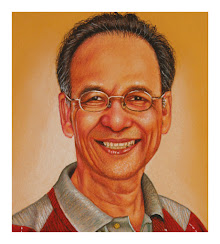
FROM DILIP MUKERJEA

"Genius is in-born, may it never be still-born."

"Oysters, irritated by grains of sand, give birth to pearls. Brains, irritated by curiosity, give birth to ideas."

"Brainpower is the bridge to the future; it is what transports you from wishful thinking to willful doing."

"Unless you keep learning & growing, the status quo has no status."
Showing posts with label Triple Bottom Line. Show all posts

Wednesday, April 15, 2009

INNOVATE TO INVIGORATE


Sustainability and the Triple Bottom Line, must be a part of development, of which there are three modes:

- new development;
- maintenance/conservation; and
- restorative development (the longest-lasting mode);

A gargantuan new category of business opportunities is opening up in the domain of restorative development . . . where focus is placed on the restoration of both natural and built environments.

We can’t afford to focus solely on new development; and though (perhaps) not as expensive as new development, maintenance/conservation development is still costly.

Both ignore what already exists, but has been allowed to degrade, pricipally due to the triple crises of corrosion, contamination, and constraint (not enough land).

Restorative development is the opposite of the one-way developmental path taken by the other two modes. The wastage in one-way development is evident when we see its passage from:

forest into farm, wetland into factory, clean air and water into toxicity, living soil into lifeless dirt, the consumption and depletion of non-renewable resources, and so on.

These paths of wastage have never had any counterbalancing activity...until now.

As Storm Cunnigham declares: “We are witnessing the birth of the global Restoration Economy.”

This is critical, before so much of our planet deteriorates, disappears, or dies. In 'The Sleepwalkers', Arthur Koestler describes the development of scientific thought, how the great thinkers of the past, such as Kepler, Galileo and Newton, seem to have wandered around and around the concepts they were seeking until they eventually stumbled upon them.

Robert Frost deftly generalises this intellectual process in a two-line poem: “We dance around in a ring and suppose. The secret sits in the middle and knows.”

In 'Non Zero', Robert Wright addresses how human culture has developed by finding non zero-sum games to play; he writes: “In highly non-zero-sum games, the players’ interests overlap entirely. In 1970, when the three Apollo 13 astronauts were trying to figure out how to get their stranded spaceship back to earth, they were playing an utterly non-zero-sum game, because the outcome would be either equally good for all of them or utterly bad. (It was equally good.)”

May the choices we make about our businesses be such that they are equally good for our planet!

We must Innovate to Invigorate!

Other than the three crises imaged above, we could equally consider the escalation in oil prices, the growth of international debt, and alarming climate change. But these too are connected to the triple crises of constraint, corrosion, and contamination.

[Excerpted from the 'Igniting Innovation' edition of The Braindancer Series of bookazines by Dilip Mukerjea. All the images in this post are the intellectual property of Dilip Mukerjea.]

Tuesday, April 14, 2009

THE CREATIVE CONSCIENCE

The financial bottom line is no longer the only measure of business success. In order to guarantee our planetary survival, the human creative conscience must aim to protect, preserve, and propagate a sustainable world.

Today’s best-run organisations pay heed to the need to nurture and nourish a world where success comes from social, environmental, and economic performance factors.

A company will not be allowed to continue business if its success stems solely from financial returns, especially if these returns are at the expense of social disharmony and environmental degradation.

General Electric, focusing on climate change, has garnered great returns. In the last six years, its wind energy business, acquired from Enron, has quadrupled in revenue. The company is attracting customers galore via its fuel-efficient jet and locomotive engines, and natural gas turbines, all designed to minimise greenhouse gas emissions. GE has sold over $1 billion worth of wind and natural gas turbines to China, and is slated to amplify sales across the planet.

In 2004 PepsiCo managed to surpass Coca-Cola in terms of market cap for the first time in history. The secret lay in establishing an overlap between increased market share and healthier lifestyle habits of the general public.

These are just two examples that show the benefits of companies finding the “sweet spot” between their business interests (the shareholders) and the interests of the general public (the stakeholders).

Sustainability addresses our consciences, where businesses must strive not just for an impact on profits, but equally so, for an impact on the world. People, Planet, and Profit.

Sustainable development is about business, not philanthropy per se... assuming that the values of a business are a recognition that profit is entwined within the dynamics of people and planet. It is systemic. Thus, for an enterprise to succeed, sustainable development must be an integral part of a company’s core business.

NOTE: The ‘triple bottom line’ (TBL) expression was coined by John Elkington in 1994. It was later expanded and articulated in his 1998 book Cannibals with Forks: the Triple Bottom Line of 21st Century Business.

Sustainability, itself, was first defined by the Brundtland Commission of the United Nations in 1987.

The concept of Triple Bottom Line demands that a company’s responsibility be to ‘stakeholders’ rather than shareholders. In this case, ‘stakeholders’ refers to anyone who is influenced, either directly or indirectly, by the actions of the firm.

[Excerpted from the 'Igniting Innovation' edition of The Braindancer Series of bookazines by Dilip Mukerjea. All the images in this post are the intellectual property of Dilip Mukerjea.]

Say Keng's personal comments:

For me, the best way to understand what Dilip Mukerjea has written in the foregoing essay is to go back to what American biologist Barry Commoner, now 92, had originally conceived as the First Law of Ecology during the 70's:

"Everything is Connected to Everything Else. There is one ecosphere for all living organisms and what affects one, affects all."

By the way, it's analogous to what Leonardo da vinci had said more than five centuries ago.

Sunday, February 22, 2009

TOWARDS A CARBON NEUTRAL LIFESTYLE

The following text has originally existed as an 'Example of a Radiant Thinking Essay on the Theme: BOOKS' on page 102 in the book, 'Taleblazers: Imagination to Imprint', by Dilip Mukerjea.

"Books as we know them, on paper, are transitioning into digital panels: electronic, flat screen displays, with cheap electronic memory large enough to store several hundred titles.

Consider their dominant benefit:

they save trees, by eliminating the need for printing paper and cardboard cartons necessary for storage and shipment of books. The absence of physical books equates with eliminating warehouses for their mass storage. There are massive savings on maintenance costs on vans and trucks, and associated costs on fuel needed to run them.

E-books also enable instant service at your keyboard, as you can download multiple titles into a single device, which can accommodate thousands of pages of text and imagery in a finite physical space.

A single, inexpensive, high-definition screen can display hundreds of books, magazines, and newspapers; the amount of material needed to produce one paper book far exceeds that needed to produce several hundred e-books.

Purists still prefer the feel of a paper book, but as haptic (pertaining to the sense of touch) technology gets more sophisticated, it is inevitable that e-books will soon have the look and feel of paper books…but not their limitations!

Clear-cutting entire forests for paper is a violation against nature!

This practice will be trumped by memory boosting technology: just a few years ago, we were amazed at storage capacities in megabytes, then gigabytes, and now terabytes (each terabyte is a thousand billion bytes).

The power sources for such amplified memory devices are getting cheaper and more sophisticated; perhaps we will realise that we should be collaborating, instead of competing, with nature.

After all, nature to be commanded, must be obeyed.

Modern consciousness is decorated by the images and imaginations of every age. Books must reflect this truth, and evolve with the times.

Creativity is multiplicity derived from the destruction of the original unity: the act of grinding destroys the corn but, at the same time, multiplies it by fragmenting it. This is the same with e-books, emerging from the digitizing of traditional books.

Cremation is creation: burning is learning.

We must keep moving ahead, or stay dead: all that stays put shall fall; that which is in motion, shall stay."

What Dilip Mukerjea has written, as a brief essay - in August last year - is essentially a personal reflection of 'sustainability'.

In the corporate world, we call it 'The Triple Bottom Line' (3BL) strategy.

For corporations, the 3BL strategy sets out a challenge to make themselves differentiated from their competitors, to increase their profitability, & more importantly, to improve the environment, as good corporate citizens.

That's to say, to make their businesses ultimate part of the global climate change solution today.

The ROI to the company as such comprises 'People, Planet & Profit', a term believed to have been coined by the Royal Dutch/Shell Company.

It is principally intended to expand the traditional accounting report framework to take into the social & ecological/environmental performance in addition to economic/financial performance.

In a nut shell, I can see that everything boils down to an endeavour by corporations - as well as consumers - to reduce the ecological footprint, & to avoid the endangering depletion of natural resources on the planet.

As we all know, books & magazines gobble up trees. Sadly, global climate change is driven by rising concentration of carbon dioxide in the atmosphere.

Trees pull carbon out of the atmosphere. Less fallen trees mean a carbon neutral lifestyle for all of us.

Interestingly, & come to think of it while drawing apt cues from planet Earth's friendly genius, also engineer, inventor & futurist R Buckminister Fuller, we are all crew members travelling together on the same old spaceship.

Actually, what I have just highlighted has been sparked off today by Dilip Mukerjea, when he suddenly realised that his earlier thoughts, while writing the essay part in Taleblazers, may have unwittingly entered into a collision course - somewhere in the universe - with the brilliant thoughts of Dr Winston Wei, who has created Smartt Papers, an environmentally friendly, world's leading compression & transformation technology.

For airlines & the publishing industry, & with the timely role of Smartt Papers technology, the carbon costs, so to speak, can be turned into business opportunities.

Please refer to my earlier post with regard to our meeting with Dr Winston Wei.

Is it a coincidence? No, not the way I see it. Great minds think alike. More likely.