[continued from the Last Post.]
Storyboarding Points to Note & Actions to be Taken
Points to Consider:
■ Storyboarding is vital for nurturing creative and critical thinking.
■ Storyboards can be used to formalise various types of communication.
■ Individuals and teams of all sizes can use storyboards to translate what they visualise into hard copy imagery concerning their: challenges, goals, constraints, problems, strategies, solutions, project work, and even their random idea generation.
■ Meetings can deliver real value in real time with storyboarding techniques.
■ All employees, regardless of their position in the hierarchy, should be encouraged to develop their storyboarding skills. The anonymity guaranteed by this technique serves to dissolve any barriers due to organisational hierarchies.
■ The storyboarding techniques, because of their inherently democratic nature, should be actively used within the marketplace as well as in the webbed ‘marketspace.’ This should enable the participants to include customers, suppliers, vendors, and even members of the general public. The technique can be put into effect either in ‘real’ or in ‘virtual’ space.
Suggested Actions to be Taken:
■ Train all employees in at least a few versions of storyboarding.
■ Ensure easy accessibility of storyboards for individuals and groups or teams, so that they can
be updated.
■ Use storyboarding in planning and strategising to develop and depict sequences, timelines, and project assignments. At no time must the storyboard be considered as a rigid device; one should feel free to modify, amplify, revise, update, as required.
■ Provide a ‘safe’ environment for storyboarding sessions. This enables anyone and everyone involved, to actively participate in the exercises without having to identify themselves if they choose to remain anonymous. This is relevant when dealing with sensitive issues.
■ Use storyboarding sessions to highlight the who, what, when, where, and how aspects of a situation. This exercise leads to immensely improved communication and a chain reaction of improvements. The visibility of the storyboarding technique lends itself to rapid idea generation, even in trying circumstances.
Modified and Adapted from Source: Capodagli & Jackson
[Excerpted from 'Surfing the Intellect: Building Intellectual Capital for a Knowledge Economy', by Dilip Mukerjea.]
Showing posts with label Disney Methodology. Show all posts
Showing posts with label Disney Methodology. Show all posts
Friday, August 7, 2009


Thursday, August 6, 2009
FROM DILIP MUKERJEA'S ITINERANT TOOLBOX: STORYBOARDING, THE DISNEY METHODOLOGY
[continued from the Last Post.]

[To be continued in the Next Post. Excerpted from 'Surfing the Intellect: Building Intellectual Capital for a Knowledge Economy', by Dilip Mukerjea. All images in this post are the intellectual property of Dilip Mukerjea.]

[To be continued in the Next Post. Excerpted from 'Surfing the Intellect: Building Intellectual Capital for a Knowledge Economy', by Dilip Mukerjea. All images in this post are the intellectual property of Dilip Mukerjea.]
Wednesday, August 5, 2009
FROM DILIP MUKERJEA'S ITINERANT TOOLBOX: STORYBOARDING, THE DISNEY METHODOLOGY
[continued from the Last Post.]

[To be continued in the Next Post. Excerpted from 'Surfing the Intellect: Building Intellectual Capital for a Knowledge Economy', by Dilip Mukerjea. All images in this post are the intellectual property of Dilip Mukerjea.]

[To be continued in the Next Post. Excerpted from 'Surfing the Intellect: Building Intellectual Capital for a Knowledge Economy', by Dilip Mukerjea. All images in this post are the intellectual property of Dilip Mukerjea.]
Tuesday, August 4, 2009
FROM DILIP MUKERJEA'S ITINERANT TOOLBOX: STORYBOARDING, THE DISNEY METHODOLOGY
[continued from the Last Post.]
The Dot Voting Method of Storyboarding
The structure of this storyboard is a little different from the ones shown earlier. The logic replicates that of a Mind Map, and the procedure is as follows:
1. Assemble the group of people acting as problembusters.
2. Write the challenge, issue, situation, or problem on a large board, card, or sheet of paper. This is called ‘The Topic Card’ (equivalent to the central image on a Mind Map).
3. Address the challenge with one brief but concise observation per storyboard panel. You can complete as many panels as you wish. Remember the Laws of Brainstorming: particularly, suspend judgment, until the very end.
4. Eventually, after say, a fixed time limit, sort out all the panels that have been completed. From this outpouring of ideas, determine a set of major categories ~ these panels are called ‘Header Cards’ for each category (equivalent to the main branches of a Mind Map).
5. All the remaining cards are to be arranged under their respective categories ~ these cards are called ‘Categorised Detail Cards’ (equivalent to levels that expand beyond the main branches of Mind Maps).
6. Give each participant an equal amount of Priority Voting Dots; they could be of two colours, red and blue, for example. The red ones are fixed to the ‘Header Cards.’
The ‘Detail Cards’ receive the blue ones.
Voting is purely democratic and no pressure must be applied to anyone about having to lean one way or another. (If the Voting Dots are too expensive, simply use coloured markers, and draw red or blue circles ~ once again, the quota is fixed for everyone.)
7. The panels with the most dots should stand out as the ones where greatest emphasis is being placed. We would need to pay particular attention in these areas.
This ‘idea landscape’ or ‘mindscape’ is like building a house, entailing a logical progression.
The technique works because of the high level of participation, the guarantee of anonymity, and the speed of idea generation.
The internal workings of an organisation can be dramatically improved when this technique is incorporated into its routine procedures. The integration of storyboarding into activities such as planning, communication, idea generation, and organisational development leads to operational excellence.
No matter what the application, the role of this technique is vital in nurturing creative, as well as critical, thinking.
The next post summarises the various applications of this methodology.
[To be continued in the Next Post. Excerpted from 'Surfing the Intellect: Building Intellectual Capital for a Knowledge Economy', by Dilip Mukerjea. All images in this post are the intellectual property of Dilip Mukerjea.]
The Dot Voting Method of Storyboarding
The structure of this storyboard is a little different from the ones shown earlier. The logic replicates that of a Mind Map, and the procedure is as follows:
1. Assemble the group of people acting as problembusters.
2. Write the challenge, issue, situation, or problem on a large board, card, or sheet of paper. This is called ‘The Topic Card’ (equivalent to the central image on a Mind Map).
3. Address the challenge with one brief but concise observation per storyboard panel. You can complete as many panels as you wish. Remember the Laws of Brainstorming: particularly, suspend judgment, until the very end.
4. Eventually, after say, a fixed time limit, sort out all the panels that have been completed. From this outpouring of ideas, determine a set of major categories ~ these panels are called ‘Header Cards’ for each category (equivalent to the main branches of a Mind Map).
5. All the remaining cards are to be arranged under their respective categories ~ these cards are called ‘Categorised Detail Cards’ (equivalent to levels that expand beyond the main branches of Mind Maps).
6. Give each participant an equal amount of Priority Voting Dots; they could be of two colours, red and blue, for example. The red ones are fixed to the ‘Header Cards.’
The ‘Detail Cards’ receive the blue ones.
Voting is purely democratic and no pressure must be applied to anyone about having to lean one way or another. (If the Voting Dots are too expensive, simply use coloured markers, and draw red or blue circles ~ once again, the quota is fixed for everyone.)
7. The panels with the most dots should stand out as the ones where greatest emphasis is being placed. We would need to pay particular attention in these areas.
This ‘idea landscape’ or ‘mindscape’ is like building a house, entailing a logical progression.
The technique works because of the high level of participation, the guarantee of anonymity, and the speed of idea generation.
The internal workings of an organisation can be dramatically improved when this technique is incorporated into its routine procedures. The integration of storyboarding into activities such as planning, communication, idea generation, and organisational development leads to operational excellence.
No matter what the application, the role of this technique is vital in nurturing creative, as well as critical, thinking.
The next post summarises the various applications of this methodology.
[To be continued in the Next Post. Excerpted from 'Surfing the Intellect: Building Intellectual Capital for a Knowledge Economy', by Dilip Mukerjea. All images in this post are the intellectual property of Dilip Mukerjea.]
Monday, August 3, 2009
FROM DILIP MUKERJEA'S ITINERANT TOOLBOX: STORYBOARDING, THE DISNEY METHODOLOGY
[continued from the Last Post.]


[To be continued in the Next Post. Excerpted from 'Surfing the Intellect: Building Intellectual Capital for a Knowledge Economy', by Dilip Mukerjea. All images in this post are the intellectual property of Dilip Mukerjea.]


[To be continued in the Next Post. Excerpted from 'Surfing the Intellect: Building Intellectual Capital for a Knowledge Economy', by Dilip Mukerjea. All images in this post are the intellectual property of Dilip Mukerjea.]
Sunday, August 2, 2009
FROM DILIP MUKERJEA'S ITINERANT TOOLBOX: STORYBOARDING, THE DISNEY METHODOLOGY
[continued from the Last Post.]
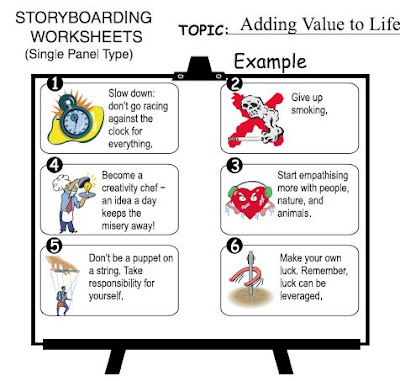
In the single panel type of storyboard, imagery and text can be included in the same panel. The sequence is determined after generating ideas, then sorting them out in order of importance.
For sake of convenience and publishing quality, I have crafted this exercise on the computer.
However, in real life, it is best to do the exercise at speed, and by hand. Later on, if you wish, you can apply cosmetic effects.
The manual version of this exercise is described in this author’s previous book, Braindancing.
It is often a good idea to set a time limit for such an exercise, say 15 minutes. Several people can do the exercise individually, and then come together to finally sort out the best options.
[To be continued in the Next Post. Excerpted from 'Surfing the Intellect: Building Intellectual Capital for a Knowledge Economy', by Dilip Mukerjea. All images inthis post are the intellectual property of Dilip Mukerjea.]

In the single panel type of storyboard, imagery and text can be included in the same panel. The sequence is determined after generating ideas, then sorting them out in order of importance.
For sake of convenience and publishing quality, I have crafted this exercise on the computer.
However, in real life, it is best to do the exercise at speed, and by hand. Later on, if you wish, you can apply cosmetic effects.
The manual version of this exercise is described in this author’s previous book, Braindancing.
It is often a good idea to set a time limit for such an exercise, say 15 minutes. Several people can do the exercise individually, and then come together to finally sort out the best options.
[To be continued in the Next Post. Excerpted from 'Surfing the Intellect: Building Intellectual Capital for a Knowledge Economy', by Dilip Mukerjea. All images inthis post are the intellectual property of Dilip Mukerjea.]
Saturday, August 1, 2009
FROM DILIP MUKERJEA'S ITINERANT TOOLBOX: STORYBOARDING, THE DISNEY METHODOLOGY
[continued from the Last Post.]

The concept of Storyboarding emerged from the fertile brain of Walt Disney. There are several ways to storyboard.
This example demonstrates a double-panel method, where a one-to-one relationship is established between imagery and text. Each individual double-panel can be used to sequentially build up a story or theme. The applications are manifold, some of which include:
■ creating cartoons;
■ crafting documentary films;
■ designing full-length feature films;
■ outlining the theme of a novel;
■ creative problem solving in business or in personal life;
■ education: learning subject matter in a memorable manner;
■ command-and-control communication scenarios, e.g. in the armed forces;
There can be as many panels as you wish, each custommade for an individual or an organisation.
Sizes can vary with application requirements and imagery should be in colour, if possible. This enhances idea-generation, and makes the panels look attractive.
The numbering of the panels is done only after the final sorting process has been completed.
The advantage of loose panels is the freedom to change sequences; such independence unleashes creativity, with ideas often emerging serendipitously.
[To be continued in the Next Post. Excerpted from 'Surfing the Intellect: Building Intellectual Capital for a Knowledge Economy', by Dilip Mukerjea. All images in this post are the intellectual property of Dilip Mukerjea.]

The concept of Storyboarding emerged from the fertile brain of Walt Disney. There are several ways to storyboard.
This example demonstrates a double-panel method, where a one-to-one relationship is established between imagery and text. Each individual double-panel can be used to sequentially build up a story or theme. The applications are manifold, some of which include:
■ creating cartoons;
■ crafting documentary films;
■ designing full-length feature films;
■ outlining the theme of a novel;
■ creative problem solving in business or in personal life;
■ education: learning subject matter in a memorable manner;
■ command-and-control communication scenarios, e.g. in the armed forces;
There can be as many panels as you wish, each custommade for an individual or an organisation.
Sizes can vary with application requirements and imagery should be in colour, if possible. This enhances idea-generation, and makes the panels look attractive.
The numbering of the panels is done only after the final sorting process has been completed.
The advantage of loose panels is the freedom to change sequences; such independence unleashes creativity, with ideas often emerging serendipitously.
[To be continued in the Next Post. Excerpted from 'Surfing the Intellect: Building Intellectual Capital for a Knowledge Economy', by Dilip Mukerjea. All images in this post are the intellectual property of Dilip Mukerjea.]
Friday, July 31, 2009
FROM DILIP MUKERJEA'S ITINERANT TOOLBOX: STORYBOARDING, THE DISNEY METHODOLOGY
 PURPOSE:
To help you imagistically integrate an entire scenario of ideas and plans. One view gives a complete overview; you see the sequence as well as the gestalt of your ideas.
There is a story about Walt Disney that I came across in the writings of Mike Vance and Diane Deacon.
Disney was in St. Joseph’s Hospital at Burbank, California. A journalist, knowing that these were Walt’s final days, had been persistent about interviewing the great man.
Unfortunately, the hospital’s nursing staff had repeatedly thwarted his efforts.
Eventually, the night before Walt passed away in late 1966, the reporter finally gained entry into the room. Walt was naturally very weak, and could barely speak above a whisper. He thus requested the man to lie down on the bed beside him, so that he could whisper into his ear.
Lying beside one another, the next thirty minutes were spent with Walt referring to an imaginary map of Walt Disney World on the ceiling above his bed.
As Vance and Deacon state: “Walt pointed out where he planned to place various attractions and buildings. He talked about transportation, hotels, restaurants and many other parts of his vision for a property that wouldn’t open to the public for another six years.”
What a way to live, fuelled by a powerful vision. Death was just a formality, because Walt would live on in his magnificent legacy.
The 10 Beliefs at the Heart of The Disney Methodology
1. Every member within an organisation must be encouraged to dream. Dreams are the reservoirs of creativity, and everyone should feel free to tap into them at any time.
2. Be resolute about your beliefs and principles.
3. Treat your customers like guests.
4. All employees should receive appreciation through various means: support, empowerment, and rewards. You can then never pay them enough, for they will give of themselves freely.
5. Cultivate long-term relationships with key suppliers and partners.
6. Innovative ideas need to be nurtured, and brought to fruition; dare to take calculated risks.
7. Keep learning, incorporating new knowledge in your work; remain in alignment with the company culture.
8. Match long-term vision with short-term execution.
9. Use the storyboarding technique to solve planning and communication problems.
10. Pay close attention to detail.
Adapted from: Capodagli & Jackson, 'The Disney Way';
[To be continued in the Next Post. Excerpted from 'Surfing the Intellect: Building Intellectual Capital for a Knowledge Economy', by Dilip Mukerjea. All images in this post are the intellectual property of Dilip Mukerjea.]
Subscribe to:
Comments (Atom)




 Posts
Posts


