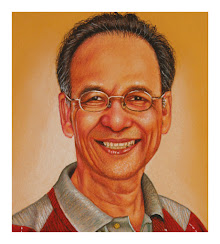
FROM DILIP MUKERJEA

"Genius is in-born, may it never be still-born."

"Oysters, irritated by grains of sand, give birth to pearls. Brains, irritated by curiosity, give birth to ideas."

"Brainpower is the bridge to the future; it is what transports you from wishful thinking to willful doing."

"Unless you keep learning & growing, the status quo has no status."
Showing posts with label Conquering Critical Thinking. Show all posts

Friday, November 4, 2022

Continuing from an earlier post, and capturing another wonderful excerpt from Dilip Mukerjea's new book, Conquering Critical Thinking:

HUMOUR IS CRITICAL TO YOUR HEALTH!

In Critical Need of Helping Yourself!

He went to a bookstore and asked the saleswoman, “Where’s the self-help section?” She answered,

“If I tell you, it will defeat the purpose.”

Critical Jaw Jitsu

To speak is to think with the volume turned up.

To talk is to transmit sounds in the absence of thought. To converse is to engage one another in an exchange of mutually enjoyable perspectives. And then of course, there’s verbal combat, argument, dissent, and general noise...all an exchange of ignorance.

Good critical conversation is the harmony between kindred spirits, even if they disagree on matters. It is not an arithmetical summation of two monologues making one dialogue. In the spirit of good conversation, the interacting parties must meet one another with a consciousness that enthuses, illuminates, and intrigues. And silence can be eloquent...especially when it expresses itself by snuffing out the unkind utterance.

Jaw Jitsu is the martial art of verbal combat. Like the pen and the sword, it can harm, or it can heal. Used well, it can express wit and wisdom, mirth nand merriment. May your communication be infused with these qualities.

So jaw jitsu away! The world awaits your critical eloquence.

Continuing from an earlier post, and capturing another wonderful excerpt from Dilip Mukerjea's new book, Conquering Critical Thinking:

HUMOUR IS CRITICAL TO YOUR HEALTH!

Romancing Critically

World War II had just ended. A general and his aide boarded a train in England. The only seats available were across from a beautiful lady and her grandmother. During the journey, the train entered a long tunnel. For about ten seconds, total darkness prevailed. In the accompanying silence, the passengers heard two sounds ~ a kiss, and a slap.

Everyone on the train had their own perceptions of what had actually happened. The young lady thought to herself, "I'm flattered that the lieutenant kissed me, but it's so embarrassing that Grandma slapped him!"

The grandmother thought, "I'm mad that the young man kissed my granddaughter, but I'm so proud that she had the guts to slap him!"

The general sat dumbfounded, thinking to himself, "My aide showed a lot of guts kissing that girl, but why did she slap me?"

The aide was the only one on the train who knew the truth. In that brief span of darkness he grasped the opportunity to kiss the girl and slap his boss!

Staying Positively Critical!

A linguistics professor was lecturing to his English class one day. “In English,” he said, “a double negative forms a positive. In some languages, though, such as Russian, a double negative is still a negative. However, there is no language wherein a double positive can form a negative.”

A voice from the back of the room piped up, “Yeah, right.”

Here's another wonderful excerpt from Dilip Mukerjea's new book, Conquering Critical Thinking:

HUMOUR IS CRITICAL TO YOUR HEALTH!

There’s a reason jokes entertain us, and it has more to do with intelligence than we think. Crafting a good joke is as serious an exercise in critical thinking as anything else. When comics recognise something as funny, they actually explore why it is funny. The process usually looks something like this:

(1) Humorists will make an observation about the world around them, something that reflects the mundane occurrences of life.

(2) Then they will examine one of those observations and think about the ways that most people intuitively interpret that observation (the more universal the better).

(3) Finally, the comic must look for alternative interpretations that no one else has considered but are just as true, if not more so.

A Critical Thinking Apéritif For You!

Michael: Do you drink beer?

Conrad: Yes, I do.

Michael: How many beers a day?

Conrad: Usually 3.

Michael: How much do you pay per beer?

Conrad: $5.00, which includes a tip.

Michael: And how long have you been drinking?

Conrad: About 20 years, I suppose...

Michael: So a beer costs $5.00, and you have 3 beers a day, which puts your spending each month at $450.00. In one year, it would be approximately

$5,400.00 correct?

Conrad: Correct.

Michael: If in 1 year you spend $5,400.00, not accounting for inflation, the past 20 years puts your spending at $108,000.00 correct?

Conrad: Correct

Michael: Do you know that if you didn’t drink so much beer, that money could have been put in a step-up interest savings account and after accounting for compound interest for the past 20 years, you could have now bought a Ferrari?

Conrad: Do you drink beer?

Michael: No.

Conrad: Where’s your Ferrari?

Thursday, November 3, 2022

Here's  an excerpt from Dilip Mukerjea's new book, CONQUERING CRITICAL THINKING! Breaking Through from HOW to WOW!

YOUR BRAIN IS YOUR BUSINESS!

DO YOU HAVE A 6 SIGMA BRAIN?

  • Counterargumenting Skills
  • Collaborating Skills
  • Critiquing Skills 
  • Creative Originality Skills
  • Cooperativeness Skills
  • Communication Skills
  • Comprehension Skills
  • Contextualising Skills

Six Sigma is a set of techniques and tools for process improvement. It was introduced by engineer Bill Smith while working at Motorola in 1986.

What is Sigma? 

In statistics, Sigma is the Greek letter representing standard deviation. Standard deviation measures the amount of variation within a set of data. If the data set is “normal”, meaning that the values within the data set are split above and below the data set’s average, the standard deviation is helpful in describing how spread out the data are.

What Does “Six” Represent? 

In a normal data set, a variation of one standard deviation above the mean will include 84.1% of the total population below that value. Expanding that to two standard deviations increases that to 97.7% of the population. Going one standard deviation further increases the data points included to 99.85% of the population. 

Taking this scenario out to 6 standard deviations above the average yields a calculated value of 99.9999998% or 2 parts per billion. In simple terms, this means that a process functioning at this level will yield only two defects for every billion items produced.

Examples of Critical Thinking Skills

* COMMUNICATION: being clear, relevant, to the point, and succint in your thoughts;

REFLEXIVITY: being able to reflect on your own thinking. How well are you communicating and expressing yourself? How are your ides being received?

* COMPREHENSION: being able to spot the core ideas in complex texts and in rambling and disjointed presentations. Here we start with deep listening to what is being said, and staying open to diverse points of view.

* CONTEXTUALISATION: your facility at considering breadth and depth of view, being able to see beyond traditional boundaries, and yet remain objective, whilst operating from first principles. Then being able to see ahead to practical applications, in the process of making new connections.

* CREATIVE ORIGINALITY: placing emphasis on independence of thought, flexibility of approach, and inventiveness; the ability to emerge with fresh, stimulating examples and counter-examples.

* COOPERATIVENESS & COLLABORATION: being able to empathetically work productively with others, in multifarious contexts, especially in cross-cultural scenarios. Being able to address conflicts so as to solve, resolve, absolve, or dissolve them.