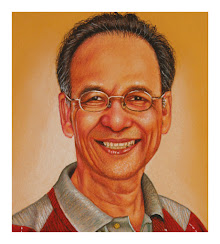
FROM DILIP MUKERJEA

"Genius is in-born, may it never be still-born."

"Oysters, irritated by grains of sand, give birth to pearls. Brains, irritated by curiosity, give birth to ideas."

"Brainpower is the bridge to the future; it is what transports you from wishful thinking to willful doing."

"Unless you keep learning & growing, the status quo has no status."
Showing posts with label Dudley Lynch. Show all posts

Monday, July 25, 2022

I love this particular quote from Dr Richard Bandler, co-creator of the popular and proprietary NLP training methodology.

Think about it, for it makes a lot sense to me.

As I view it, the most powerful, rich and vast real estate of the world actually lies just within our own headspace, lobed between our own two ears. 

All the six higher-order mental faculties which each and every one of us has had naturally been endowed already reside here.

As a matter of fact, as I read further, an interesting and yet parallel quote comes quickly to my mind, from the accelerated self-growth strategist Dudley Lynch, also founder of the Brain Technologies Corporation (with its own gamut of proprietary brain profiling instruments), who puts it in perspective:

"CHANGE YOUR WORLDVIEW, AND YOU CHANGE THE WORLD! 

NOT JUST THE WORLD AT LARGE BUT ALSO YOUR OWN PERSONAL WORLD, WRIT LARGE!"


Friday, July 22, 2022

UNDERSTANDING THE DYNAMICS OF GOAL SETTING

These astute observations plus the Million Dollar Personal Success Plan by entrepreneur Paul J Meyer, who founded the Success Motivation Instituite, Waco, TX, actually represented my nascent journey into developing personal mastery, while participating in their Dynamics of Goal Setting program, back in the late seventies.

I was then a young manager, in the late twenties, working in a large German firm in Singapore. I was also just promoted from the position of an engineering executive.
It was from this point of my life that I came to know Dr Maxwell Maltz and his Psycho-Cybernetics classic.
Around the same time, I then got involved in reading up Napoleon Hill's work, particularly his Law of Success and Think & Grow Rich, among other popular success literature, mainly from the United States, during that era.
In retrospect, all of them started my deep personal interest in pursuing personal excellence.
Without the valuable lesson takeaways from all of them, the insightful knowledge acquisitions from further participation in numerous workshops, and the exchange of ideas and insights with myriad like-minded professionals along the way, I wouldn't have survived and sustained the almost quarter of a century in the corporate world and another 15 years of running my own business.
In particular, from the personal development angle, Paul J Meyer, Dr Maxwell Marlz, Napoleon Hill, Og Mandino, David Schwartz, Dale Carnegie, Earl Nightingale, Jim Rohn, Dr Win Wenger, Tony Robbins, just to name a few, had been tremendously great influences.
From the professional development angle, there were far more notable influences, and I would just name Dudley Lynch and Paul Kordis, for their published writings, especially their Strategy of the Dolphin and Code of the Monarch, were among the first to initiate my intellectual foray.
I must admit, though, that one quintessential common thing really stood out among all of them: the imperativeness and urgency of goal striving and the power of the human mind in creating success.
Suffice to say, it has had been a very long ride, with fond memories and sweet reminiscences, indeed.


Saturday, April 19, 2014

WHAT KIND OF MIND DO YOU NEED?

An astute observation, from one of my most favourite strategist-authors, Dudley Lynch, President of Brain Technologies Corporation, a consulting and training outfit on accelerated self-growth, and author of 'LEAP!: How to Think Like a Dolphin & Do the Next Right, Smart Thing Come Hell or High Water', among others:

"The future just flip-flopped on you. Again.

But change isn't the greatest danger.

Inertia is."

Friday, April 18, 2014

POWERFUL IDEAS ("idées puissantes") FROM INSOO KIM BERG AND STEVE DE SHAZER

A nice collection of idées puissantes ("powerful ideas") from psychotherapist team, Insoo Kim Berg and her husband Steve de Shazer  [both died unexpectedly a few years apart in the 2000s]:
• If it isn’t broken, don’t fix it.
• If it works, go with the flow.
• If it isn’t working, do something different.
• The solution to an issue—any issue—is almost never that closely related to the problem.
• This explains why the way people think and talk about problems is almost guaranteed to be different than the way they think and talk about solutions.
• The first place to look for solutions is to exceptions: ask yourself what has been working that you really hadn’t noticed all that much.
• The next best place to look for solutions is to what makes sense, now that you’ve thought a little more about it.
• What usually matters most are small, right, smart, good (that is, moral) next steps that may put you on the path to big changes.
• People need to be reminded (and none of us ever wants to forget) that the future is both created and negotiable.
• Not all change is a problem, and problems do not happen all the time. But change is inevitable.
[Excerpted from LEAP!Psych weblog of Dudley Lynch, President of Brain Technologies Corporation and author of 'LEAP!: How to Think Like a Dolphin & Do the Next Right, Smart Thing Come Hell or High Water', among others. He is one of my most favourite strategist authors.]


"GREAT MINDS THINK ALIKE" ON PRODUCTIVITY!

I love this quote from  Dudley Lynch, President of Brain Technologies, a consulting outfit on accelerated self-growth, and author of 'Leap! How to Think Like a Dolphin & Do the Next Right, Smart Thing Come Hell or High Water', among others . He also happens to be one of my most favourite strategist authors:


"Give the team what it needs and trust their brains to figure it out."

It resonates with the fine quote from the late Steve Jobs, co-founder of Apple Company:


"You cannot mandate productivity, you must provide the tools to let people become their best."

Saturday, March 10, 2012

ACQUIRING KNOWLEDGE IS EASY; IT'S PUTTING YOUR KNOWLEDGE TO WORK... TO PRODUCE THE RESULTS YOU WANT... THAT'S APPARENTLY DIFFICULT FOR MOST FOLKS!

Not too ago, a blog reader from Singapore has emailed to me to enquire about a particular seminar which I had attended many many years ago.

I wrote back with the following request:

"... If you don't mind, please let me know your intention of attending,  your current age, and profession, so that I can advise you better... "

He responded quickly, by saying that:

"... I have just turned 30 this year and I quit my full time job 2 years ago to try and find my passion in life as I felt I was at a dead end with my job. I couldn't see any future and definitely could not picture myself doing what I did for the next 20 years. Now I am studying full time in sound and I hope to be able to do something with it and gain financial freedom whilst delving into my passion. So that's where I am at now... "

He also mentioned that he had attended several high-powered seminars in Australia, which really intrigued me as to his continuing inability to move on with his life.

I wrote back: "... Let me be very blunt. From your writeup, I can sense that you already have what you actually need to move forward.

First, your passion in "sound", even though I don't know the exact details... presumably, sound as applied to health.

Secondly, you have all the rich material from both the Loral Langmeier's Cash Machine Workshop and Reuben Buchanan's Rich Business Workshop.

Your problem, as I see from here, is that you lack the creative ability to take away what you have already learned from the two seminars/workshops to generate viable ideas for conceiving and plotting a roadmap for achieving your "sound" pursuits.

All I can say is that attending Money and You will not solve your current problem. It's not skills-based; it's just "self awakening". I don't think you need that.

[Their "business school" is more skills-based, but in recent years, it has been watered down to conserve costs for the purveyors. I had attended it in Kona, Hawaii, during the early nineties. It's duration was 16 days.

BTW, don't trust what they talk about "mastermind network".  Most graduate folks, especially those "still looking good, but going no where",  go into it for that "feeling good" environment.]

Drawing on my own experience, you are now entering the most productive phase of your life, i.e. from 30 to 45.

I am sure you understand the following harsh reality:

It's not what's in your head; it's what you do with what's in your head.

I believe Einstein said it well: "Nothing changes, until something moves... "

There was a further brisk email exchange, whereby I shared with him some other ideas, and after that, I didn't hear from him.

Somehow, the foregoing email exchange sets me thinking about how seemingly intelligent folks can still remain blur and lead "screwed up" lives, after having attended purportedly powerful life-changing seminars.

Then, I began to reflect on my own mid-life transitional experience during the early nineties, and also recall an inspiring piece of advice from the legendary American football coach, Vince Lombardi:

"The difference between a successful person and others is not a lack of strength, not a lack of knowledge, but rather a lack of will."

That to me, lies the primary problem with a lot of intelligent folks, who unfortunately turn out, with all due respects, to be just "seminar junkies".

Frankly speaking, most folks can generate a lot of ideas in their head, and with the attendance of more seminars, they probably can get some more ideas, but the basic and crucial problem remains: they simply can't narrow down the workability, and translate one of those viable ideas into commercial reality.

Most folks don't realise that all the stuff in seminars are just "word experiences" of other people. Only when one puts those "word experiences" to work in your own life, to produce the results you desire, then only will they become "world experiences".

In a nut shell, only "world experiences" can truly put cash in your hands.

In fairness to the poor seminar attendees, it's a known fact that some unscrupulous seminar purveyors and/or workshop presenters don't tell you precisely and systematically what you need to do to create the intended results in your life with their stuff, which give them ample room to sell more follow-up seminars.

As part of my own personal quest to navigate mid-life transition, I left Singapore on one weekend of May 1991 to attend the Money and You seminar in Adelaide, Australia, which was followed by the Excellerated Business Schools in Kona, Hawaii in May/June 1991. It was on the last day of the final seminar that I had crafted and designed the second half of my life.

Shortly upon my return to Singapore, I then said good bye to the corporate world for good - where I was a hardworking rat  for almost a quarter of a century - at the end of 1991.  I was only 43 then.

With vivid imagination, sincere belief, ardent desire, and enthusiastic action, I had ultimately translated my passion for reading and personal hobbies into three small entrepreneurial ventures.

As I told the blog reader from Singapore, "My last GM bonus, plus some small savings and all the credit I could draw from banks through their advertised cards - I had applied for all the available "ready credit" facilities against my GM position/salary before I left."

The rest was history.

Maybe, it was my disciplined training as an engineer that had given me the iota of willpower, as engineers are trained to "get things done".

Or maybe, I have the innate ability to convert tasks into results. 

Interestingly, in the profile assessment - Asset Report®: The Book of You  - done by my "mentor", Dudley Lynch, founder of Brain Technologies, and author of several excellent books on accelarted self-growth, I had been rated as a "Task Commander".

Nonetheless, to cut to the chase, I like to share with readers the quickest way to put ideas to work, by using the S.M.A.R.T. Gameplan.

[to be continued in the Next Post: Developing the S.M.A.R.T. Gameplan.]

Sunday, March 4, 2012

KEEPING MYSELF PHYSICALLY ACTIVE, INTELLECTUALLY ALIVE, & SOCIALLY INTERACTIVE, AS PART OF MY 'RETYRING' IN HO CHI MINH CITY


Ever since I have had the opportunity to read the genius behind "image streaming"  Dr Win Wenger's classic, 'How to Increase Your Intelligence', back in the seventies or so, I have always been fascinated by the power of the human brain, notwithstanding its numerous intricacies and idiosyncracies. 

As a matter of fact, I had even communicated with the genius himself via snail mail as well as fax machine, because I was eager at that time to obtain more material from him, other than those that had already been published. He was very kind to oblige. Thank you, Dr Win Wenger!

By the way, I have had also the opportunity to communicate with Japan's inventor extraordinaire with more than 3,000 patents to his name, Dr Yoshiro Nakamatsu, or better known internationally as Dr Nakamats, who also happens to be a renowned brain expert himself on this side of the world.

Unfortunately, all his published works are available only in the Japanese Language. [Nonetheless, I own two of them, as I can read Chinese, which gives me the facility to read about 50% of what he had written.]

Another brain expert, with whom I am still in touch occasionally, is none other than my 'mentor', Dudley Lynch, President of Brain Technologies Corporation, and author of the classic, 'Your High Performance Business Brain: An Operator's Manual', among other great works, all of which I have had the opportunity to peruse and digest during the mid-eighties, and subsequently in later years.

Since then, I have in fact developed an insatiable thirst - and subsequently, instituted a life-long quest - to acquire and read up all the good books about brain fitness and intelligence amplification.

In my personal library of some 5,000 assorted books, more than 20% are related to optimum brain performance.

Over the years, I have developed my own habitual routines in maximising brain-power, and I naturally have stood on all those brilliant giants well before me.

I like to share with readers what I have explored and synthesised, but first things first.

The brain is our pre-eminent information processor and perpetual idea generator. It is already hard-wired that way since birth, irrespective of whether we like it or not. The only problem is that it didn't come with an operating manual.

So, we have to seek many different ways to understand how it works, and more importantly, how to cultivate its latent power.

Here are a few important things that I have discovered about the brain.

We have to use the wonderful mass of grey matter lodged inside our head more often, so that we can get more mileage from its continuing usage.

Interestingly, there is  such a thing as "neuroplasticity" in the brain.

I have learnt that, as long as we continue to thrive on learning new things; creating novelty and variety in our lives; designing stimulating environments where we live, work and play; seeking new physical as well as intellectual horizons to challenge ourselves; and also to accept whatever challenges and obstacles that come along with the learning pursuits, "neuraplasticity" will take its intended course.

In a nut shell, "neu­ro­plas­tic­ity" refers to the brain’s natural propensity to change, for the better of course, through­out life. The brain has the amaz­ing abil­ity to reor­ga­nize itself by form­ing new con­nec­tions and networks between brain cells or neurons.

Research studies have shown that in fact the brain never stops chang­ing through new learn­ing activities and constant exposure to novelty and stimulating environments.

Changes asso­ci­ated with new learn­ing activities occur primarily at the level of the rich con­nec­tions, known as synapses, between neu­rons. To put it in blunt terms, learning is essentially biochemistry at work!

Contrary to popular belief, new and rich con­nec­tions can form and the inter­nal struc­ture of the exist­ing synapses between neurons can also change. This is basically what "neurogenesis" is all about.

From time to time, play with scenario projections in the head, which according to neuroscientist Dr David Ingvar of Lund University, Sweden, is our innate human propensity.  In a nut shell, that's prac­ticing future-oriented thoughts until they become one's default mind­set.

With such a cogntitive indulgence, one can look for­ward to every new day in a construc­tive way.

In reality, that's also what I often do in Ho Chi Minh City, and many of my everyday exploits have already been covered in my 'Bonjour Vietnam, Here I Come!' weblog.

With all these innate capabilities of "neuroplasticity" and "neurogenesis", our brain is, in real terms, a very powerful - and unparalleled - necktop computer, with a comparatively long designed life-span and a virtually unlimited memory processing capacity.

To keep our brain in peak performing state, we need to exercise the physical body. Remem­ber,  the brain is a vital part of the body.

More importantly, our body is designed to move, not sit down on our butt all day long.

According to experts, even half an hour every day of physical exercise, like walking briskly, is good enough for the brain and the body. 

According to  Dr Neo Ning Hong, who wrote a health book, entitled 'T.H.E A2Z Diet: Dieting Made as SIMPLE as Possible', after he had retired as a cabinet minister in the Singapore Government, one should walk at least ten thousand steps daily to keep our body in ship shape.

Interestingly, the effect of phys­i­cal exer­cise on cog­ni­tive performance has been well researched and documented.

My wife and I go to the gym every morning from Mondays to Saturdays for our cardio-vascular routines. In the gym on Tay Thanh Street, my favourite machines are the treadmill, the stationary bike and the elliptical cross-trainer. 

Occasionally, I indulge in the wide array of body building equipment at the gym, but my exercise regimen is always easy-going and at a leisurely pace.

In addition to physical fit­ness, I for one  have also incorporated some form of deliberate and disciplined cognitive exercises, by reading, annotating, journaling, mapping, and reviewing new books on Amazon, in addition to weblogging, websurfing and more excitingly, "websparring" with my good friend in Singapore/Mumbai, Dilip Mukerjea

I have also to thank my smartphone and/or tablet toys, like Dell Streak 5, Samsung Galaxy Tab and Motorola Xoom [their usage at any one time depends on where I am] to keep my mind amplified with technology.

The foregoing plethora of intellectual routines is pre-occupied on top of my new and challenging tasks as follows:

- learning more earnestly to speak the Vietnamese Language from my wife; I have found that learning a new language supercharges my brain cells;

- coaching my two teenaged boys in secondary school, Trung and Duy, in mastering the English Language;

- conducting a weekly English Language coaching program for a French-trained Vietnamese doctoral graduate (my wife's niece, Giang) in mastering professional English;

- conducting a weekly personal coaching program on teaching and learning mastery for  a locally-trained university graduate, with a major in English, Hong Nga, daughter of my gym buddy, Chuc;

Strictly in tactical terms, cog­ni­tive exercises, executed consistently in a deliberate and disciplined manner, always lead to bet­ter brain health, according to the brain experts.

The human brain weighs only about 2% of our body mass, and yet it con­sumes over 20% of the oxy­gen and nutri­ents we intake.

We don’t need to pump ourselves with all the available "brain-friendly" nutri­tional sup­ple­ments. All we have to do is just make sure that we don’t stuff our bodies with "brain-destructive" food.

My wife and I eat a lot of lush green, leafy vegetables as well as herbs, and a wide variety of marine seafood.  Fortunately, our meals in Vietnam often centre around fresh, raw vegetables and herbs, and naturally, fresh fruits.

Also, my wife has started with small-scale organic farming of selected fresh vegetables at our new home in Ho Chi Minh City.

We also try our level best not to over-eat.  Here we more or less follow the personal examples of senior statesman Lee Kuan Yew [he advocates eating up to 80% full] and former cabinet minister Dr Yeo Ning Hong [he advocates eating only half of what we normally eat; that to me is a tough challenge!].

More importantly, we also constantly explore a rich variety of foods to consume. To our delight, Vietnam happens to be a wonderful foodie paradise, with reportedly 1,700 dishes to savour.

It is a well-accepted fact that stress kills brain cells. Thus, stress is definitely not a good idea. That's to say, stress is reportedly the #1 cause of neural wreckage, due to the buildup of the deadly "cortisol" hormones if we don't relax. 

My way of creating a mindful and resourceful state is always listening to the 'Relax with the Classics' from the Lind Institute, USAMetamusic  selections inbuilt with Hemi-Sync bi-aural beats from the Monroe Institute, USA, as well as anti-frantic music selections from Stephen Halpern, USA, just to name a few.

Other preferred relaxation routines include watching DVD movies at home or taking a slow cruise on two-wheels to the neighbourhood ice-cream parlour with my wife, occasionally with our teenaged boys,  in the evening to chill out.

Additionally, we routinely hang out with our gym buddies after gym practice, whereby there is always incessant fun, humour and laughter. As a matter of fact, we take our socialisation process very seriously and actively, and this is even extended to May's family, relatives, friends and business associates.

By the way, maintaining - and sustaining - a strong and loving relationship with the spouse is also crucial to cognitive development, especially in the golden years. For me, every day is honeymoon with my wife. No kidding!

Naturally, we also sleep well.  The old adage, "early to bed, early to rise, makes a man healthy, wealthy and wise!" has not yet been proven wrong.

In a nut shell, physical exercise, stimulating environments, a balanced diet, stress control,  active socialisation, adequate sleep, and a somewhat challenging life-style, form the foundational pillars of solid long-term brain health and fitness, for me and my wife.

To all the  brain experts out there, past and present, many thanks for sharing your strategic insights over the years.

I like to leave an apt quote from Dr Win Wenger as food for thought:

"...unless we are taught to use our brains, unless we understand how our brains work & their relationship to intelligence, we may never even approach truly intelligent functioning.

Within all of us is the potential for genius. It is there for us to develop, to explore & to enjoy."

[Note: More information about Dr Win Wenger and his brilliant work can be found at this link.]

Thursday, May 26, 2011

THE BRAIN'S POWERS OF THIN SLICING

My favourite "mentor" in the United States, strategy consultant Dudley Lynch , also author of the classic, 'Strategy of the Dolphin', among other excellent works, wrote an interesting blog piece about the brain's powers of thin slicing. Here's the link.

One particular segment of his writing caught my attention, especially from my deep interest in understanding - and developing - anticipatory prowess:

"... Boiled to a few words, it says that when everything is happening at once, the brain defaults to what it feels is most right (that’s the “gestalt” part).

It really doesn’t even have to think about it; in fact, it usually doesn’t.

If you want it to do something else... make tactical decisions... then you better spend a lot of time upfront explicitly teaching the brain about what to look for and what to do when it finds it (that’s the “feature intensive” part)... "

drawing his inspiration from the book, 'Processing Under Pressure: Stress, Memory and Decision-Making in Law Enforcement', by Dr. Matthew J. Sharps, a psychology professor at California State University, who has made a career of studying the actions of people who must make split-second, life-and-death-affecting decisions. In the book, he offers his G/FI (Gestalt/Feature Intensive) Processing Theory. Sounds like a good book to read!

In a nut shell, as I have understood from him, anticipatory prowess is also a learned behaviour.

Thank you, my friend.

Thursday, July 29, 2010

AN INTERESTING... ALSO THOUGHT-PROVOKING... PERSPECTIVE ON BREAKTHROUGH THINKING

Go to this link to get the interesting... also thought-provoking... perspective from none other than thinkologist Dudley Lynch, my "mentor" when it comes to thinking elegantly & powerfully.

Wednesday, May 5, 2010

PLACES ON THE NET WORTH A SECOND LOOK! REALLY FAB LINKS!

My "mentor" in the field of brain-based, change-oriented, future-focused technologies, thinkologist Dudley Lynch, & progenitor of 'The Strategy of the Dolphin' methodology, has compiled a wonderful list of top websites - all promoting self-improvement by fueling your curiosity!

Go & take a look! Here's the link.

Friday, April 23, 2010

QUESTIONS TO PONDER: 7 ANTI-STUCK QUESTIONS FROM DUDLEY LYNCH

Thinkologist Dudley Lynch is one my most favourite authors, especially within the realm of brain-based, change-oriented, future-focused, technologies.

[When I talk about "brain-based", I am essentially referring to self-mastery, in terms of understanding my own brain, & also the brains of others, as well as mastery of the immediate environment by making it conducive to learning, or brain-friendly, so to speak.]

He is the founder of Brain Technologies Corporation, a consulting, training & publishing outfit on brain change, thinking skills upgrade & world handling tools.

Among his many excellent books, & not discounting his many equally excellent proprietary profile instruments, 'Your High Performance Business Brain' & 'Strategy of the Dolphin', plus 'The Mother of All Minds', have been most influential in my being today.

I have in fact gathered many of his excellent thoughtwares (books, instruments, quotes, etc.) in my 'Optimum Performance Technologies' weblog, where readers can go & read about the stuff.

Here, I like to take the opportunity to highlight his famous 7 anti-stuck questions (from his personal weblog): [I often use these provoking questions to poke & probe myself!]

1) My brain thinks I'm who?

2) So, what am alive to do?


3) What does my mind keeps turning my blind eye to?

4) How can I become a wiser, savvier winner?

5) Can my brain learn to avoid its bigger error?

6) Where's the real total story about me?

7) Where's the next level & how do I get there?

The questions, plus Dudley's teachings, have certainly made me realised that developing and sustaining a future-savvy mind requires the ongoing work of a personal lifetime.

I like to equate the foregoing, in some ways, with what psychologist Prof K Anders Ericsson first called "deliberate practice", which was subsequently popularised by marketing strategist Seth Godin in his 10,000-hour-challenge.

It is pertinent for me to point out Dudley's published thoughwares were generally not easy to read at first reading. They often required few deep readings, plus deliberate marginal annotations to flesh out his new-sprung ideas.

During my early years of learning pursuit, what I had like most was the author's disciplined & yet artful blending of cognitive sciences, psychology, physics, sociology, & business strategy in his writings.

On hindsight, I have also realised that most of author's work were often far ahead of the conventional mass-market business writings.

In fact, I am proud to say, much of his writings, despite the transpiration of time, are still relevant today.

Best of all, to my pleasant delight, the author had always offered me with a plethora of elegant choice-seeking strategies to think & act at the future edge.

To paraphrase the author,..."to think audaciously, live strategically & act wiseheartedly".

Tuesday, February 16, 2010

Introducing FLAMES DREAMSCAPE


Here's a quick snapshot - or sneak preview - of Dilip Mukerjea's latest masterpiece to show kids how to do their "strategic visioning". He calls it 'FLAMES Dreamscape'.

It will be an integral part of his new trilogy of books for school children, from Primary I to Secondary IV, who aim to excel in an 'Age of Transformative Productivity', an apt term coined by futurist/thinkologist Dudley Lynch.

The trilogy is scheduled to be released in March.

Saturday, December 12, 2009

QUESTIONS TO PONDER

In tough times, where do you start from?

If your desire to change yourself is getting stronger, more urgent, where are your tipping points?

When you want to tell people about yourself, what's the most effective thing for you to say?

Readers can go to this weblink of 'The BrainMap', an unique self-assessment profile instrument created by thinkologist Dudley Lynch since the early eighties, to help you explore your answers to the foregoing questions, among others, so that you can build a road map to tomorrow.

[Dudley Lynch is the lead author of some of the thinking skills field's most unique & groundbreaking books, including 'The Mother of All Minds: Leaping Free of an Outdated Human Nature', 'Strategy of the Dolphin®: Scoring a Win in a Chaotic World', & 'Evergreen: Playing a Continuous Comeback Business Game'.]

Thursday, August 20, 2009

10 WAYS TO ENHANCE YOUR PERSONAL CONTROL VARIETY

One of my most favourite authors, thinkologist Dudley Lynch, has just written a fascinating but insightful blogpost.

I certainly like his personal philosophy of 'rebel with an agenda'.

Here's the link.

Please pay particular attention to his '10 Ways to Keep Adding Innovative New Lanes to Your Personal Capacity'.

I like to call them '10 Ways to Enhance Your Personal Control Variety'.

To me, they resonate very well with the 'Law of Requisite Variety', especially from the standpoint of knowledge & skill acquisition to deal with the never-ending onslaught of disturbance variety from the environment.

Monday, August 10, 2009

A WISE QUOTE FOR MONDAY MORNING

"The psychology of the mature human being is an unfolding, emergent, oscillating, spiraling process marked by progressive
subordination of older, lower-order behaviour systems to newer, higher-order systems as man's existential problems change."
~ Dr Clare W Graves;

[Further elaboration & exploration of Dr Grave's pioneering work can be found in two great books, namely 'Spiral Dynamics: Mastering Values, Leadership & Change ', by Don Beck & Christopher Cowan, & 'The Mother of All Minds', by Dudley Lynch.]

Wednesday, August 5, 2009

HOW TO RECOGNISE & DEVELOP YOUR REAL THINKING HOMEBASE

[The following extended article has been written by thinkologist Dudley Lynch.

In it, he has shared his personal insights behind the working mechanism of the 'Asset Report: The Book of You', which he has systematically created as an unique personal assessment tool, unlike many conventional instrumentalities.

When I had my personal evaluation done by Dudley Lynch several years ago, & upon receiving the 100-page report from him, it was the first time in my entire life that I had been described in such rich astonishing details - as a powerful individual, intended on becoming all I could be.

In a nut shell, the report became my personal leadership guide for pushing further the envelope of my personal future, & also for providing me with a repertoire of skills & strategies to confront reality & evaluate options in a fast-changing world.

As a result of knowing myself better, I became more versatile in scanning the horizon with soft focus, reading the signals smartly, adapting quickly to unxpected changes, & integrate information skillfully for timely personal decision making to grasp viable opportunities out there than ever before.

Best of all, the self-understanding of what had made me tick also helped bring my natural advantages & personal strengths to the surface of becoming different, in the marketable sense.

I dare to say in no uncertain terms, what I am today is essentially the physical manifestation of living the real, total story about me, & about what I am really capable of, as embodied in my 'Asset Report'. By the way, I am a Task Commander.]


As an entrepreneur, you are going to be reminded time and again that many people aren’t very skilled at recognizing ability. Specifically, your abilities. What can you do? Be clear at all times about exactly who you are. Then, be ready to spell it out ability by ability for anyone who needs to know.

The unrecognized-abilities problem plagued three-time Super Bowl winning coach Bill Walsh right up to the spectacular finish of his professional coaching career.

“I was forty-five before I even had an interview for a head coaching job in the NFL,” says the man who would eventually transform pro football as an offensive wizard. And that interview didn’t get him a job. Nobody wanted anything to do with the Walsh ideas that were later destined to get him labeled as a football genius.

The Bengals interviewed him, and rejected him. Then the Jets.

And the Rams.

Until the 49ers put an end to his apprenticeship of 21 years as pro assistant, college and semi-pro coach with a head NFL job, Walsh was saddled again and again with this professional put-down: “Good technician. Not a head coach.”

The home-based entrepreneur is destined to notice this kind of unfair and inaccurate dismissal time and again. Competent enough. But works out of the house. Or, Talented pair. But it’s multi-level marketing. Or, Passionate person. But doesn’t have the track record. And getting decision-makers and action-takers to recognize your special talents and skills is only the beginning.

Much of your success as a Power of One will depend on how adroit you are at recognizing ability when you see it—or when you don’t! Then finding exactly how to fit your own or someone else’s special gifts—or less-than-obvious weaknesses—into your winning formula.

Be forewarned: turning yourself into an abilities expert doesn’t even show up on many entrepreneurial coaches’ list of essential skills. And I can understand most of the reasons.

In admitting that there are some things you may not do well, you risk being seen as a negative, anti-can-do-type thinker. But that’s simply not so. You are being a realistic thinker—and that’s something very different, and smart.

Some persons take umbrage, too, at believing you can learn to size up in a heartbeat how another person thinks. New Age audiences—and some positive-thinking groups, too—condemn the idea because they say it pigeon-holes people.

My reply: Nothing is more manipulative and calloused than refusing to recognize another person’s clues to what will help them feel more at ease, be better understood, be more productive.

Not paying close, organized attention to how people think—yourself and others—is an invitation to trouble. Here are risks:

- You don’t know how to tell people what you are—or can be—really good at.

- You don’t know if this (whatever it happens to be) is the right thing for you?

- You don’t know what parts of you are going ignored—to your detriment.

- You don’t know what you need to make you truly happy and productive.

- You don’t know how to optimize yourself.

- You don’t know how you will react under stress.

- You don’t know what is liable to blindside you.

- You don’t know who to partner with.

- You don’t know the full range of your negotiating strengths and weaknesses.

- You don’t know what there is about yourself that turns other people on—and turns them off.

- You don’t know what psychological games you are most vulnerable to.

- You don’t know the best methods and routes to changing yourself—for developing new thinking skills and strengths.

- You can’t tell if your purpose in life is in sync with how you think most of time.


The idea that each person has a special set of personal thinking skills that equips him or her to do certain things well and not others is much rarer in business than you might think. A more likely assumption is that “one size fits all.”

When temp agencies test for typing skills, the answer they want is “60 words per minute” (or, better yet, 85!). But how long is that person willing to sit still and type? If you have the insights you need into how that person thinks, you can probably make a judgment that’s so accurate and on-target that it’s scary.

Why aren’t these important thinking skills sets more obvious to us? My answer: they get covered up by all kinds of things. The behaviors your parents rewarded and encouraged in you, and those they didn’t. Things you tried once—and failed at. Things you’ve trained yourself to do, without really thinking about whether it is you. Things you’ve never tried because no one ask you to or thought you could.

The available experts don’t always help that much, either. There are so many kinds of motivational and growth-technique consultants trying to tell you how to think and what to think about. So many models and viewpoints, often in conflict.

So much so that, by the time we grow to be adults, it can be very confusing to ourselves and others to understand exactly how we do think.

I’ve spent nearly 30 years studying the thinking skills sets that people in business use. Before turning to my findings, let me say that I appreciate that we are each, in our own way, uniquely original creatures. It is a quality that I celebrate and respect.

But I also know that underneath each of our distinctive personas we share common thinking systems. I call them “home bases.”

For example, depending on their thinking home base, different people react differently to information. Do you gravitate toward what you don’t know? Or prefer to focus on what you do know? Do you go immediately with what fits? Or postpone knowing so you can come up with more complex answers.

Are you more comfortable preserving the past? Or do you lean more toward the future? Do you build community? Or do you ignore community to get better results from the parts?

My home base model looks for clues to how you personally handle these kinds of issues.

The bases—eight in all—aren’t everything about a person but they give a focus and a tone to nearly everything a person thinks, feels and does.

Your home base describes what you can be expected to do with who you are. The result: when you know your home base, you get a mirror unlike perhaps any into which you’ve peered before. Your home base can become a wonderfully instructive guide to your future growth as well as help you deal with many of the current practicalities facing you in your business.

If you recognize the home base someone else is operating from, you know much of what you need to know about whether partnering with them is a good idea, or is a potential disaster.

Whether you can do business on a handshake or need a detailed contract and a lawyer. Whether your prospect needs more space, more information, a push or a hug to close a deal, or whether there is likely a deal there at all. Whether someone is a good candidate for home entrepreneurship or probably should get a job. Whether they are likely to let things fall through, or can be depended on to follow through.

“Know then thyself, presume not God to scan; the proper study of mankind is man [and woman],” opined Alexander Pope.

That’s generally the idea behind the home bases model: knowing yourself, knowing others and making better business and life decisions using your potent new knowledge.

Look closely and I think you’ll discover that one of these fundamental thinking positions or bases serves as the bedrock for how nearly everyone you’ll ever encounter—yourself included—goes about their business:

The Mobilizer

You can feel it the moment you arrive in the presence of these individuals. The energy. The can-do spirit and attitude. The commitment, the determination. My real estate salesperson has it. Buying a home with his help was both a revelation and an education. For him, nearly everything is negotiable, or so it seems.

When he meets an obstacle, he instantly repositions his thinking to view it as an opportunity or an alternative—or several. Nothing is written in concrete.

When you need quick results, it is good to have a Mobilizer’s abilities on hand.

The Mobilizer needs to make sure that others appreciate that he or she:

- Is swift to size up possibilities.

- Can remove bottlenecks quickly.

- Enjoys deal-making.

- Can focus intensely on goals.

- Uses hands-on approaches.

- Can often get results when others can’t.

Of course, most Mobilizers occasionally crash, too. (What millionaire entrepreneur can’t tell you a story or two about first having gone bankrupt?)

If you are a Mobilizer or must deal with them frequently, a good thing to work on is recognizing when to back off, let go, chill out. Otherwise, there may be blood in the water—yours.


The Trailblazer

Have you ever sat in a meeting that was going nowhere? Serious issues remained but the ideas had turned stale.

The suddenly, out of the blue, someone threw out a possibility that was pure electricity. It was so different, so novel and unexpected and yet so, so . . . right, appropriate, useful.

Welcome to the abilities of the Trailblazer. These are idea people, through and through.

If you are a Trailblazer, you need to understand—and to make sure that others are aware—that you have these abilities:

- Likes to create new possibilities.

- Thinks a lot about the future.

- Seeks variety and novelty.

- Targets “being all he or she can be.”

- Is intrigued by life’s mysteries.

- Often takes on unpopular causes.

If dealing with others who are Trailblazers, it’s wise to be aware that can’t always count on these individuals when it comes to the details—seeing the new product through to roll-out, making sales, paying the bills, collecting debts. So probably you shouldn’t.

If this is your home base, it may be a good idea to partner with a Mr. or Ms. Right whose thinking abilities are more structured. You be the idea person; depend on your partner to keep things on schedule.

One additional tip: Credit card companies love variety-seeking Trailblazers, so be careful with the plastic!


The Task Commander

When I tested the professional staff at the largest personnel recruiter in my city, virtually everyone used the abilities of the Task Commander.

“I want to hire more people like them,” the firm’s owner told me. “I have this system, and if my people will use this system, they’ll make us all rich. The system works.”

Task Commanders usually do have a system in mind—have it down pat, in fact. And use it effectively to finish the project on time, on budget, on quota. To deliver consistently.

If you operate from this home base, you need to make sure that others are aware of these abilities:

- Is a take-charge, go-to player.

- Gets consistent results—on deadline.

- Is good at follow through.

- Will make tough decisions.

- Targets what works.

- Makes resources go a long way.


As you probably suspect, the Task Commander’s vulnerability is trying to do to much. Or continuing to use “the system” when the need and time have arrived to do things differently.

At such times, it’s a useful idea to perhaps show a little more humility. Listen this time, instead of barking orders, as usual. Gear down, instead of gearing up.


The Ideals Crafter

It was years before I fully understood why my friend had walked away from a thriving career as a scientist for Texas Instruments. First, I had to develop a real appreciation for the depth and passion of his idealism—that is, I had to truly understand his thinking home base.

Today, my friend is a licensed therapist. Also, he spends a lot of time—for free—counseling ex-prison inmates, building houses for the poor, volunteering at his church. But using the abilities of the Ideals Crafter doesn’t mean you prefer poverty over prosperity. My friend is also an astute investor (he started with all that TI stock).

If you are an Ideals Crafter, it is important that you make sure others notice and value these abilities in you:

- Excellent at relationships.

- Good change agent.

- Service-minded.

- “People” problem-solver.

- Can be very intuitive.

- Is principle-based.

A surprising number of individuals who go into home businesses excel at the Ideals Crafter’s abilities. And almost immediately, they get into trouble. In the marketplace, reality isn’t always gentle with idealism.

Often, my advice is this: create a hybrid life and work style. Draw on abilities elsewhere in the home-base thinking model. Then use the proceeds, contacts and influence you gain to further your ideals. It’s a powerful combo for the person who “wills” it to happen.


The Evaluator

When observing the abilities of an Evaluator, I sometimes think of the little boy and his Grandpa.

“Gramps, why don’t you get a hearing aid?” the child asks.

“Don’t need one, son,” Gramps replies. “I hear more now than I can understand.”

I felt that way recently while in a room filled with attorneys. At first I was intrigued by these lawyers’ extraordinary appetites for information and detail. Question after endless question. Answer upon answer. But eventually, I wanted to shout, “Enough, already.” My own mind boggled from information overload.

Of course, that’s the way we want our lawyers to think. And our surgeons. Our airplane pilots. And maybe closer to home, our bookkeeper and our computer consultant!

If you are an Evaluator, you can benefit from helping others to see these abilities in you:

- Can meet exacting standards.

- Good at organizing information.

- Holds out for quality.

- Very logical, will follow through.

- Is a sponge for data, for details.

- Responsive to schedules, deadlines.


If the user of the Evaluator home base has an Achilles’ heel, it is the danger of becoming too pessimistic. After all, it nearly always requires less effort to be negative than positive.

If I sense that an Evaluator client is taking the easy way out, I sometimes share this Chinese proverb: “Person who says it cannot be done should not interrupt person doing it.”


The Early Resolver

Remember the TV commercial where people fall silent and the announcer intones, “When E.F. Hutton speaks, everyone listens”?

There is a thinking home base like that, too. I call it the Early Resolver because that’s what its users do: think up quality solutions or approaches to difficult problems quicker than the rest of us.

One Colorado company I know about has taken the time to identify employees who are Early Resolvers and put them on special problem-solving teams by themselves.

No matter how difficult the problem, they get only one day to come up with a workable solution. The leader of this team told me that the company’s return on investment in Early Resolver teams runs from 10-to-1 to 50-to-1. “One team saved us $29 million in a single day’s work,” he reports.

If you realize that you are an Early Resolver, it is wise to help others appreciate these abilities:

- Can quickly apply new knowledge.

- Listens closely to others.

- Has a knack for spotting patterns, trends.

- At home with complex issues, situations.

- Likes to experiment with new approaches.

- Good with people; also with technology.

If you are lucky enough to have an Early Resolver around, it’s a good idea to listen up when they speak up. If this is your own home base, you’ll want to guard against the “assumptions”:

Assuming that if you can do something, anyone else can do it. Assuming that if someone says they will do something, that they will do it. Assuming that when you speak out and get put down, there is no value to your idea.


The Gatekeeper

Former IBM chairman John Akers knew about Vince Lombardi’ s quote: “Winning is not the most important thing; it’s the only thing.”

But he said he much preferred another Lombardi quote. “He expected his players, he once said, to have three kinds of loyalty: to God, to their families, and to the Green Bay Packers, in that order.”

Loyalty may be out of fashion these days, but it’s not out of order. Show me any company, organization, group or family that is proud of itself, is healthy and cohesive, and I’ll point out some people in their midst who are operating from a thinking home base I call the Gatekeeper.

If this is home for you, here are abilities about yourself you need to publicize:

- Creates good reasons to be loyal.

- Can turn people on to their traditions and history.

- Good at explaining the right thing to do.

- Willing to defend important values.

- Genuinely cares about people.

- Can be a patient mentor and teacher.


My instincts tell me that the ranks of the home entrepreneur are bulging with Gatekeepers.

People fiercely loyal to what they believe—and to others they believe in.

One word of caution only: vigilance. Not everyone who asks for your loyalty deserves it. Not everyone who promises you theirs will give it. And you can’t be loyal to everyone and everything to same degree. To paraphrase Henry Clay: “Loyalty is no substitute for judgment.”


The Instinct Player

My wife, Sherry, is an Instinct Player (when you factor in my own Early Resolver home base, it makes for a lively mix at our house!).

Recently, we put our house up for sale—a very unusual house, a Shar Pei in a neighborhood of Spaniels. And we quickly turned up a hot prospect … but one, it turned out, who couldn’t make up his mind. Days passed. More visits, more inspections, more questions, more indecisiveness.

Finally, I said, “Enough is enough. I don’t want to mess with him anymore.”

“We’ve got this house sold,” she reassured me. “This man is frightened. Scared out of his wits by paying this kind of money for this kind of property. I want to talk to him.” She did—for almost an hour. And he signed a contract the next day.

I’ve long since quit asking her questions about how she knows certain things—like what’s going on inside a person. If I do ask, she usually answers, “I don’t know, I just know.”

If you share the Instinct Player’s home base with her, you have these abilities to showcase:

- Can cut straight to the core issue.

- Able to point out fundamental things others are missing.

- A contagious, energizing playfulness.

- Likes immediate, total involvement.

- Enjoys seeing what can be made of a mess.

- Will roll up his or her sleeves and go to work.

“Above all, try something,” said FDR.

That’s the core ability of the Instinct Player: Having an innate, sometimes uncanny sense of what might work and then trying it.

The greatest danger of this way of thinking is that sometimes you can run the skein out too far. It is good to step back occasionally and tote up the costs. Take stock of where you are. And where, as an Instinct Player, you’d really like to go.

The descriptions I’ve provided here are merely the tip of the iceberg of what we’ve learned over the years about the thinking home bases.

In the next few days, put this information to the test. See if one of the bases seems to mirror you more than all the others.

When there is only you—a home-based entrepreneur—to make it all work, there is much value in being able to size up people, opportunities, circumstances, options, and odds in a hurry by using yourself as the primary yardstick.

You owe it to yourself to be able to say, if it is true, “I know who I am and what I do best, and this isn’t a good fit for me.”

Or, to a prospective partner if necessary, “Please don’t take it personally, but I would be oil to your water; we’re not meant to be mixed.” Or, when you’ve eyeballed an opportunity and found it doesn’t feel right, to say to yourself, “I won’t stay the distance on this, so why waste time and energy now?”

Of course, there will be all those times when the answer is Yes! This is Me!

It may be because you can feel your heart and soul and mind endorsing an opportunity to the fullest. But it may also be because you have taken time to size yourself up.

You have become closely acquainted with your thinking skills, preferences and expectations. You know better than ever how to help people appreciate that you have abilities that can take you from twinkle star to superstar.

To me, this is the real value of knowing where your thinking calls home.

[More information about Dudley Lynch, his established consulting practice (dedicated to brain training & life change), all his books & resources (on accelerated self-growth), & more specifically, the 'Asset Report', can be found at his corporate website.

If you have been a follower of my weblog, you will know instantly that I am truly a raving fan of his great work.]

Thursday, April 23, 2009

MY PRIME DOLPHIN WORLDVIEW SURVEY REPORT

According to the Yo!Dolphin! Worldview Survey, created by Dudley Lynch of Brain Technologies Corporation:

"I am a Prime Dolphin thinker by nature, and I believe in potential abundance and potential scarcity. That is, I believe that we can have either—it is our choice. And I believe that we can learn to leverage what we have and can use our resources strategically and elegantly. Therefore, I make flexibility, innovating and doing more with less the cornerstones of how I create my world. Above all, I have little patience with or use for localities, organizations or individuals that are clearly and frequently dysfunctional. And I have even less tolerance for persons and entities that are ethically challenged and indifferent to people's real needs and fair share. I like new ideas, tools, technologies and opportunities, especially if they will help me solve difficult problems and produce breakthrough outcomes with win/win results."

If you are interested in securing one for yourself, you can go to this link.

[Dudley Lynch, thinkologist, founder & president of Brain Technologies Corporation, is also the author of 'The Mother of All Minds' & 'The Strategy of the Dolphin' (with Paul Kordis), among many other great books on accelerated self-growth. I read his first book, 'Your High Performance Business Brain, an Operator's Manual', now out of print, way back in the mid-eighties.]

Monday, April 6, 2009

A WISE QUOTE FOR MONDAY MORNING


"It is simply isn't true that all you have to do in life to make something real is change your beliefs. Growing a better mind
is the ongoing work of a lifetime & many changes in beliefs."

~ Dudley Lynch, thinkologist, founder & CEO of Brain Technologies, an established source of unique, highly effective personality tests & "how to" literature & services, dedicated to improving how people think;

Sunday, April 5, 2009

WHY DO DOLPHINS LEAP?


"To enjoy a superior view!"

This wonderful metaphor from the animal kingdom comes from thinkologist Dudley Lynch, who is also the lead author of a series of great books on accelerated self-growth, including 'The Strategy of the Dolphin: Scoring a Win in a Chaotic World' (1989), & 'Code of the Monarch: A Guide to the Real Global Business Revolution' (1990) [both with Paul Kordis].

As a matter of fact, I recall one of the earliest & most provocative business strategy books I have read during the eighties - at that time, I had just secured my third career transition towards general management - was the 'Strategy of the Dolphin'.

I was then extremely fascinated by the author's original, far-sighted concepts. Far from being dated in spite of the transpiration of time, & for me, they are still very relevant in today's context.

[I reckon, with a little bit of hindsight, my fascination with the dolphin at that time probably had to do with the sci-fi thriller movie, 'The Day of the Dolphin', starring one of my favourites, George C Scott, as a marine biologist, during the mid-seventies. In the movie, he had unwittingly trained a dolphin to kill the US President.]

In fact, the author's principal premise in the book made a lot of practical sense for me:

"The strategy of the dolphin requires that we constantly think about how we think. This raises the human coping & change capabilities available by an order of magnitude."

According to the author, most of today's managers, professionals & entrepreneurs, looking operationally from the strategy standpoint, could be classified into three competing paradigms:

- the sharks;
- the carps;
- the dolphins;

These are the basic metaphorical characteristics of each species, according to the author:

THE SHARKS:

- their scarcity mindset dictates their actions & reactions;
- they love to move in for the kill, striving to get as much as they can everywhere, regardless of the cost;
- their perception: there must be winners & losers;
- their basic nature: to take over or trade off;
- they assume they always have the only possible solution;
- they have desperate need to be right 100% of the time & will go to any extreme to cover up failures & shortcomings;
- they are difficult to work with sharks because they lack ability to use creative strategies;
- they are unable to try out difficult things or learn from mistakes;

THE CARPS:

- they are also scarcity minded, but unlike sharks, they believe they can never be winners;
- they always focus their efforts on not losing what they currently have;
- they do not like any type of confrontation;
- their preferred response: give in (nothing left, eaten alive) or get out (cut off & isolated);

THE DOLPHINS:

- they have brains as large as ours, which explains why they are the most accomplished all
-around thinkers of the deep;
- they are inquisitive, observant, innovative & are quick learners;
- they are the only occupants of the sea that can butt heads with a shark;
- they quickly & precisely alter behaviours to get what they want;
- they have the ability to successfully adapt to any situation;
- they learn from their mistakes & mistakes of others;
- they behave in both potential abundance & potential security;
- they learn to leverage what they have & use their resources superbly;

No wonder, as you can see, the dolphin is one of the world's smartest creatures that's not like any other "fish in the sea" - the carp (co-dependent who shirks responsibility) & the shark (greedy & aggressive control freak).

According to the author, the fundamental difference between dolphins and their fellow sojourners in "the pool" is that dolphins understand the importance of knowing what their purpose in life is & whether at any given time they are on purpose, & carps and sharks often do not.

So, in the end analysis, the dolphin strategy is the most elegant choice. Remember, a dolphin can even outsmart a shark any time!

Best of all, when something isn't working, a dolphin does something different!

That's a powerful lesson for surviving - & thriving - in the 21st century!

Over the many years ever since I had read this book (& also the accompanying action manual, 'DolphinThink Workbook', from the author), I have always adopted - & put to work - many of the author's significant ideas & practical insights in my own life pursuits, professionally as well as personally.

I have found the powerful metaphor of the dolphin very enriching & also very rewarding.

[Personally, I had read - & digested - all the author's other published works, which also include:

- 'The Mother of All Minds: Leaping Free of an Outdated Human Nature' (2003);
- 'Evergreen: Playing a Continuous Comeback Business Game' (1995) [with David Neenan];
- 'The Dolphin' High Performance Business Brain: 21st Century Thinking Skills for Ambitious People Under Challenge or Under Fire' (1993); &
- his debut book, now out-of-print, which started my personal quest, 'Your High Performance Business Brain: an Operator's Manual : How to Fine-tune the Management Mind to Increase Productivity & Profits ' (1984);

He has also developed the world's most uniquely productive personality profiles, namely:

- 'Asset Report';
- 'The BrainMap';
- 'The mCircle Instrument';
- 'MindMaker';
- 'PathPrimer';

the practical insights of which I had also put to work.

[More information about Dudley Lynch & his thoughtwares can be found on his corporate website. Readers can also visit the author's weblog, 'Deep Seer Blog for Dolphins'.]