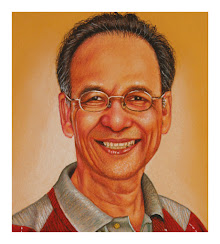
One thing that has had impressed me the most about Sherlock Holmes is his uncanny power of observation, especially after having encountered the classic, The Hounds of Baskerville, for the first time back in the days when I was a secondary school student.
Saturday, October 15, 2022
Thursday, April 3, 2014
THE POWER OF OBSERVATION
After a good meal and a bottle of wine, they lay down for the night and were soon fast asleep.
Some hours later, Holmes woke up and nudged his faithful friend, "Watson, look up and tell me what you see."
Watson replied, "I see millions and millions of stars."
Holmes asked, "What does that tell you?"
Watson pondered for a minute. "Astronomically, it tells me that there are millions of galaxies and potentially billions of planets. Astrologically, I observe that Saturn is in Leo. Horologically, I deduce that the time is approximately a quarter past three. Theologically, I can see that God is all-powerful and that we are small and insignificant. Meteorologically, I suspect that we will have a beautiful day tomorrow. Why, what does it tell you?"
Holmes was silent for a minute, then spoke. "Watson, you idiot. Some jerk has stolen our tent."
Wednesday, April 2, 2014
THE POWER OF OBSERVATION
A man is crossing the border on his bicycle. He has two big bags on his shoulders.
The guard asks, "What's in the bags?"
He replies, "Sand."
The guard says, "Get them off -- we'll examine them."The man takes the two bags off and empties them out. The guard looks through them, finding nothing but sand. The man puts the sand back in the bags, puts the bags back on his shoulders, and proceeds to cross the border on his bicycle.
Two weeks later, same thing. "What have you got there?"
"Sand."
"Get them off, we'll examine them."Every two weeks for six months this went on with the same result.
Finally one week the man didn't show up and the guard ran into him downtown.
He said, "Buddy, you got us crazy. We knew you were smuggling something. But we just couldn't figure out what. I absolutely promise not to say anything, but what were you smuggling anyway?"
Smiling, the smuggler answered, "Bicycles."
The moral of this anecdote: If what you see is what you get, be sure you are looking at it very carefully!
LEARNING TO BE OBSERVANT
He took out a jar of yellow-colored liquid.
"This", he explained, "is urine. To be a doctor, you have to be observant to color, smell, sight, and taste."
After saying this, he dipped his finger into the jar and put it into his mouth. His class watched on in amazement, most, in disgust.
But being the good students that they were, the jar was passed, and one by one, they dipped one finger into the jar and then put it into their mouth.
After the last student was done, the lecturer shook his head.
"If any of you had been observant, you would have noticed that I put my second finger into the jar and my third finger into my mouth."
Wednesday, March 21, 2012
WHAT CAN WE LEARN FROM A SCOUT-SNIPER?
In fact, I had watched it again a few weeks ago.
The exciting story centred on how a retired US Marine scout-sniper, Bob (played by Mark Wahlberg) was hook-winked and double-crossed by a high-powered rogue group led by an enigmatic Colonel Johnson (played by Danny Glover), in collusion with a mysterious senator in deep cover within the US government establishment, to take on a seemingly patriotic assignment, with the objective of flushing out a known assassination attempt on the US President.
At the end, he escaped and eventually tracked down and neutralised all the bad guys, with the unlikely aid of a disgraced FBI agent, Nick (played by Michael Pena).
Naturally, as in most Hollywood movie productions, a beautiful woman also got dragged into the web of intrigue, serving unfortunately more as eye candy.
Several years ago, I had also watched the thriller movie on cable television in Singapore, 'Sniper', followed by its two subsequent sequels, 'Sniper 2' and 'Sniper 3'. Tom Berenger had played the US Marine sniper veteran featured in all the three movies.
Well, for me, I always hold the view that reel life reflects real life, and vice versa. That's why whenever I sit down to watch a movie, I always make it a point to mine and extract my learning experience from the movie beyond the entertainment perspective.
I have read that real-world snipers actually work in team of two, as depicted in the movie, 'Shooter'.
What actually fascinates most is the skills repertoire of the scout-sniper, which comprises:
- the mental skills, especially the ability to think ahead (I call it "anticipatory prowess", as depicted by Bob in the movie), and to look at the situation critically;
- the patience to wait for the perfect opportunity to fire upon a selected target;
- the ability to "neutralise" environmental distractions; and, more importantly,;
- the ability to manage the countless mathematical variables in the head, about wind speed, wind direction, range, target movement, mirage, light source, barometric pressure, temperature and even the earth's rotation (that's why he works with a spotter in a sniper team);
- the physical discipline and survival skills;
- the observation, reconnaissance and surveillance skills, especially the ability to catch the slightest "unnatural disturbances" in the environment around them;
- the camouflage skills, to avoid detection and staying alive;
- the stalking and infiltration skills, including stealth adeptness as well as the ability to adapt and improvise with whatever resources at hand;
on top of the clever marksmanship with tactical weapons and a precise understanding of ballistics.
Interestingly, I read that marksmanship accounts for only 10% to 20% of their overall skills repertoire.
The skill and the power of observation are rated very highly.
While digging through the net for information on scout-sniper training, I found the following interesting games as part of their observational skills training, known as the KIMS game:
It goes something like this.
A number of different objects are placed randomly on the table: a bullet, a paper clip, a bottle top, a pen, a piece of paper with something written on it.
They may be 10 to 20 items.
Trainees are given a minute or so to look at everything on the table.
Then, they have to go back to their desks & describe what they saw.
They are not allowed to say "paper clip" or "bullet".
They have to say, like, "silver, metal wire, bent in two oval shapes."
In other words, the training requires you to observe the objects more closely or critically.
The foregoing game is repeated with more objects to look at and with less time to look at them.
To add to the challenge, the time between seeing the objects and describing what is seen gets longer as the scout-sniper training goes on.
By the end, they may see 25 objects in the morning, train whole day, and then at night be asked to write down descriptions of all the things they saw in the morning.
Another observation skills training happens in the field with a sniper scope.
What they are required to do is to scope out random but hidden objects in a field.
For me, this intense observational practice is intriguing.
Now, I can understand how all these observation training manoeuvres eventually help the scout-sniper to function superbly with stalking, infiltration, and reconnaissance manoeuvres in the field under dicey circumstances.
I reckon the same acute observational skills of a scout-sniper can also readily apply in the skills repertoire of today's business professional, except for the "one-shot, one-kill" score.
To be able to spot opportunities, a business professional today must exercise active and intense observational skills in novel situations as well as in ordinary encounters, besides a substantial dosage of personal creativity and a broad network of contacts.
Tuesday, August 3, 2010
SUCCESS CELEBRATION WITH THE GURU: DR BETTY EDWARDS

In August 1996, Dilip Mukerjea flew to the United States to spend five gruelling days - he had to constantly battle with & work relentlessly to outbeat his rational, logically driven left brain [like me, Dilip had been trained as an engineer] - in order to go back to the basics of "learning to draw & drawing to learn".
The counterpoint to his focused pursuit in the United States during that period was that, Dilip had already excelled in mind-mapping, but he wanted to expand his artistic virtuosity.
To his eventual surprise, he finally managed to conclude his hard-earned lessons successfully with the art maestro Dr Betty Edwards, with flying colours of course, as you can witness the exuberance of all the graduates, including himself, as captured in the foregoing snapshot.
[The lady in white, standing in the middle row, is Dr Betty Edwards. The moustached guy clowning around while lying on the floor is you-know-who.]
Most importantly, he realised that the practice of drawing what he sees in the environment actually heightens his own power of observation of the world at large. WOW!
By the way, Dr Betty Edwards is also author of the classic, 'Drawing on the Right Side of the Brain'.
Dilip has in fact dedicated an entire section, entitled 'Learning to Draw, Drawing to Learn' (page 309 to 322), on what he had absorbed from her in his wonderful book, 'Surfing the Intellect: Building Intellectual Capital for a Knowledge Economy'.
I like to end his post with a beautiful quote from Dr Betty Edwards:
"Be clear in your mind why learning to draw well is important. Drawing enables you to see in that special, epiphanous way that artists see, no matter what style you use to express your special insight, Your goal in drawing should be to encounter the reality of experience... to see ever more clearly, ever more deeply.
True, you may sharpen your aesthetic sensibilities in ways other than drawing, such as meditation, reading, or travel. But it's my belief that for an artist these other ways are chancier and less efficient. As an artist you will be most likely to use visual means of expression, and drawing sharpens the visual senses."
[Interested readers in acquiring the skills of "Learning to Draw & Drawing to Learn": Please get in touch with Dilip Mukerjea via his email: dilipmukerjea@gmail.com.
He is fully licensed to share & facilitate Dr Betty Edwards' methodology in this part of the world.]
Thursday, November 26, 2009
THE POWER OF OBSERVATION & THE HOLOGRAPHIC BLUEPRINT
During the course of conversation, Dilip brought up a fascinating point.
He was relating a TV show he saw recently, during which a magician had interviewed - live - a woman who had earlier seen an unknown man just walked past.
When asked at the beginning, she wasn't sure about specific details of the man, but when cajoled by the magician, & at the same time putting her at ease, she was able to talk about details of the cap, the jacket, the inside T-shirt, etc., which the guy had apparently worn.
What a remarkable feat?
Actually, each & every one of us has that ability. It's innate.
Whatever person, object &/or event that falls in our field of vision is always captured by our mind, consciously as well as unconsciously.
Don't forget that we also have both a focused vision as well as peripheral vision.
Focused vision generally captures what is directly in front of us, or our eyes, so to speak.
Peripheral vision often captures what is at the corner of our eyes, even for a fleeting moment. Most scientists believe that peripheral vision is the most powerful of the two.
In fact, its vision field is comparatively much broader than the focused vision
More importantly, sensory information from the environment flows into our peripheral vision unconsciously. In other words, without realising the entire experience.
When the two vision fields are synergisticaly "combined", so to speak, you can imagine our latent power of observation.
When you scan a horizon, say in a broad sweep, you are actually using both inherent vision skills.
In reality, when we look at the horizon of our immediate environment, we are not depending on our eyes alone. We also use our ears, our sense of smell, our sense of feeling about what's around us, about the ambience, etc.
All these sensory data are somehow processed, synthesised & integrated in our mind.
The end result is what I often like to call, drawing intellectual cues from Dr Karl Pribram, Professor Emeritus of Stanford University, a "holographic blueprint" of our sense impressions, which is created by the "interference patterns" of prevailing sights, sound, smells, feelings, etc.
It is pertinent for me to point out that the "holographic blueprint" is not really a tangible thing per se.
Neurologically, it's actually a resulting networking pattern of neurons & brain cells firing in harmony during the process of assimilation of incoming data.
The blueprint may generally be fuzzy, but it's there. Always. So, once we are in a resourceful state of mind, we can often recall the blueprint with ease.
We are know that kids are truly adept in using their power of observation, so much so that we often think that only kids have that acute sensory acumen.
Don't forget, we were kids before. It is just that, as adults, our logical sensor invariably often like to take primary control.
One way to practise this power of observation is to "gaze" at our environment, & try not to "stare" at one particular point or aspect.
This is also called "soft focus".
Innovation strategist Wayne Burkan calls it "splatter vision", which I had already talked about it at length in this weblog.
What can we use it for?
One area of immediate application is reading.
With "soft focus", we are able to look at a larger area of the book pages, thus giving us the ability to pinpoint the topic sentences or key ideas rather quickly, & also learn to identify text organisational patterns, signal words, as well as contextual clues to difficult words in the text.
Once we have gotten the global overview of what we have read initially, so to speak, it becomes much more easier for us to narrow down the requisite passages to read more slowly with focused attention, in order to meet our reading objectives.
[to be continued in the Next Post.]
Thursday, October 15, 2009
A SIMPLE EXERCISE IN DEVELOPING YOUR POWER OF OBSERVATION
Reality is partly what you see and partly what you make it to be. Curiosity impels imagination towards eventual analysis.
Look around you and select an object. It could be a table, glass, chair, shoe, or pepper mill as I have selected in the example below.
Observe the object carefully and filter what you see through these five categories: origin, materials, history, use, and future (possibilities).
With practice, you will soon appreciate that there is a story to every object. It may seem mundane at first, but keep enquiring, and you will find that the object becomes fascinating.
These categories are by no means finite; they guide your observations, which in turn, stimulate you to find new categories in which to channel what you perceive.
[Excerpted from the 'SuperBrain Study Skills' seminar participant's manual. The 'SuperBrain Study Skills' seminar is conducted by Dilip Mukerjea in the schools.]
Sunday, April 26, 2009
WHAT DO YOU CHOOSE TO SEE? WHERE DO YOU DIRECT YOUR ATTENTION?
Tip: Relax. Do not be judgmental. Just look at the square with “soft focus” and let your imagination drift into the surreal imagery of the scene. The answers will soon become obvious.

The mind is easily able to fabricate anything out of anything, whether conceptually or perceptually. When something is set before it, the mind responds to the creative potential of unconscious imagery, often with electrifying brilliance.
Leonardo da Vinci (1452–1519), “universal man,” and arguably the greatest genius of all time, hit upon the potential for creative magic when he stated:
“When you look at a wall spotted with stains, or with a mixture of stones, if you have to devise some scene, you may discover a resemblance to various landscapes, beautified with mountains, rivers, rocks, trees, plains, wide valleys, and hills in various arrangement; or again you may see battles and figures in action; or strange faces and costumes, and an endless variety of objects, which you could reduce to complete and well-drawn forms.”
~ Patrice Boussel;
Leonardo’s ideas equate somewhat with the modern-day Rorschach test, and provide a method for tapping into and exploiting the subconscious for creative accomplishments.
Leonardo often signed himself “disciple of experience” and acquired “experience” via the formidable use of his senses. His astonishing powers of observation led him to uncover many of nature’s secrets.
In “knowing how to see,” which he called sapere vedere, he understood and related to whatever it was that happened to be the object of his scrutiny. He believed that the only way to learn something by heart was by first learning how to draw it accurately.
Subconscious creative processes are propagated by starting with unformed stimuli. These could be random shapes on any surface, features on a person’s face, cloud shapes, wall spots, or patterns cast by shadows.
One simple way of seeing such fuzzy imagery is by squinting your eyes at things. The obvious then becomes ambiguous and permits your mind to drift into making new connections.
Now look at the adjoining page and see what I have seen for the exercise that has been set for you. What you see may or may not be different. Know only that images do exist and that there is no limit to them.
Important points to consider are:
• The images perceived need not always be complete. Ideas come ready to refine, not ready to use.
• The main benefit of this device is to expose your senses to the “trigger effect” of seeing images on a surface that is otherwise perceived as simply an uneven expanse of rockscape.
• Creativity is the new combination of existing elements. Look for what exists, then mix and match as you desire. Finally, convert your perception into reality.
Squint your eyes at the text on this page and see what you can make of it. Shapes are created not just by the text but also by the spaces between the text. I see an entire wonderland of life teeming with activity. What do you see?
Now look at the marketspace: innovation happens at the fuzzy edges, then becomes the core.
The fuzzy edge is where the action is - in terms of growth, innovation and value creation. Master the edge, and you become the puppetmaster!
Four Realms of Human Behaviour That Determine Our Creative Outcomes:
· Social: the dynamic, complex relationships where we establish our individual identities and the forms of social interaction we engage in to shape these identities.
· Enterprise: the ways in which we organize ourselves in order to create economic value and how we construct, and de-construct, the boundaries of these economic entities.
· Market: how we compete and collaborate on local and global scales to create, capture, and deliver economic value.
· Learning: how we learn, applied to what we need to learn, in terms of individual, as well as group, learning.
These four realms overlap and interact with one another. The biggest opportunities will emerge from the interplay at the edges of these realms where tensions will surface and need to be resolved.
[Excerpted from the 'Catalysing Creativity' edition of The Braindancer Series of bookazines by Dilip Mukerjea. All the images in this post are the intellectual property of Dilip Mukerjea.]
Say Keng's personal comments:
What Dilip Mukerjea has touched on in the foregoing essay is, to me, one of the most profo
und as well as most potent aspect of the creative process I have ever learned: enhancing perceptual sensivitiy.
It is the same point which the Renaissance genius Leonardo da vinci had put forward more than five centuries ago. He said:
"All our knowledge has its origins in our perceptions."
Likewise, creativity guru Edward de bono had argued about the perceptual aspect of thinking when he coined 'Lateral Thinking' in the late sixties. In fact, he once said:
"Everyone is surrounded by opportunities. But they only exist once they have been seen. And they will only be seen if they are looked for."
Other creativity experts like James Adams, Michael Michalko & Roger von oech, to name a few, have also done their individual part to drive home the same point in their respective great works.
Interestingly, even marketing & business innovation strategists have the same beliefs:
"You are surrounded by simple, obvious solutions that can dramatically increase your income, power, influence & success. The problem is, you just don't see them."
~ Jay Abraham, author of 'Getting Everything You Can Out of All You've Got';
"Successful opportunities for innovation & growth are right here, in front of us, & we often can't see them or don't act on them."
~ Erich Joachimsthaler, author of 'Hidden in Plain Sight: How to Find & Execute Your Company's Next Big Growth Strategy';
Most importantly, modern neuroscience research has also in fact substantiated this point, as argued brilliantly by Gregory Berns in his recent wonderful book, 'Iconoclast: A Nueroscientist Reveals How to Think Differently'. Please read my book review in the 'Optimum Performance Technologies' weblog. Here's the link to it.
I like to leave the following apt quote from internationally acclaimed peak performance & success coach Anthony Robbins as food for thought:
"The difference between those who succeed & those who fail isn't what they have - it's what they choose to see & do with their resources & experiences of life."