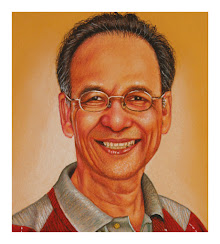
FROM DILIP MUKERJEA

"Genius is in-born, may it never be still-born."

"Oysters, irritated by grains of sand, give birth to pearls. Brains, irritated by curiosity, give birth to ideas."

"Brainpower is the bridge to the future; it is what transports you from wishful thinking to willful doing."

"Unless you keep learning & growing, the status quo has no status."
Showing posts with label Reading Beyond the Page. Show all posts

Thursday, July 29, 2010

DEVELOPING A REFLECTIVE RESPONSE WHEN READING...

This is essentially a continuation of my earlier post.


LESSON PLAN #2: ONCE UPON A TIME… [Page 9 of 'BRAINCHILDREN']

Please note that all the questions that follow are not arranged in any particular order. They are specifically designed to spur your kid’s learning safari.

Exploration - or rather,braindancing, to paraphrase the author, Dilip Mukerjea - is the key to it.

1. Do you know why most stories often start with ‘Once upon a Time’?

2. Have you ever been close-up or seen a real beaver? A real mouse-deer? How much do you know about each of the animals?

3. In local Malay (also, Indonesian) folklore, a mouse-deer, which is found abundantly in our part of the world, is referred to as a pelandok or kancil”. It is often depicted as a “cunning, nimble, & intelligent” animal.

What stories have you heard about the mouse-deer in this respect?

4. In Malaysia, an image of the mouse-deer is used as part of the state emblem.

Do you know which state is that & do you know why?

5. Do a paper exercise on ‘Compare & Contrast’ between a beaver & a mouse-deer. You are welcome to use a graphic organiser, e.g. Venn Diagram.

6. How about doing another paper exercise on ‘Compare & Contrast’, this time with ‘Humans vs Animals’?

7. What is a dam? Have you been to a real dam? If affirmative, how about sharing some of your observations?

8. Do you know what or where is the world’s largest dam?

9. Are you aware that the building of a dam always changes the landscape ecology of the entire place, negatively as well as positively? What are your personal thoughts or feelings on this issue?

10. In what ways, maybe in small ways, are you personally contributing to the earth ecology?

11. How much do you know about the human brain?

12. Oftentimes, ‘brain’ & ‘mind’ are used interchangeably.

Do you think there is a distinct difference between the two, or do you just agree with the “interchangeability”?

13. According to the story, 'CHILDREN' are apparently the ones with the 'GREATEST EVER BRAINS'?

Do you agree or disagree? Why? You are welcome to share some anecdotes to substantiate your stand.

14. Having read the story, what connections do you see in the relationships of each animal to the dam?

15. Are there any questions in your mind as you think about the story?

16. What are the key lessons you can draw from reading the story?

17. In your own words, explain the meaning of the following words:

a) Brilliance;
b) Beauty;
c) Bedazzling;


Then, construct a sentence with each word.

18. How about crafting a simple story using all the foregoing three words in it?

19. What other words can you think of, say as a possible synonym (similar word), to each of the words? How about possible antonym (opposite word), if any?

20. From the story, you have learned that “ideas are just stuff made out of brilliance, beauty, and bedazzling brains!”

Elaborate on this statement. Can you share some useful examples from your personal experience?

21. When reading a textbook, you are supposed to pull out “key ideas” out of it to demonstrate your comprehension.

How do you do it? Share your personal strategy, if any.

22. You may have heard of the expression, “Ideas are worth a dime a dozen”.

What does that mean to you?

23. In the context of “humans”, how does one develop or enhance “personal brilliance”?

24. “Beauty is in the eyes of the beholder.”

What does it mean to you?

25. Describe a personal experience where you have been “bedazzled”.

26. Does your mother own a diamond ring? If affirmative, discuss with her about the concept of “brilliance” when selecting a diamond ring, & then share the outcome of your discussion.

27. What other good animal stories have you heard or do you know of? Share your stories by giving a gist of each.

28. If you were the author, what other animals &/or objects would you have used to illustrate the theme of the story?

29. How can you relate what you have learned from this story to your school work, especially from the standpoint of productivity & improvement?

Draw up an action schedule for implementing your ideas, if possible.

30. Is there any other new stuff you like to learn or know about based on what you have just learned?

Enumerate your wishes, say, in the form of a mind-map.

31. In today’s economic era, known as the Learning Economy, “ideas” are the driving forces.

Do you agree? What great ideas do you have that you strongly believe could really change the world?


By the way, the graphic illustration at the top of this blogpost, showing the beaver & the mouse-deer talking about the dam, exemplifies the powerful philosophy of "ideas build on ideas" as well as the robust concept of biomimicry.

Wednesday, July 28, 2010

DEVELOPING A REFLECTIVE RESPONSE WHEN READING...

I am just taking the opportunity to develop my own initial as well as reflective responses to Dilip Mukerjea's forthcoming masterpiece, 'BrainChildren', which is one of his 'Learning Skills Trilogy'.


At the moment, Dilip is putting his final finishing touches to the book, which is expected to be released shortly.

Hopefully, my brainwork will serve as the beginning of a possible study guide (&/or a curriculum guide) for parents & teachers in using the book with their kids & teens &/or students.

Here's a preliminary list of my initial & reflective responses to only one particular page, i.e. page 8.

For simplicity, I call it Lesson Plan #1.


LESSON PLAN #1 [Page 8 of ‘BRAINCHILDREN’]

1. Read the statement again:

“No problem outside you can ever be as strong as what you have inside you! Nothing can defeat you because you are a learning champion.”

What does it really mean to you? Explain in your own words.

2. Do you feel you can rephrase the statement in (1) in much better &/or simpler terms?

Write down your restatement.

3. Is the word ‘resource’ or maybe ‘asset’ a good term to describe “what you have inside you”?

If that’s the case, what is your most important ‘resource’ or ‘asset’? Why?

4. Oftentimes, ‘No Problem’ is used as a common expression in everyday situations.

What does it mean?

5. You are probably more familiar with the term ‘sports champion’.

Can you see a connection? So, what is a learning champion? What are the personal attributes of a learning champion?

6. How do you become a learning champion? Or, how do you develop a learning champion mind-set?

7. What quickly comes to your mind when you read the phrase ‘Cat’s Wisdom’?

8. Does ‘Cat’s Wisdom’ trigger a connection to ‘Mother Nature’?

If affirmative, can you share by outlining your thoughts?

9. Read the statement again:

“Make the world your playground”.

Can you relate it in some ways to your personal experience? Explain or clarify.

10. “Think fresh. Offer views that are uniquely your own while staying open to those of others.”

Explain what it means you, with some examples from your personal experience.

11. Sometimes, the statement in (10) seems easier said than done.

What do you think?

12. ‘Think Fresh’ & ‘Think Original’:

Is there a difference, or are they the same? What about ‘Think Afresh’?

13. How about ‘Think Smart' ? Please give your personal views.

14. How about ‘Think Outside the Box’? Please give your personal views.

15. Think about the statement:

“Be independent.”

Are you an ‘independent’ person? How do you measure or qualify ‘independence’?

16. Read the statement again:

“When in trouble, just purr & look cute.”

Do you feel it will really work? What do you think? What alternatives do you have?

17. In the text, four examples of ‘Cat’s Wisdom’ had been given.

Do you know of any other good examples?

Please don’t hesitate to do some research on your own.

18. Given a choice, what other animal would you use, instead of a cat, to share its wisdom? Why?

19. Can you sum up all the key lessons you have learned from this particular page of the book?

20. What would you have done differently on this particular page of the book if you were the author?

21. How can you relate what you have learned from this text to your school work, especially from the standpoint of productivity & improvement?

Draw up an action schedule for implementing your ideas, if possible.

22. Is there any other new stuff you like to learn or know about based on what you have just learned?

Enumerate your wishes, say, in the form of a mind-map.

Frankly, it is also my intention for readers to study & then use the foregoing exercise to develop your own initial as well as reflective responses.

Give it a go! Stimulate your perspectives!

Strategically speaking, developing reflective responses when reading as I have illustrated allows one to attain a deeper understanding of a subject or a set of related subjects.

I call it 'Reading Outside the Lines'. Dilip calls it, 'Reading Beyond the Page'.

Nonetheless, it is a simplistic form & an integral part of what we both like to call a 'Learning Safari'.