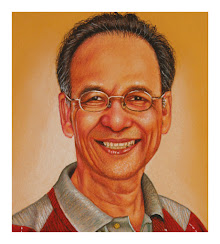
FROM DILIP MUKERJEA

"Genius is in-born, may it never be still-born."

"Oysters, irritated by grains of sand, give birth to pearls. Brains, irritated by curiosity, give birth to ideas."

"Brainpower is the bridge to the future; it is what transports you from wishful thinking to willful doing."

"Unless you keep learning & growing, the status quo has no status."
Showing posts with label Karl Pribram. Show all posts

Wednesday, November 9, 2022

JUST SHARING A PERSONAL MUSING ON STRATEGY FORMULATION:

"Strategy, at its heart, is always about positioning for future competitive advantage."
I can't recall who had said this or defined it as such.
Nevertheless, I have found it to be a valid statement.
Moreover, I know one thing for sure: 'Strategy' implies "thinking strategically about the future".
Let's see whether I can dissect it and explore where it will lead me to.
Strategy:
In military jargon, this is "generalship" or science of planning, directing and maneuvering large scale military forces into the most advantageous position, prior to actual engagement with enemy forces.
For me, it's actually a "mental model" for thinking about what I want to do in the future.
Dr Karl Pribram, of Stanford University, calls it an "image of achievement". Dr David Ingvar of Lund University in Sweden terms it as "memory of the future".

These findings from the two eminent brain scientists imply that man has the innate ability to "see" the future.
I strongly believe that whatever I think and do always happens thrice:
- first, as an "idea" or "concept" inside my head - psychologists call it "mental construct";
- secondly, as a plan when I write it down so that I can crystallise my thoughts about the "idea";

- thirdly & finally, as a physical reality when I put my "idea" to work according to the plan in the real world;
That's why it's always important to formulate a strategy in life.
For lay persons, it's "goal setting". For corporations, it's "strategic visioning".
Come to think of it, I reckon 'daydreaming', particularly in the case of kids, is also a form of strategy formulation, even though they don't actually understand it.

Surprisingly, adults do that too, even though they don't realise its power.
I also believe very strongly that everything is possible in life; it's just a question of strategy and dsicipline.
To formulate a strategy, I know these are the first things first:
- what do I want?
- where am I?
- where do I want to go?
Positioning:
For me, there are two important issues here.
First, there is this issue of currency: what do I have or possess at the moment?
To understand it, I need to do an internal audit of myself. A SWOT, to be more precise. A SWOT will generally provide me with information about what I would need as additional resources or support.
Next, there is the issue of relativity - a position relative to the confluence of various external forces acting on me as well as other people in &/or around my space, in one way or another.
A good way to look at external forces is to use the acronym TEMPLES to determine exactly what can affect or impact my strategy:
- technology;
- economics;
- money;
- political;
- legal aspects;
- ethical & ecological aspects;
- social-demographics;
To look at people in and/or around my space that have the greatest impact, strategy-wise, the best way is first, determine my particular role in each instance as I interact with them.
There is also the issue of perception in the eyes (and the mind) of people around me. This one is a little bit more complicated.
Future:
For me, this is a "time frame" or "scenario" some time - near or distant - ahead. It generally denotes an "unknown territory" - a place where I have not been before. I recall the tag line from the Star Trek TV series: "... to go where no man has gone before."
It's always important to think about the future. There is nothing much I can do about my past, although I can learn quite a lot from it. There is, nevertheless, a lot of stuff I can do in the present. This where my strategy - and plan of action - can come in.
Naturally, I would need insight about myself, my personal aspirations, my SWOT i.e. all the inputs from my understanding of 'Positioning'.
I also need some hindsight about what works well before, what resources I have, as well as foresight about what's out there, what's possible. Also, what-ifs, why nots. I also need a better view of the situation (BVS).
To have a better future, it's always important to explore it, think about it, plan for it and then put the plan to work, right now. In other words, I have to invent it.
Having a future scenario set in my mind, I reckon it's much easier for me to anticipate a lot of stuff that goes with it.
If I don't do that, some one else will do it for me, and I may not like it at all.
A "future" can also be the "edge" of my personal comfort zone.

According to Judith Barker, there is always danger in the comfort zone.
Sometimes, I need to push myself to the edge i.e. to stretch myself - to enter the stretch zone, so to speak.
Opportunities - more specifically, possibilities to grow, to learn, etc. - are abundant in the stretch zone.
Competitive:
This term naturally has some negative connotations.
For me, the best way to look at it is to always consider doing things better than what I have done before, instead of comparing myself with others.
It also means I should always leverage on what I know and what I have.

A lot of personal creativity is needed here, too.
I think it was Billy Joel, a famous singer, who said something like this:

"We don't have to be better than anybody; we just have to be the only one doing what we do."
Therefore, I must constantly strive to build on my existing competency. Life-long learning, especially learning new things, is one.
By the way, what are the personal as well professional competencies for the 21st century?
Advantage:
For me, this is, in essence, creating distinctions so that I am visibly different from the others.
Advantage can also mean "one step ahead of the competition".

It is important to take note that the competition does not sleep.
Stretching it further, advantage can also denote "putting myself on the toes" all the time. Be prepared - for oportunities as well as contingencies.

Continual improvement, too!
In fact, if I practise strategic thinking - with active and fluid use - all the time, I reckon I can sustain my competitive advantage in the long run.
I think it's also important to practise strategic foresight or future-casting.
That's all, folks!

Monday, September 19, 2022

"... your vision should be much bigger than what you can actually see.
What you envision is what you get.
Look beyond your eyes to see the possibilities!
What is your vision?"
~ Lee J Colan, founder of the L Group, a consulting firm that equips and inspires leaders at every level;
This observation has scientific basis.
Back in the late 80's or so, brilliant neuro-scientist Dr Karl Pribram of Stanford University had called this, "image of achievement", which subsequently inspired the vision modeling methodology in Sybervision Systems.
In the 90's, author-filmmaker-futurist Joel Arthur Barker had documented this phenomenon in his powerful training video, "Power of Vision", with great examples drawn from educator Benjamin Singer, sociologist Fred Pollack, psychiatrist Viktor Frankl, and consultant Jim Collins.

[In the snapshot, Lee J Colan is standing on the right, with legendary football coach Bobby Bowden on the left.] 

Wednesday, August 31, 2022

Think about it!

The image of achievement in your headspace is real, especially when you vividly imagine it, ardently desire it, and sincerely believe it, with all your sensory impressions.
When you euthusiastically act upon it, it must inevitably come to pass.
To sports psychologists and competitive sportsmen, this is the essence of creative visualisation and mental rehearsal.
This is based on the research work of neuroscientist Dr. Karl Pribram of Stanford University.

Monday, November 22, 2010

CHAMPIONING STUDENTS: CULTIVATING VIVID TIME HORIZONS VIA PROPRIETARY 'LIFESCAPING' METHODOLOGY

[continuation from the Last Post ~ in connection with the recent launch of a series of new programs intended for parents as well as their school-going kids/teens, under the auspices of 'The House of Creative Brains'.]


This is my favourite topic, also my strategic forte ~ vision-building.

My real-world experiential understanding of vision-building came from a memorable, though painful, personal encounter from my former "big boss" ~ the late Tan Sri [that's the Malaysian equivalent of "Sir"] Eric Chia, Chairman & CEO of the United Motor Works (UMW) Group during the early eighties, when I had joined them as a manager.

[Readers are welcome to pop into my 'Optimum Performance Technologies' weblog to read about that encounter.]

My working knowledge was subsequently expanded & fine-tuned when I came across the splendid work of futurist/film-maker/author Joel Arthur Barker during the early nineties, especially his acclaimed 'Power of Vision' video-based training program.

As a matter of fact, one of Barker's wise axioms often reverberates in my head, whenever I talk about vision building:

"Vision without action, is but a dream; action without vision just passes the time; vision with action can change the world."

Nonetheless, the latter then led me to the scholarly works of Canadian educational psychologist Dr Benjamin Singer, Dutch futurist & sociologist Dr Fred Polak, & Holocaust survivor & Austrian psychiatrist Dr Victor Frankl, who wrote his magnum opus, 'Man's Search for Meaning', as well as the research work of strategy consultants Jim Collins & Jerry Porras.

Collectively, they drove home the vital point about the power of vision-building:

Nations, organisations, individuals as well as students with vision are powerfully enabled. Those without vision are at risk.

Just as King Solomon had once said, as reported in the Bible of the Old Testament: "Where there is no vision, the people perish."

In the case of students, Dr Benjamin Singer made these startling revelations, back in the sixties:

i) children with vision out-performed their assets;

ii) successful students had one thing in common: a profound belief in their future & their ability in their own efforts to shape it.

Likewise, based on the pioneering research work of Jim Collins & Jerry Porras, visionary organisations out-performed their assets, too.

As a nation, Singapore is a great example! Thanks to the compelling vision - & the strategic foresight - of MM Lee Kuan Yew & his colleagues as well as ministerial stalwarts, Goh Keng Swee, S Rajaratnam, Toh Chin Chye, Eddie Barker, etc., just to name a few of them.

By the way, what is "vision"?

A vision is just a simple idea or mental picture you have in your head about where you want to be in the future.

A clear vision helps one to pursue dreams & achieve goals.

A well-defined vision helps one to focus on the end-state of who you want to be, what you want to have &/or do, & where you want to go.

Generally, it can be applied in two different ways:

1) Inspiration ~ to inspire youself to follow your bliss & pursue your dreams;

2) Anticipation ~ to foresee the changes & improvements you want to have in the future;

When you can envision a future that is better, happier & more productive, you are more likely to make the necessary changes & improvements for yourself to attain that end-state in the future.

To Dr Karl Pribram of Stanford University, who works with sports champions, vision is akin to his "image of achievement".

By the way, what the difference between "vision building" & "goal setting"?

Operationally, they are complementary. A quick one... This is how I look at them:

- vision gives purpose & meaning; goals give direction & power;

- vision comes from the heart; goals come from the head;


At this juncture, I like to share an inspiring quote, to sum up "vision building" & "goal setting":

"If you have a vision and you find that someone doesn't share that vision, you either change the vision or change the people you share it with. We learn and grow one goal at a time. But to set meaningful goals, we need imaginative insight or vision."

~ Dr. Roberta Bondar, the world’s first astronaut-neurologist in space (with Discovery mission, 1992); also, globally recognized for her pioneering contribution to space medicine;

In essence, vision-building is a relatively easy endeavour, if you know how to go about it.

In fact, Dilip will share valuable lessons from the corporate world as well as educational arenas, besides coaching you on how to look at your own life strategically in long-range time-horizons, & also, how to do your own 'lifescape' using his proprietary 'lifescaping' methodology.

[to be continued in the Next Post.]

[For more information about the series of new programs under 'The House of Creative Brains', please get in touch with Ms. Faye Yeoh via her email faye_yeoh@yahoo.com]