
We are constantly solicited by visual images. But in looking, what do we really see?
This is one of the fundamental areas in learning how to draw and we thus should know how important it is to recognise the link between seeing and creativity.
Research conducted by
Dr Betty Edwards has highlighted the vital need to equate vision with the brain. She addresses the issue that seeing here refers to not merely using one’s eyes, but one’s brain, which is what we really see with.
In using the
“mind’s eye” to see, we permit ourselves to open up to a wonderful world of spontaneous ideas that manifest themselves in
“Illumination,” the fourth phase of “Creativity”.The sensation of
“Illumination,” at the moment of
“Inspiration,” is defined in the dictionary as
“throwing light on a subject in order to see it better.”
Dr Edwards has identified two terms that are often used interchangeably with such Illumination: intuition and insight. Both words reveal more clues hidden within their origins.
The root of
“intuition” is intuitus, the past participle of the Latin verb intueri, to look at, and the word is defined as
“the power or faculty of attaining direct knowledge or cognition without rational thought and inference” – seeing something directly, or, in other words,
“getting the picture” without having to figure it out.
Insight is a sibling to intuition. Yet, a paradox emerges.
Insight refers directly to seeing and vision but means seeing something not necessarily visible, such as
“seeing into” something, or
“apprehending” something.
To apprehend,
“to grasp with understanding,” and discernment, a synonym of insight,
“to detect with the eyes (or with other senses),” or
“to come to know or recognize mentally,” directs us towards the nexus between seeing and understanding – in essence, grasp of meaning, a key element in creativity.
Variations of the same idea can be observed in the terms foresight, hindsight and clear-sightedness. The emphasis is subtly shifted by other phrases to differentiate specifically the kind of
“seeing” or grasp of meaning that is taking place.
Dr Edwards breaks this down into the following areas: to see in perspective, to see in proportion, to see things differently, to see through someone (or some deception), to see the light, to get things in focus.
In fact, when a person has struggled to understand something, and
“daylight breaks,” or
“the light dawns,” the most commonly heard expression is
“I see it now!”
To quote
Kimon Nicolaides,
“learning to draw is really a matter of learning to see – to see correctly – and that means a good deal more than merely looking with the eye. The sort of “seeing” I mean is an observation that utilises as many of the five senses as can reach through the eye at one time.
Although you use your eyes, you do not close up the other senses – rather, the reverse, because all the senses have a part in the sort of observation you are about to make.”
"Logical, systematic thinking is surely essential for survival in our culture, but if our culture is to survive, understanding of how the human brain moulds behaviour is our urgent need."
–
Dr Betty Edwards;

One night, during the darkest period of the revolutionary war,
George Washington gave instructions to his orderly not to be disturbed. Not wishing to rush into making a decision, Washington turned his deep problems over to the creative, intuitive part of his mind.
By his own testimony,
George Washington used that kind of insight to guide his decisions throughout his presidency. So did
Abraham Lincoln, among others.
This was considered to be such an imperative feature in the decision-making process that the founding fathers used a clever means to remind us of it on the back of the dollar bill.
There you will find an unfinished pyramid with an eye over the top of it. The symbol was not chosen at random. Its meaning is thousands of years old. The structure is not complete, whether it is the individual’s life or the nation, until the all-seeing eye is in the capstone position.
Completion is totally dependent upon this creative, intuitive part of our mind that is constantly playing a major role in guiding our decisions.
Dr Edwards’ great work in teaching
Perceptual Skills in Drawing to all ages is based on her close affinity with the creative process through the development of visual intelligence.
If insight, intuition and illumination are what the roots of the word indicate – grasp of meaning through special perception – preliminary training in perceptual skills might be an appropriate means of attaining greater understanding of the whole creative process.
It is important at this point to emphasise that
“art” and
“thinking” are very closely related to one another, as well as to
“creativity.” When one considers the very creation of life, the evolution of the human mind, the conception of thoughts, our investigation receives illumination from the mythologies of diverse cultures.
When Jupiter, the king of the Gods, and
Mnemosyne, the
Goddess of Memory, spent nine days and nights together, their union resulted in humanity being graced by the
Nine Muses – the
Goddesses of the Creative Arts.
This is the tale according to Homer, though his predecessors amongst the ancient Greeks believed that there were three Muses.
Regardless of the arithmetical computation, what emerges as fascinating is that the word
“muses” equates with
“thinkers” (Greek).
The Muses presided over the production of artistic works. This naturally led to the term
“music” which encompassed all the arts, and through its connection with “thought,” it concerned the development of the human mind – complementing
“gymnastics” where one focused on the parallel development of the human body.
Perhaps this inspired the subsequent observation in Latin: mens sana in corpore sano.
Music, the arts, imagery in its manifold manifestations, they all equate with thinking – and creativity.

In every age, drawing was based on the assumption that the true reproduction of nature was the aim of the accomplished artist, and that this formed the basis of his creative activity.
Apelles, who worked as court painter to
Alexander the Great, was the most famous painter in Antiquity.
Among the many anecdotes concerning him is one illustrating his high regard for perfect naturalism. He once engaged in a public competition with a colleague; each was to paint a picture.
Apelles’ contemporary produced a picture of grapes, which looked so real that the birds came to eat them. After due admiration of this feat the audience called on
Apelles to unveil his picture.
This he could not do, for the veil was all he has painted. Thus,
Apelles succeeded in deceiving even the human eye.
[Excerpted from
'Brain Symphony: Brain-blazing Practical Techniques in Creativity for Immediate Application', by
Dilip Mukerjea;
All the digital images in this post are the intellectual property of
Dilip Mukerjea.]
Say Keng's personal comments:
If readers have followed this weblog, you will note that I have responded quite extensively with regard to this
"seeing" phenomenon, which also happens to be a personal fascination of mine.
All I know from the experts is that, more than three-quarters of our brain (the occipital cortex & its associated areas) are dedicated to visual processing.
Also, as much as 90% of what we learn in a lifetime often come to us via visual cues.
The genius of all geniuses, Leonardo da vinci, knew about this apparently more than 500 years ago. No wonder he once said, with his astute understanding of the human brain,
"The eye is the window of the human body through which it feels its way & enjoys the beauty of the world."
Interestingly, I have always noted from my own exploration that words which we often connect to creativity, like
"perception", "perspective", "insight", "illumination", "enlightenment", "envisioning", "viewpoint or point of view", "imagination", "inspection", "spectacles", "foresight",
"hindsight",
"farsighted", share a common denominator that has a lot to do with
"seeing".After all, words don't just pop up like that; they go through evolution.
As
Dilip has rightly pointed out, even the word
"intuition" has some connections to
"seeing", at least at the metaphysical level from my perspective.
As a matter of fact, I understand that the word
"idea", which has its origins from the Greek Language, is also related to
"seeing".
Come to think of it, what about the word
"seer"?
In the larger scheme of things, as a sage advice goes,
"without a vision, the people perish".I like to leave this beautiful quote from French novelist & critic
Marcel Proust (1871–1922) as food for thought:
"The real voyage of discovery consists of not in seeking new landscapes but in having new eyes."
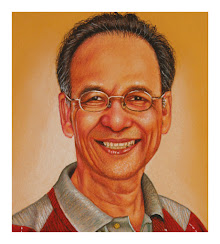
 Do you like to draw like Dilip Mukerjea, whose artistic virtuosity has always been exemplified throughout this weblog?


 Negative spaces are the areas around positive forms. It is often easier to see negative shapes (once you have become aware of their existence) than positive shapes.




 Posts
Posts


