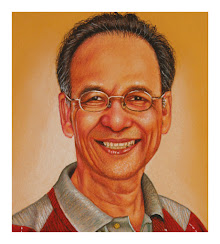
FROM DILIP MUKERJEA

"Genius is in-born, may it never be still-born."

"Oysters, irritated by grains of sand, give birth to pearls. Brains, irritated by curiosity, give birth to ideas."

"Brainpower is the bridge to the future; it is what transports you from wishful thinking to willful doing."

"Unless you keep learning & growing, the status quo has no status."
Showing posts with label PhotoReading. Show all posts

Monday, July 25, 2022

[Continue from Part II: HOW TO BECOME AN INTELLIGENT LEARNER] 

Enter the Peak Learning State

According to Paul Scheele, principal developer of the PhotoReading technology, the brain must be adequately prepared in order to study or ready efficiently.

Two mental exercises will accomplish this preparation:

a) Clearly state your purpose, and

b) Generate a resourceful state of mind;

Clearly State Your Purpose

Reading everything many times in order to achieve total comprehension would take a tremendous amount of time. It would also not be worthwhile in most cases. 

Since all reading ultimately serves some purpose, it is best to learn to set a specific purpose.

Here are a few questions which can help you establish a purpose in your reading:

i) What is my ultimate application of this material?

ii) How important to me is what I am reading, and in the long term, how worthwhile is it?

Once these questions are answered, try to narrow down your purpose:

iii) What specifically do I want or need to remember from the material: Is it “global overview” or is it small information I want?

State to yourself the purpose for reading every time you read. 

Get into this reading habit. This tends to engage the brain, to increase your concentration and sharpen your focus. It also reinforces your ability to choose when to make the power of your brain to work for you.

You will undoubtedly find yourself choosing not to read the less important materials. You can then release any sense of guilt about procrastinating or failure to read by default. Instead, you can start affirming, “I can accomplish anything I sincerely set my mind upon.”

Generate a Resourceful State of Mind

Many studies have shown that a relaxed & resourceful state of mind is crucial for efficient reading. When a person is relaxed and alert while reading, he is more likely to be faster, more fluent, and less distracted. He will be more able to comprehend, retain and recall what is read.

I would like to introduce you to ‘The Tangerine Technique’ developed specifically for PhotoReading.

Using the Tangerine technique, a reader can quickly and easily establish a relaxed state of alertness. 

An added feature of this simple technique is that it automatically directs a person’s available unit of attention. The result is an immediate improvement in reading skills.

Further studies have shown that both reading and memory require attention. A person has seven, plus or minus two, units of attention available at a conscious level. 

By fixing one’s attention on a single point, a person can effectively focus his other available units of attention to perform the task at hand.

Research also indicates that the actual location of one’s point of attention is important. For example, when driving a car, the best point of attention is down the road – not on your dashboard or the rear bumper on the car in front of you. 

For the efficient reader, the ideal point of attention is just behind and above the head.

The Tangerine technique helps locate and maintain the ideal point of attention for reading.

Basic Steps to Follow:


i) Hold an imaginary tangerine in your hand. Feel the size, shape, weight, texture, and experience the smell of the tangerine;

ii) Gently close your eyes and place the tangerine so that it delicately balances just behind and above the back of your head. Become aware of the feeling;

iii) Imagine your field of vision opening up;

iv) Open your eyes while maintaining the feeling of the tangerine resting on just behind and above the back of your head. Read;

By playing with this technique, you will navigate reading material with increased speed and fluency. Your ability to concentrate on the information improves and reading becomes more relaxing.

For the first few weeks, you will have to consciously place the tangerine just behind and above the back of your head. Soon it becomes an automatic (unconscious) process so that whenever you approach reading materials, the imaginary tangerine floats into place.

[to be continued in Part IV]


Monday, March 5, 2012

FUN, LEARNING & RELAXATION WITH RANDOM DOT STEROGRAMS (or "Magic Eye" Pictures): CAN YOU SEE THE HIDDEN IMAGE?


In retrospect, throughout the nineties when I was still running my own unique book store, aptly called 'The Brain Resource' [1992-2005], located just outside the Central Business District in Singapore, I often played with random dot stereograms, or better known to most folks as "Magic Eye" pictures, one of which [from www.garybeene.com] is shown above, since I was also retailing them in my store.

In fact, I had also used them in my creativity classes to illustrate the power of the human mind, especially its innate ability to discern a hidden image of 3D, amidst the seemingly chaotic mess of random dots organised on a black-and-white or colour picture of 2D.

The principles of random dot stereograms were first invented by Prof. B. Julesz in during the early sixties, and refined further during the late eighties by Prof. C. W. Tyler, who had made significant improvements, which in turn facilitated the many popular 3D pictures to be created around the world.

It is pertinent to note that the  technology for constructing those 3D pictures was intended beyond just fun and entertainment, as we knew them then. They could be applied in 3D modeling as in architecture, engineering, manufacturing, and even in medicine, as well as for Visual Science research, including brain behaviour research.

As an engineer by training, I was naturally intrigued by random dot stereograms. In fact, my introduction to them came actually from Patricia Danielson, co-developer of the PhotoReading methodology with Paul Scheele of Learning Strategies Corporation, and one of its international master trainers, in early 1992.

Frankly, I couldn't see them the first time, and to my chagrin, it took me several months later to be able to discern the hidden image of each random dot stereogram which came my way.  As a matter of fact, I had since then amassed a large collection of beautiful 3D posters, which are still in my personal library today.

At its primary core, a random dot stereogram is basically composed of two arrays (or frames) of randomly scattered dots, organised with the aid of computer technology.

The arrays are identical except for the fact that in certain areas, one of the arrays has been  "shifted" horizontally to create a deliberate  disparity between the two arrays.

The two arrays  are usually displayed side by side to allow the viewer to compare them visually.

When viewed "monocularly", i.e. with one eyeball functioning, the viewer is confronted with a mass of random dots, and often fails to make any correspondences across the dots.

However, when the images are "stereoscopically" fused, with both eyes functioning, correspondences across the random dots are made in one's perceptive mind, and the "shifted area" in the stereogram appears at a separate depth level from the "unshifted area", in a manner of speaking.

Because of your innate capability of stereoscopic vision of the world around you, on account of the inherent binocular disparity of your eye balls, discerning a hidden image in a random dot stereogram is a piece of cake. In a nut shell, your eye balls  can see "depth".

Unfortunately, from most of my customer encounters while running my book store during the heydays, I had found that, in general, accountants, economists, engineers like yours truly, lawyers and psychologists, often encountered tremendous displeasure of not seeing the hidden image, at the beginning, whereas most folks in the visual and performing arts had absolutely no problems at all from the beginning.

This is because of what is generally known as "brain dominance".

In simplistic terms, when we are too logically-oriented in our natural disposition, our left brain - with its preferred focus on logic, analysis, sequencial processing, and words - has the dominant tendency to exert executive control of our cognitive functions. Hence, it becomes a major obstacle in viewing random dot stereograms.

Only when we are able to tap on our right-brain, with its preferred focus on pictures, imagination, random processing, and images, the whole brain comes into play, through our densely-packed corpus collasum - that's the marvellous inter-connecting and inter-active superhighway in our brain -  to facilitate the 3D viewing.

In fact, during those heydays, I had surprisingly found that kids generally could embrace random dot stereograms more readily as well as spontaneously, as compared to adults. This could be attributed to the fact they still had that sense of wonder and sense of discovery when dealing with novelty, and had yet to be "degeniused" by the school system.

By the way, it is pertinent for me to point out that, about 10% of the population are always unable to view the random dot stereograms because of their eye defects or other medical reasons.

Having played with them for so long, I have come to know that there are usually two appropriate  ways to view random dot stereograms.

- divergent or far-eyed viewing method;

- convergent or cross-eyed viewing method;

In the first method, while looking at the random dot stereogram, you turn both your eye balls "outward" and straight-ahead, to maintain a sort of a long-distance focus, as if you are looking out of the window and gazing at the horizon. It almost like you are daydreaming.

In the second method, with your nose almost close to the random dot stereogram, you turn both your eye balls more or less "inward" to maintain a sort of a near-distance focus, with your eye balls crossed, so to speak.

In both methods, it is important for you to stay relaxed but persistent, and not to give up too soon.

It takes some time for your brain to make sense of the random dots, and after a few practice attempts, your brain will then gradually form the combined image.  Just be relaxed and curious with what you are attempting to do.

From a physiological standpoint, controlling how we use and "aim" our eye balls at the world out there together as a "team" is an important skill.

The ability to use both eyeballs as a singular functioning pair, is what allows our brain to fuse the two separate "pictures" coming in from each eye ball into a single combined image. These innate abilities are the essence of binocularity disparity and stereoscopic vision.

By the way, random dot stereograms can also provide an entertaining way to relax the eye balls, especially after you have spent inordinate amount of time glued to the computer screen.

It is refreshing to note that random dot stereograms are still available today in some Singapore book and/or stationery stores, especially in the form of post-cards and pocket-books.

Here is a quick sampling of random dot stereograms excerpted [from the gallery of www.eyecanlearn.com] for your lesiure viewing:


Readers who are hungry for more random dot stereograms to play with are welcome to explore the following interesting links on the net:

www.3dstereograms.com

www.colorstereo.com

www.eyetricks.com

www.magiceye.com

[Notes: The hidden images in the foregoing stereograms are: a skull; two fishes; a dinosaur, and three dolphins.]

Monday, November 30, 2009

SYNVERGENT THINKING: Mind-Mapping, PhotoReading & Syntopicon Method


The foregoing hand-drawn mind-map by Dilip Mukerjea captures his major learning points from the 4-day 'PhotoReading' workshop, which he had attended during the mid-nineties. I was then the workshop organiser, under 'Optimum Performance Technologies'.

The hand-drawn mind-map as appended below, also by Dilip, captures his major thoughts from the syntopical reading of five books, as part of the application of 'PhotoReading' strategies.

For more information about the syntopicon method, as originally conceived by Mortimer Adler's in his classic, 'How to Read a Book', please refer to my earlier post entitled 'How to Become an Expert'.


[The term 'Synvergent Thinking' was originally coined by creativity expert Michael Gelb, as explained in his book, 'Thinking for a Change: Discovering the Power to Create, Communicate & Lead'. I have used it deliberately to describe the synergistic combination of disparate processes.

For more information about the 'PhotoReading' workshop in Singapore, please contact Ms Jean Giam of Xssion Training & Consultancy, at 65361612 (O)/96850020 (HP), or check out her corporate website.]