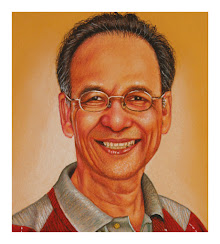
FROM DILIP MUKERJEA

"Genius is in-born, may it never be still-born."

"Oysters, irritated by grains of sand, give birth to pearls. Brains, irritated by curiosity, give birth to ideas."

"Brainpower is the bridge to the future; it is what transports you from wishful thinking to willful doing."

"Unless you keep learning & growing, the status quo has no status."
Showing posts with label Strategic Thinking. Show all posts

Wednesday, November 9, 2022

JUST SHARING A PERSONAL MUSING ON STRATEGY FORMULATION:

"Strategy, at its heart, is always about positioning for future competitive advantage."
I can't recall who had said this or defined it as such.
Nevertheless, I have found it to be a valid statement.
Moreover, I know one thing for sure: 'Strategy' implies "thinking strategically about the future".
Let's see whether I can dissect it and explore where it will lead me to.
Strategy:
In military jargon, this is "generalship" or science of planning, directing and maneuvering large scale military forces into the most advantageous position, prior to actual engagement with enemy forces.
For me, it's actually a "mental model" for thinking about what I want to do in the future.
Dr Karl Pribram, of Stanford University, calls it an "image of achievement". Dr David Ingvar of Lund University in Sweden terms it as "memory of the future".

These findings from the two eminent brain scientists imply that man has the innate ability to "see" the future.
I strongly believe that whatever I think and do always happens thrice:
- first, as an "idea" or "concept" inside my head - psychologists call it "mental construct";
- secondly, as a plan when I write it down so that I can crystallise my thoughts about the "idea";

- thirdly & finally, as a physical reality when I put my "idea" to work according to the plan in the real world;
That's why it's always important to formulate a strategy in life.
For lay persons, it's "goal setting". For corporations, it's "strategic visioning".
Come to think of it, I reckon 'daydreaming', particularly in the case of kids, is also a form of strategy formulation, even though they don't actually understand it.

Surprisingly, adults do that too, even though they don't realise its power.
I also believe very strongly that everything is possible in life; it's just a question of strategy and dsicipline.
To formulate a strategy, I know these are the first things first:
- what do I want?
- where am I?
- where do I want to go?
Positioning:
For me, there are two important issues here.
First, there is this issue of currency: what do I have or possess at the moment?
To understand it, I need to do an internal audit of myself. A SWOT, to be more precise. A SWOT will generally provide me with information about what I would need as additional resources or support.
Next, there is the issue of relativity - a position relative to the confluence of various external forces acting on me as well as other people in &/or around my space, in one way or another.
A good way to look at external forces is to use the acronym TEMPLES to determine exactly what can affect or impact my strategy:
- technology;
- economics;
- money;
- political;
- legal aspects;
- ethical & ecological aspects;
- social-demographics;
To look at people in and/or around my space that have the greatest impact, strategy-wise, the best way is first, determine my particular role in each instance as I interact with them.
There is also the issue of perception in the eyes (and the mind) of people around me. This one is a little bit more complicated.
Future:
For me, this is a "time frame" or "scenario" some time - near or distant - ahead. It generally denotes an "unknown territory" - a place where I have not been before. I recall the tag line from the Star Trek TV series: "... to go where no man has gone before."
It's always important to think about the future. There is nothing much I can do about my past, although I can learn quite a lot from it. There is, nevertheless, a lot of stuff I can do in the present. This where my strategy - and plan of action - can come in.
Naturally, I would need insight about myself, my personal aspirations, my SWOT i.e. all the inputs from my understanding of 'Positioning'.
I also need some hindsight about what works well before, what resources I have, as well as foresight about what's out there, what's possible. Also, what-ifs, why nots. I also need a better view of the situation (BVS).
To have a better future, it's always important to explore it, think about it, plan for it and then put the plan to work, right now. In other words, I have to invent it.
Having a future scenario set in my mind, I reckon it's much easier for me to anticipate a lot of stuff that goes with it.
If I don't do that, some one else will do it for me, and I may not like it at all.
A "future" can also be the "edge" of my personal comfort zone.

According to Judith Barker, there is always danger in the comfort zone.
Sometimes, I need to push myself to the edge i.e. to stretch myself - to enter the stretch zone, so to speak.
Opportunities - more specifically, possibilities to grow, to learn, etc. - are abundant in the stretch zone.
Competitive:
This term naturally has some negative connotations.
For me, the best way to look at it is to always consider doing things better than what I have done before, instead of comparing myself with others.
It also means I should always leverage on what I know and what I have.

A lot of personal creativity is needed here, too.
I think it was Billy Joel, a famous singer, who said something like this:

"We don't have to be better than anybody; we just have to be the only one doing what we do."
Therefore, I must constantly strive to build on my existing competency. Life-long learning, especially learning new things, is one.
By the way, what are the personal as well professional competencies for the 21st century?
Advantage:
For me, this is, in essence, creating distinctions so that I am visibly different from the others.
Advantage can also mean "one step ahead of the competition".

It is important to take note that the competition does not sleep.
Stretching it further, advantage can also denote "putting myself on the toes" all the time. Be prepared - for oportunities as well as contingencies.

Continual improvement, too!
In fact, if I practise strategic thinking - with active and fluid use - all the time, I reckon I can sustain my competitive advantage in the long run.
I think it's also important to practise strategic foresight or future-casting.
That's all, folks!

Tuesday, March 25, 2014

PROF. HENRY MINTZBERG: STRATEGY AS SEEING

This fine quote excerpted from the recent article, 'Every Leader Must be a Change Agent or Face Extinction', by contributor Glenn Llopis on forbes.com, reminds me of a valuable lesson I have had the wonderful opportunity to pick up from strategy guru Prof. Henry Mintzberg back in the nineties:

"... Leadership in the 21st century not only requires the ability to continuously manage crisis and change – but also the circular vision to see around, beneath and beyond the obvious in order to anticipate the unexpected before circumstances force your hand... "


Prof. Mintzberg introduced his beautiful concept of "strategy" or rather "strategic thinking" as "seeing", as illustrated below:

- Seeing ahead: planning ahead;

- Seeing behind: drawing lessons from the past;

- Seeing above: seeing the big picture;

- Seeing below: finding and understanding the root causes;

- Seeing beside: thinking laterally;

- Seeing beyond: expecting better futures with long range projections;

- Seeing through: following up and following through the vision.

However, according to him, this is not a recipe for strategic thinking but "seeing" is crucial to the formation of the strategic thinking process.

Friday, December 4, 2009

THINKING STRATEGICALLY: QUESTIONS TO PONDER

When faced with a new task, ponder over these questions as part of thinking strategically:

1) what am I actually expected to do here?

2) how does this task resemble or differ from others I have dealt with before?

3) what different ways are there of interpreting this task?

4) what is the significance of the particular aspects of this task?

5) what do I actually know?

6) what are the facts as distinct from the opinions?

7) what information would I need to have in order to deal with this task?

Wednesday, October 7, 2009

A QUICK LESSON IN STRATEGIC THINKING


"We all do it every day, the difference is that it takes discipline to become aware of it... consider all the significant decisions you made... You don’t have to be a chess player or an executive to benefit from improving your decision- making process. We make hundreds of decisions just to get through each day. A handful are important enough to keep track of, to look back on critically. Were they successful? Why or why not? We can train ourselves, which is really the only way."

~ Garry Kasparov, [with 22-year reign as Grandmaster; retired in 2005] when asked to recommend some good ways to practise strategic thinking, in an interview by amazon.com, in conjunction with his book, 'How Life Imitates Chess: Making the Right Moves from Board to the Boardroom';

Thursday, September 10, 2009

BIG PICTURE THINKING

Andrew Sobel, consultant, educator & authority on client relationships, also author of the book, 'All for One: 10 Strategies for Building Trusted Client Partnerships', shares his expert insights on 'Big Picture Thinking' in his weblog.

Here's the link to Part I, Part II & Part III of his extensive blogpost.

Accordingto him, there are three major ingredients of 'Big Picture Thinking':

• Foundations;

• Tools and Techniques;

• Habits of Mind;


Once the foundations are in place, there are four specific techniques that you can use to develop the 'Big Picture' for your clients:

1. Develop Simplifying Frames;

2. Use Analogies and Metaphors;

3. Develop Multiple Perspectives;

4. Look for Patterns and Commonalities;


In a nut shell, the essence of 'Big Picture Thinking' is the ability to synthesise, i.e. to identify the overaching patterns & themes in our daily observations & seemingly never-ending findings from information, to "connect all the dots", so to speak, & to pull them all together as a whole to determine the valuable strategic insights, & the appropriate tactical responses, for ourselves & our organisations, as well as for our clients, if any.

I concur with him: the ability to synthesise - which is the root of strategic thinking - is a critical skill for all professionals, especially when it comes to earning enduring client loyalty.

I like to leave the following quote from internationally renowned marketing expert Al Ries as food for thought:

"No computer is as smart as a human being with a holistic point of view."

Saturday, February 28, 2009

BOOK REVIEW: 'FUTURE SAVVY', by Adam Gordon

[Extracted from the 'Optimum Performance Technologies' weblog.]

While reviewing this book, my curious mind somehow retrogresses to the early eighties, which had given me my first exciting encounter with strategic management, more specifically, the domain of planning & forecasting.

I was then involved in corporate planning & research of a Malaysian conglomerate based in Singapore.

I recall my first introductory book, among a few others (including George Steiner's 'Strategic Planning'), to help me understand & appreciate the basics of horizontal scanning, was actually Francis Aguilar's 'Scanning the Business Environment'. It was in fact my excellent field guide for many years.

Since then, I had become very fascinated by the subject of planning & forecasting, venturing into new ancillary fields like futurology or future studies, trend tracking, even after I had left the corporate world in the early nineties.

I had even joined the World Future Society & other learned institutions to gain more access to available resources.

From that subsequent period onward, all the way right up to even today, as part of my own strategy consulting as well as personal development, I began to develop a deep interest in state-of-the-art stuff like anticipatory management & developing strategic foresight.

Over the ensuing years, I have amassed, read & digested a whole gamut of good books as well as interesting articles, including watching webcasts & listening to podcasts.

It has never dawn on me that all the books on exploring the future & intelligence gathering, which I have now acquired in my personal library, could be placed on a continuum, just for the purpose of seeing where all the books stand syntopically, until recently:

- at one end, I have acquired the books that pertain to the broader methodologies of "exploring the future & scanning the horizon", e.g. 'The Art of the Long View' (Peter Schwartz), 'Strategic Foresight: Standing in the Future' (Nick Marsh), 'Futuring: The Exploration of the Future' (Edward Cornish), 'Thinking about the Future' (Peter Bishop), & including the works of Alvin Toffler, John Naisbitt, James Canton, Kees van der Heijden, Edie Weiner & Arnold Brown, Richard Slaughter, Peter Drucker, Joel Arthur Barker, Jennifer James, Margot Cairnes, Chantell Ilbury & Clem Sunter, just to name a few;

- at the other end, I have acquired the books that pertain to the tools of "sculpting information into informed decisions, & in turn, shaping the latter into incisive actions, with the effective use of technology", e.g. 'Information Management for the Intelligent Organisation' (Chun Wei Choo), 'InfoThink' (Mary Park), 'Info-Sense' (Keith Devlin), 'The Warning Solution' (Kristan Wheaton), 'Inside Information' (DVL Smith), 'Hearing the Voice of the Market' (Vincent Barabba), & including the works of Benjamin Gilad, George Day, Paul Schoemaker, Bob Johansen, Alain Martin, Frederick Timmerman, Thomas Buckholtz, just to name a few;

Standing back, with 'Future Savvy' right in front of me, I somehow feel very strongly that the author, Adam Gordon, has done a great job of more or less plugging the imaginary gap between the two perceived extremes, & thus pulling & tugging the twain together, resulting in an offering with the best of both worlds, so to speak.

More signifcantly, the author has provided us with a deliberate & disciplined critical thinking routine for coping with a rapidly-changing world.

I have really enjoyed perusing 'Future Savvy', especially for its battery of critical tests to evaluate the validity - also, exercise quality control & ensure 'future-fit' (between our strategic initiatives & the world out there) - of information from the torrential myriad of sources, like newspapers, economic insights from TV stations, conference presentations, industry papers, etc.

For me, I have found my favourite chapters to be those towards the second half of the book, from chapter 7 to 11.

As a matter of fact, I reckon that the last chapter, Chapter 11, offering the well-thought 'forecast filtering' checklist, together with the preceding chapter, Chapter 10, covering many case examples of application, is actually worth the price of the entire book.

I also appreciate the author's many fine distinctions, e.g. future-aligning vs future-influencing forecasting, point forecasts vs multiple scenarios, the dynamics of system variables in a forecast, maintaining a wise balance between uncertainty/complexity & quantitative modeling, etc.

In a nut shell, the author has shown in great detail how to come up with realistic predictive statements, so as to dovetail or resonate in some way with our particular circumstances, fortuitous timing & even good fortune, which often play into eventual outcomes.

The book is almost written like a scholarly exposition, but the author, fortunately, doesn't bother the reader with historical facts & theoretical perspectives often found in forecasting books.

With succinctness & clarity, he goes straight into the jugular to help readers to identify the factors that most often derail the potentially good predictive process.

His principal premise is very clear from the start: "Forecasts are a crucial decision-making success resource . . . but these forecasts are often badly done or done with a purpose to influence the future (i.e. not to neutrally predict it.) . . ."

He argues that, as decision-makers, we "need to be able to judge how good a forecast is – so as to know how to or whether to factor it into our world view".

Also, again as decision makers, we "need to be able to critically judge which predictive statements are worth planning for & investing in".

To end this review, I must qualify that this book does not supercede or diminish the importance of all the other book resources I have highlighted earlier. Those mentioned books are worth pursuing on their own, especially if you are like me, always wanting to have a clearer view of the future.

To take a creative cue from creativity guru Michael Hewitt-Gleeson from Down Under, a BVS (better view of the situation) > (greater than; which is measured as a ten times by this author;) CVS (current view of the situation).

From my perspective, both as a consumer & a practitioner, Adam Gordon's 'Future Savvy' is definitely a highly useful & much-needed addition to the strategy repertoire of a 21st century manager.

[Incidentally, more information about Adam Gordon & his work can be found at his corporate website or personal weblog.

Also, very interestingly, he has acknowledged in his book that Peter Bishop, author of 'Thinking about the Future: Guidelines for Strategic Foresight', another wonderful book from my perspective, especially for its 115 superb guidelines, as his teacher & mentor for many years.

More information about the latter book can be found at this link.]