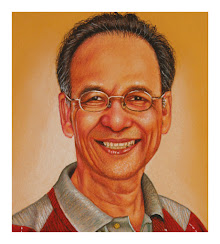
FROM DILIP MUKERJEA

"Genius is in-born, may it never be still-born."

"Oysters, irritated by grains of sand, give birth to pearls. Brains, irritated by curiosity, give birth to ideas."

"Brainpower is the bridge to the future; it is what transports you from wishful thinking to willful doing."

"Unless you keep learning & growing, the status quo has no status."
Showing posts with label Joel Arthur Barker. Show all posts

Thursday, November 10, 2022

Absolutely true!

Just as author-filmmaker-futurist Joel Arthur Barker puts it:

"A positive, inspiring vision is one thing all successful organizations have in common.
Having a positive vision of the future is the most forceful motivator for change… for success, that companies, schools, communities, nations, and individuals possess."!

Thursday, October 27, 2022

I reckon, as I read and ponder, the point here is to keep moving on the forward trajectory.

From another angle, I see it as the essence of the power of vision at work. Drawing intellectual cues from author-filmmaker-futurist Joel Arthur Barker:
"... that having a positive vision of the future is the most forceful motivator for change… for success, that companies, schools, communities, nations, and individuals possess."!

Wednesday, September 28, 2022

The Power of Vision 

In the words of author-filmmaker-futurist Joel Arthur Barker:

"... A positive, inspiring vision is one thing all successful organizations have in common. 

Having a positive vision of the future is the most forceful motivator for change… for success, that companies, schools, communities, nations, and individuals possess."


I fully concur! 
Achieving your dreams is always a hard thing to do. And many people believe that we can predict the future. We can’t. What we can do is create it.
With a positive vision of the future, we’re able to do this with imagination and creativity. 
Exercising your imagination will help you create a better future for yourself and those around you. 
Imagination is the ability to form images in your mind or make someone else create those images in their mind about what could be possible in the future.
Believe in yourself, and you can achieve anything you want. You don’t need to rely on anyone else’s power or strength for it. You are strong enough, powerful enough, and capable of achieving anything worth achieving with all your heart. 
All you need is the right strategy and the steadfast  discipline to work on it. But what is even more important than the things mentioned is the belief in yourself! 

Wednesday, September 21, 2022

Change your paradigm, change your life, for it controls your perception, use of time, logic, creativity, effectiveness, productivity and even your ability to make money.

To paraphrase high performance management strategist Werner Erhard:
“Our paradigms determine the way the world ‘shows up’ for us, and that allows for only certain possibilities. Our paradigms determine our worldview, the way we perceive things, what we perceive, what we can see as possible, what we can’t see as possible and what we can’t see at all.
Ultimately, they limit our strategies and our actions.”
Likewise, author-filmmaker-futurist Joel Arthur Barker, who actually popularises the concept of paradigms in the corporate world, says it best:
"To be able to shape your future, you have to be willing and able to change your paradigm."

Tuesday, September 20, 2022

Dr Maxwell Maltz shared this fascinating observation back in the early sixties when he wrote Psycho-Cybernetics.

Interestingly, America's Greatest Prosperity Teacher Bob Proctor had reinforced Dr Maltz's point:

"You don't have to know how to get it. You just have to know that you can."

He added:

"Want is the only prerequisite to get what you want. Do you really want it?"

Bob's partner, Sandy Gallagher, CEO of the Proctor Gallagher Institute, went on to create a 32 minute video on YouTube, entitled Visioneering.

She shared her brilliant insights on the art of Visioneering, including a checklist which you can even download.

For the corporate and business world, author-filmmaker-futurist Joel Arthur Barker had introduced his half-hour long Power of Vision video, which demonstrated that "having a positive vision of the future is the most forceful motivater for change and success".

You can watch it for free at the StarThrower Distribution corporate website.

In a nut shell, it's fair to say, Dr Maltz was far ahead of his time.

Monday, September 19, 2022

"... your vision should be much bigger than what you can actually see.
What you envision is what you get.
Look beyond your eyes to see the possibilities!
What is your vision?"
~ Lee J Colan, founder of the L Group, a consulting firm that equips and inspires leaders at every level;
This observation has scientific basis.
Back in the late 80's or so, brilliant neuro-scientist Dr Karl Pribram of Stanford University had called this, "image of achievement", which subsequently inspired the vision modeling methodology in Sybervision Systems.
In the 90's, author-filmmaker-futurist Joel Arthur Barker had documented this phenomenon in his powerful training video, "Power of Vision", with great examples drawn from educator Benjamin Singer, sociologist Fred Pollack, psychiatrist Viktor Frankl, and consultant Jim Collins.

[In the snapshot, Lee J Colan is standing on the right, with legendary football coach Bobby Bowden on the left.] 

Tuesday, September 6, 2022

Interestingly, this picture somehow reminds me of the vital lesson I have had picked up from the Leadershift video of author-filmmaker-futurist Joel Arthur Barker: 

A leader is someone who people will follow to places they would not go alone. 

Using the bridge building metaphor, he sums up that:

The 21st century leader will build bridges built of hopes, ideas and opportunities - bridges that help people move from where they are to where they need to be.

Friday, July 15, 2022

In my earlier post, I mentioned  a training video of author-filmmaker-futurist Joel Arthur Barker, The Power of Vision.

In the video, Barker shared an interesting anecdote about Eugene Lang:

“In 1981, businessman Eugene M. Lang returned to P.S. 121, the elementary school he had attended in East Harlem 50 years earlier, to address a class of graduating sixth graders. He intended to tell the students, “Work hard and you’ll succeed.” But on the way to the podium, the school principal told Lang that three-quarters of the school’s students would probably never finish high school, prompting Lang to make an impromptu change to his speech: he promised college tuition to every sixth grader who stayed in high school and graduated.” 

Barker stated that the most successful students think in time horizons of five to ten years out while unsuccessful students have nearly no future picture. He also shared the research of Dr Benjamin Singrer on future focused role image.

Successful students saw in long time horizons with multiple alternatives. They had a belief that their own behavior made a big difference in how the future would turn out.

Less successful students saw in short time horizons with no idea of what they were going to be doing. They believed their lives were in the hands of fate.

Children with vision outperformed their assets. They had a profound belief in their future and their ability to use their own efforts to shape it.

If we want to increase student success, it will take more than just a future picture. But those pictures could drive innovation within schools and communities to implement learning opportunities missing in our current structures. Lang set up support systems in addition to the offer of college tuition. What future pictures drive your school and classroom innovations?

And Lang’s original 61 Dreamers? Of the 54 who remain in contact with the organization, more than 90% have earned their high school diplomas or GED certificates; and 60% have pursued higher education. The Dreamers have received degrees from Bard College, Barnard College, Swarthmore College, Rensselaer Polytechnic Institute, CUNY Hunter, and other schools. Almost all of the P.S. 121 Dreamers hold fulfilling jobs, and now their children are beginning to graduate from college.”

Drawing intellectual cues from author-filmmaker-futurist Joel Arthur Barker, also creator of the The Power of Vision training video for companies, having goals is akin to having a positive, inspiring vision, which all successful organizations have in common.

He neverthelesss demonstrates that having a positive vision of the future is the most forceful motivator for change… for success, that companies, schools, communities, nations, and even individuals possess.(*)
* [Based on the empirical research of Fred Polak, Martin Seligman, Viktor Frankl, Jim Collins, Jim Kouzes, Benjamin Singer]

Wednesday, May 7, 2014

THE ABILITY TO ANTICIPATE THE FUTURE PROVIDES THE BIGGEST COMPETITIVE ADVANTAGE


Interestingly, author-filmmaker-futurist Joel Arthur Barker, has exhorted this line of thought as far back as the 80's, when he wrote his magnum opus, "Discovering the Future: The Business of Paradigms".

In fact, he highlighted two other important forward-thinking aspects: the quest for excellence and the pursuit of innovation.

That was my nascent entry into future studies.

Sunday, May 4, 2014

A NICE AND YET PENETRATING QUESTION TO PONDER

A nice and yet penetrating question to ponder (inspired by author-filmmaker-futurist Joel Arthur Barker):

"What do I do in my job that I should only do in Hell?"

GREAT MINDS THINK ALIKE ABOUT THE FUTURE!


That's right!

In fact, this nice quote of technology futurist Daniel Burrus reminds me vividly of what author-filmmaker-futurist Joel Arthur Barker has said back in the nineties:


"It is the future where our greatest leverage is. We can't change the past, although, if we are smart, we learn from it.

Things happen in only one place - the present, and usually we react to those events.

The space of time in the present is too slim to allow for much more.

It is in the yet-to-be, the future, and only there, where we have the time to prepare for the present."

Tuesday, April 15, 2014

INNOVATION ON THE VERGE

This is a good example of innovation on the verge, which is described by author-filmmaker-futurist Joel Arthur Barker as "something and something different meet:

Here you see an industrial robot, built by Kuka Robotics (Germany), moving from a traditional sphere of activity, industrial automation, to another new and yet unrelated sphere of activity, in this case, entertainment ride.

ROBOCOASTER!


Monday, October 18, 2010

A WISE QUOTE FOR MONDAY MORNING

"No one will thank you for taking care of the present if you have neglected the future."

~ futurist, author, & film-maker Joel Arthur Barker;

Wednesday, August 11, 2010

THE 5 STRATEGY TOOLS FOR STRATEGIC EXPLORATION, FROM JOEL ARTHUR BARKER

A recent casual conversation at the Hanis Cafe in the NLB Building on North Bridge Road with Dilip Mukerjea brought up the work of futurist-filmmaker-author Joel Arthur Barker into limelight, so to speak.

Our conversation had somehow centred on the collation of powerful & yet pragmatic strategy tools as part of a tentative curriculum for Dilip's newest pet project, the Brainaissance University.

Joel Arthur Barker is one of my most favourite authors. I like to rate his deliberate forays in recent years into the exploration of the" law of unintended consequences" [in particular, with the application of his proprietary methodology known as the 'Implications Wheel';] as well as "innovation on the verge" as truly exemplary.

The five strategy tools for strategic exploration had originally been highlighted in Joel Arthur Barker's debut book, 'Discovering the Future: The Business of Paradigms', during the mid-eighties. He had self-published the book, which later became 'Future Edge' in the early nineties or so. [The paperback version is 'Paradigms: The Business of Discovering the Future'.]

To share my thoughts with readers, here's my recap to Dilip:

1) Influence Understanding: understanding how your perceptual sensitivity & fluidity of perception affect your environmental scanning, & eventually, your decision making;

2) divergent thinking: discovering more than the one right answer;

3) convergent thinking: organising for evaluation all your integrated information with prioritised choices;

4) mapping pathways: using visual approaches to chart out your journey; [Dilip has his proprietary visual planning methodology known as "lifescaping"]

5) imaging: putting your explored ideas into pictures or visual models; [Dilip has his own visual tools, e.g. "splash-mapping"; "thumb-charting", "note-boarding", just to name a few; in fact, in recent months, we had iointly created one or two new ones, one of which, we had just simply it call 'mandala map';]

Despite the transpiration of almost a quarter of a century, I still think the foregoing strategy tools are still relevant in today's era of digital convergence.

For me, at the end of the day, it's the concrete results that you produced by using the foregoing strategy tools, which in turn propel you to move forward faster... better... & maybe, cheaper than your competition!

So, enjoy your exploration & assimilation!

Thursday, August 5, 2010

WALKING THE TALK: LEADERS ARE READERS!

Like Einstein, Dilip always has a book with him.

Whenever Dilip is not crafting new ideas, or cogitating on his next new book, or coaching, or consulting or clowning around with kids (as well as professional adults), he is reading!

I always remember the exhortation from futurist, film maker & author Joel Arthur Barker, ever since I had read his debut & classic book, 'The Business of Paradigms: Discovering the Future',

"The cheapest most powerful way to stretch your paradigms & improve your strategic exploration skills is to read."

As a matter of fact, futurists like Peter Schwartz & Faith Popcorn said more or less the same thing.

Monday, July 12, 2010

A QUICK LESSON ON HOW TO EXPLORE A CASCADE OF CONSEQUENCES TO YOUR DECISION

I have found the following simple but powerful exercise from a .pdf document, entitled 'Radical Times Require Radical Actions', which eventually became the basis of the book, 'Radical Action for Radical Times', by consultant Jonathan Hornby.

The exercise has its origins from futurist Joel Arthur Barker's 'Implications Wheel' methodology [involving the use of his proprietary software, known as I-Wheel], which has been designed to help organisations to explore in-depth all the "unintended consequences" & "black swans" in their executive decision making processes. JAB calls it "cascade thinking".

"Put your decision or idea [about a trend, event, innovation, policy change or new policy, change, goal] in the middle of a sheet of paper.

Involve five to ten others.

Ask the question, “What could happen just as soon as we implement this decision or idea?”

Draw off 12 radial spokes from the circle and capture answers in rapid fire.

Get at least one positive and one negative outcome.

Repeat the process for each of the 12, only this time draw 5 outcomes for each.

Repeat the process one more time. You now have 300 potential outcomes.

How will you leverage opportunities or mitigate threats revealed?"

[Source: 'Radical Times Require Radical Actions', by consultant Jonathan Hornby; The .pdf document also shares eleven interesting ideas - & two provoking self-check questions - on how to find opportunities in a down economy. You may have to register first in order to access the document.

Actually, a more elaborate explanation of the "cascade thinking" process can be found in the author's book, 'Radical Action for Radical Times'.

More information about the thinking & the work of Joel Arthur Barker can be found at this link to the Global Dialogue Centre.]

A WISE QUOTE FOR MONDAY MORNING

"... In particular, we must regrind our lenses to monitor the periphery, that is, the edges, of our business. At these edges lie our richest opportuntiies for value creation & our strongest protection against value destruction...

If we adjust our lenses accordingly, then we will begin to see something remarkable: The edges will reshape & eventually transform the core..."


~ business strategist John Hagel III & scientist John Seely Brown, writing in their wonderful book, 'The Only Sustainable Edge: Why Business Strategy Depends on Productive Friction & Dynamic Specialization';

[I like the authors' battle cry: "Embrace the edge or Perish"!

From my understanding: "The edge" refers to the edge of the enterprise; boundaries of matured markets as well as industries; geographic edges of emerging economies; demographic edges between generations (old & new); & the edges of special domains of knowledge;

The "core" has two meanings: At one level, it refers to the inside of the enterprise - the core capabilities that determine our business success. At a global scale, it refers to the developed economies.

On both levels, the emerging patterns on the edges will force us - & help us - to rethink & reconfigure our core activities;

By the way, the two authors have a new book, 'The Power of Pull: How Small Moves, Smartly Made, Can Set Big Things in Motion', which I have yet to procure & read.

Nonetheless, readers can also pop into their 'Edge Perspectives' website to download some interesting e-books, which explore some of the edge-themes in the foregoing book.

For me, as far as innovations from reading & observation are concerned, both futurists Joel Arthur Barker & Peter Schwartz, as far back as the nineties, had often referred to the significance of "the fringe", while innovation strategist Wayne Burkan took a different spin when he talked about fringe competitors, disgruntled or lost customers & rogue employees;

Interestingly, today, Joel Arthur Barker revels about "innovation at the verge".]

Tuesday, September 15, 2009

DIVERSITY ACCELERATES INNOVATION TO EVERYONE'S ADVANTAGE

The foregoing blogpost title more or less sums up the gist of the book.

In fact, it has been extracted from the 'Foreword' by futurist/strategist Joel Arthur Barker to the book, 'Putting Our Differences to Work: The Fastest Way to Innovation, Leadership & High Performance', by Debbe Kennedy.

[Both consultants/authors have been relatively long-time collaborators.]

Frankly speaking, it's Joel Arthur Barker's particular contribution of 'Chapter 10: Innovation at the Verge of Differences' & 'Chapter 11: Collaborating at the Verge of Differences' that has initially attracted me to read the book.

On the other hand, I am also familiar with the author (Debbe Kennedy)'s previous work, namely, 'Breakthrough! The Problem Solving Advantage' (1998) & 'Action Dialogues: Meaningful Conversations to Accelerate Change, (2000), as well as her complete 'Strategic Action Series' (2000) of short & snappy booklets, total six of them, comprising:

- 'Assessment: Defining Current Realities';
- 'Acceptance: Developing Support for Change';
- 'Action: Moving Forward';
- 'Accountability: Establishing Shared Ownership';
- 'Achievement: measuring Progress/Celebrating Success';
- 'Diversity Breakthrough with More Action: Keeping Momentum Alive';

As a matter of fact, while running my own small retail outlet, aptly called 'The Brain Resource', in the Central Business District during the nineties, the nifty toolkit - 'Breakthrough!', in the form of a book/card deck/CD-ROM package - was included in my store repertoire.

I would add that the practicality & the utility of her earlier thoughtwares in the workplace actually earned her the reputation as a master problem solver.

For me, reading 'Putting Our Differences to Work' is like doing a partial refresher, because the book is almost an intellectual amalgam of all her previous works, particularly the entire section of Part 2, which replicates the 6-step iterative framework for putting diversity to work in fostering organisational change.

Before I move on further, I like to recap the preamble on the inside front flap of the book, which I thought has captured the essence of the book beautifully:

"Putting our differences to work means creating an environment where people, naturally unique & different - diverse by nature & experience - can work more effectively in ways that drive new levels of creativity, innovation, problem solving, leadership, & performance in the marketplaces, workplaces, & communities of the world."

In addition to the six-step model, with each step elaborated in a given chapter, combined with best practice stories, the rest of the book identifies the five distinctive qualities of leadership, that leaders must add to their skills portfolio - & the 16 dimensions of differences that leaders must understand - in order to make diversity an engine of success.

The book closes with a presentation on virtual gathering, involving web 2.0 technologies & other social media, which open up ever-expanding possibilities for putting diversity to work. These are included in Part 3 of the book, which also includes Joel Arthur Barker's contribution (Chapter 10 & 11), as mentioned earlier.

If readers are already familiar with the intersection of ideas, concepts & cultures, as embodied in the 'Medici Effect', proposed & authored by Frans Johansson, then readers will readily notice a relatively similar, but still interesting spin, given by Joel Arthur Barker in the two chapters.

Both authors have brilliantly asserted, with numerous illuminating examples, that by exploring the 'intersections' or 'verges', we may discover the next breakthrough ideas.

As Joel Arthur Barker puts it, to dovetail with Debbe Kennedy's principal premise of the book:

"...Without diversity, there can be no verges. Celebrate the differences. Enlarge the differences. It creates more options for innovation."

Overall, I must say that the book is a great road-map on harnessing people's rich & diverse experiences, cultures, & perspectives to attract growth & sustain innovation.

Best of all, the author is a superb tale blazer, & her writing is clear, succinct & concise, with a key-point summary at the end of each chapter, which makes reading & recap a breeze.

Highly recommended.

[Readers can access more information about the author & her work at http://www.puttingourdifferencestowork.com/, http://www.globaldialoguecenter.com/, & http://www.lscompanies.com/;]

Monday, September 7, 2009

INNOVATION AT THE VERGE


In an earlier post, I have talked about 'Ideas Build On Ideas' & I have used futurist Joel Arthur Barker's latest business concept, known as 'Innovation at the Verge', as an illustration.

He explains the 'verge' as "where something & something different meet".

According to him, 'Innovation at the Verge' is when two or more elements that are very different from one another are joined together to create a single idea that solves problems the separate elements could not.

He has also given the example of a forklift that is also a weighing scale.

Yesterday, while hanging out at the Jurong Point shopping mall with my wife, I saw something that caught my eyes immediately, as captured by my digital snapshots in this blogpost.

Bossini, a popular wear apparel maker, has joined forces with & extrapolated the image of the world's largest soup maker & marketer, Campbell's, to create a new series of exciting & sporty wear apparel for young people.

Isn't this innovation at the verge?