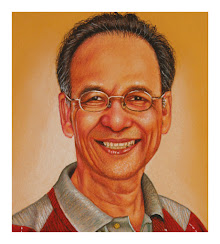
FROM DILIP MUKERJEA

"Genius is in-born, may it never be still-born."

"Oysters, irritated by grains of sand, give birth to pearls. Brains, irritated by curiosity, give birth to ideas."

"Brainpower is the bridge to the future; it is what transports you from wishful thinking to willful doing."

"Unless you keep learning & growing, the status quo has no status."
Showing posts with label Knowledge Sharing. Show all posts

Monday, June 28, 2010

FROM DIAGRAMMATIC NOTES ON THE FLY TO ELABORATE GRAPHIC ILLUSTRATIONS IN A MONTAGE

Dilip and I have often spent a lot of time together at my place in Jurong West to brainstorm business possibilities.

Last Saturday was no exception. He had wanted to explore how best to put his evolving portfolio of technical expertise & intellectual thoughtware "on a plate", so to speak, to showcase to a small group of potential investors, in a one-day fast-track session to allow them to have a hands-on feel of his offerings in terms of robustness & relevancy.

On Friday evening, while attending the funeral wake of my 98-year-old granny-in-law at the Singapore Casket premises, & during my time-out, I just jotted down some of my preliminary thoughts - in the form of ball-point diagrammatic notes - on two sheets of tissue paper. It took me about ten minutes or so to do that.

I could do it quickly, primarily because I already have an incisive insider's as well as outsider's perspective of his writings and teachings.

Please refer to the first two snapshots as appended below.


On Saturday morning, we met for our scheduled 'pow-wow' after a cuppa in my neighbourhood food-court. Using his faithful Mac Pro and Adobe InDesign software, & coupled with his own professional insights, plus also drawing on his vast digital library of conceptual symbols, Dilip painstaking transcribed my diagrammatic notes on the fly into very elaborate graphic illustrations in a montage.

From time to time, we also deliberated at length on how best to project the essence of each element.

Despite his artistic virtuosity, Dilip took almost twelve hours [including lunch & dinner breaks] to complete the montage.

The first one is what I like to term as a "mandalic display" of graphic illustrations, which essentially captured Dilip's generative portfolio to date. Dilip will print this out on a A0-sized fabric paper for display on the wall.

The second one is more of a lifescape, based on Dilip's 'lifescaping', with self-check questions, to allow the attending investors - through hands-on application - to chart out a possible course of action, based on their reflections & responses to the first one. It will be printed out in probably A3-sized paper for distribution.

The complete and elaborate graphic illustrations are appended below. Resolution-wise, they have to be reduced for easy web viewing.


On top of the foregoing work, Dilip had also completed a slide presentation, using his Apple Keynote software. Vital segments from the elaborate graphic illustrations were transposed into the presentation.

Dilip and I have agreed that the entire Saturday sojourn was worth the massive effort of putting our heads together. He can now use the two graphic productions for presentation to any investor interested in his generative portfolio of technical expertise and intellectual thoughtware, covering both corporate and educational domains.

As an epilogue, I like to sum up the foregoing synergetic outputs as physical manifestations of the following philosophies of ours:

TWO HEADS ARE BETTER THAN ONE!
KNOWLEDGE SHARED IS POWER SQUARED
!

Friday, September 4, 2009

GREAT MINDS THINK ALIKE!

I am intrigued by what I have just realised while reading.

The great Chinese philosopher, Confucius (551BC-479BC), made this observation:

"If I am walking with two other men, each of them will serve as my teacher. I will pick out the good points of the one & imitate them, & the bad points of the other & correct them in myself."

Then, in a slight contrast, I read that the brainy Albert Einstein (1879-1959) often used walking as some sort of a relaxation routine, during which he would think about philosophical & sicentific issues.

He often walked with his bosum buddies who were fellow scientists at the Princeton University, & used the opportunity to discuss his favourite stuff.

Einstein said that walking with someone else always shifted his personal creativity into shared creativity, which could foster new ideas.

Wow! I like that.

No wonder, I often find, as concurred with Dilip, my regular 'pow-wows' with Dilip over a cuppa of tea mutually very stimulating & enriching.

Well, come to think of it, Knowledge Shared is Power Squared!

Friday, April 24, 2009

THE STEPS TO POWER STUDYING X

[continue from the Last Post.]


STEP X: DISTILL & CONSOLIDATE THE MASTER MIND MAPS

If you have a third day available, you could take all eight Master Mind Maps, and interlink them into one Grand Master Mind Map!

Yes, everything does connect to everything else, no matter how different it all might seem. When you can do this trick, the world will see in you a magician of the mind!

Imagine, one Mind Map of eight books! You can do it!

A Note for School Students:

If you do this exercise with your school subjects, each group will be able to finish one year’s syllabus per subject in one week!

This is what I call A Learning Miracle!

How? Well, imagine that one of your subjects, say Geography, has 20 chapters in the text book.

Each person in a group of four can easily finish one chapter a day (I have seen kids do two chapters a day). This means four chapters per day between the four members of the group. Five days for 20 chapters!

Another two days to polish up and review. You will at worst have 20 sheets of paper each, that is, one Mind Map per chapter.

Of course, because you are smart, you will be able to consolidate the 20 sheets onto one LARGE sheet and voilahhhh! you’ve done it. This is rapid learning.

For lazy learning, all you need is to take two weeks instead of one; still top class! Go for it and claim your genius!

Note: It is a good idea to consult teachers and parents who can serve as ‘learning guides’.

[Excerpted from 'Unleashing Genius with the World's Most Powerful Learning Systems', by Dilip Mukerjea. All the images in this post are the intellectual property of Dilip Mukerjea.]

Say Keng's personal comments:

Although the proven power studying methodology as outlined by Dilip Mukerjea is apparently targetted at secondary school or junior college students, the entire systematic process is fully applicable to students in tertiary institutions as well as to entrepreneurs, managers & professionals, who are pursuing their MBAs, evening or otherwise.

In a nut shell, it's actually doing more with less. It's also leveraging on the synergistic brainpower of a group pursuing a common academic objective.

Just imagine: If a human brain contains the potential of a bazillion permutations of connections between synapses, two human brains, fully connected with a common objective, have a bazillion squared permutations. That's a lot more than double the brainpower!

In tactical terms, it is akin to the phenomenon of 'Knowledge Shared is Power Squared'. Please read my earlier post on this topic.

Saturday, February 21, 2009

KNOWLEDGE SHARED IS POWER SQUARED

I reckon that the old axiom, 'Knowledge is Power', often attributed to the philosopher Sir Francis Bacon, is gradually becoming a relic of the 20th century.

We all know that ideas come from individual minds, or rather, knowledge is stored tacitly & implicitly in our heads. Knowledge is thus expressed as power, which in reality, is only potential power. [Please read my earlier post in the 'Optimum Performance Technologies' weblog.]

Interestingly, from an organisational standpoint, I understand that knowledge often implies the maintenance of control, & knowledge is often confined to the managerial & senior levels to keep up with "silo mentalities".

However, in today's rapidly-changing world, & with globalisation & networking, productivity is far more important that what you know inside your head.

Fueled by what we now have readily accepted as the knowledge economy, & powered by the Internet, massive streams of data, information & even people move rapidly across the globe, crossing many international boundaries, multi-cultural barriers & disparate time zones to meet & anticipate shifting global market needs, among other things.

Hence, with the ongoing knowledge economy, where ideas & creativity are central, 'Knowledge Shared is Power Squared', is now the in-thing. The new axiom for the 21st century, so to speak.

In this respect, knowledge emphasises the use of project teams or consortiums, plus the diversity of people & perspectives, to achieve better & more balanced decision making. That is, in essence, to share knowledge & empower cooperative learning.

I really don't know who has actually coined that term as I could not trace its origins.

There are, however, some notable indications that the well-known knowledge management experts, Thomas Davenport & Lawrence Prusak, who had argued that "useful information flow depends on people, not technology" in the nineties could have been the progenitors, at least in conceptual terms.

Nonetheless, I have managed to locate the term 'Knowledge Shared is Power Squared' in the wonderful book, 'Organisational Survival in the New World: The Intelligent Complex Adaptive System', by David & Alex Bennet of the Mountain Quest Institute, a research, retreat & learning center "nurturing human organisational worth".

Their beautiful analogy:

"Knowledge is like a candle flame: sharing it with others (lighting their candles) does not diminish one's own knowledge but increases the light for all to see."

is really great, as it truly captures the essence of 'Knowledge Shared is Power Squared'.

According to him, "knowledge sharing facilitates the creation of even better ideas.

Knowledge is one of those rare things you can give away & still have.


As knowledge is shared & through reciprocal sharing, innovation springs into being. This sharing relationship must be built on a foundation of trust."

In the same vein, I have also found this great comparison from knowledge activist Euan Semple in his weblog:

"Knowledge is like money - if it's not going anywhere, it's not worth anything".

Dilip & I fully embrace the 'Knowledge Shared is Power Squared' philosophy, which explains why we have gotten together to work on projects.

Each of us has always come to an intellectual pow-wow with a handful of cursory ideas, but each of us, during the course of what Dilip calls "junction dynamics", find ourselves grasping with a whole array of fascinating hybrid ideas.

For example, as a simple case in point:

With his superb artistic skills, Dilip has created his 'lifescapes' as powerful visual planning tools for adult professionals.

During the course of one or two of our recent meetings, usually at my place, I have helped him, by exploring together, & also drawing upon my extensive experiences in school projects, to make appropriate graphic & textual changes, & further combining with traditional journalist's questions, to make his original 'lifescapes' more palatable as practical visual planning tools for teens & kids in the schools.

"Two Heads are better than One", as the adage goes.

As a matter of fact, our 'Braindancing Smorgasbord' is a physical manifestation of our planned knowledge sharing.

By the way, David & Alex Bennet have elegantly outlined the following important factors, which help to sustain the 'Knowledge Shared is Power Squared' philosophy:

i) interdependency - both taking responsibility for nurturing & sustaining the relationship;

ii) trust - based on integrity & consistency over time e.g. saying what you mean & following through what you say;

iii) a common framework - based on a common language, shared values or shared vision;

iv) openness - based on willingness to share & is directly related to trust; it contributes to a spread of trust & cooperation;

v) flow - a relationship cannot exist without interaction, without the flow of information & ideas;

vi) equitability - characterised by fairness & reasonableness;

[Here's the link to an interesting article, from which the foregoing has been extracted, by Alex Bennet.]