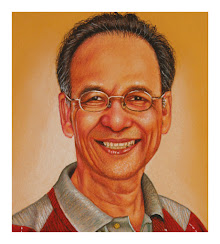
FROM DILIP MUKERJEA

"Genius is in-born, may it never be still-born."

"Oysters, irritated by grains of sand, give birth to pearls. Brains, irritated by curiosity, give birth to ideas."

"Brainpower is the bridge to the future; it is what transports you from wishful thinking to willful doing."

"Unless you keep learning & growing, the status quo has no status."
Showing posts with label Brainaissance. Show all posts

Wednesday, November 30, 2022

Continuing from an earlier excerpt from Dilip Mukerjea's new book, Brainaissance: The Renaissance of the Brain & The Rebirth of Imagination:

HUMOUR IS SERIOUS BUSINESS

The Accidental Entrepreneur:

"So, what made you decide to go into business for yourself?" "It was “Something my last boss said."

"Really, what was that?" "You're fired."

A Philadelphia dentist, Sam Lipschitz, went off to India to find the meaning of life. Months went by and his mother didn’t hear a word from him. Finally, she took a plane to India and asked for the wisest man there. She was directed to an ashram, where the guard told her that she would have to wait a week for an audience with the guru, and at that time she would only be allowed to speak three words to him. She waited, carefully preparing her words. When she was finally ushered in to see the guru, she said to him, “Sam, come home!”

Two guys are hunting in the forest and they run across a bear. They both take off running, but after a while one guy stops, takes off his backpack and pulls out a pair of running shoes. The other guy sees this and is wondering what is going on, so he stops, runs back to the guy and asks "Why are you putting on your running shoes, do you really think you are going to be able to outrun that bear with those?" The other guy said: "I don't have to out run the bear, I just have to out run YOU!"

A robot walks into an Oktoberfest celebration, orders a drink, and offers some cash.

The barmaid says, "Hey, we don't serve robots."

And the robot says, "Oh, but someday you will."

A gingerhead is sitting next to a lawyer on an airplane. The lawyer keeps bugging her to play a game with him so as to determine who has more general knowledge. Finally, he says he will offer her hundred-to-one odds. Every time she doesn’t know the answer to one of the questions, she will pay him five dollars. Every time he doesn’t know the answer to one of her questions, he will pay her five hundred dollars.

She agrees to play, and he asks her, “What is the distance from the earth to the nearest star?”

She says nothing, just hands him a five-dollar bill.

She asks him, “What goes up a hill with three legs and comes back down with four legs?”

He thinks for a long time but in the end has to concede that he has no idea. He hands her 500 dollars.

The gingerhead puts the money in her purse without comment.

The lawyer says, “Wait a minute. What’s the answer to your question?”

Without a word, she hands him five dollars.

A man walks into a bank and says he wants to borrow $200 for six months. The loan officer asks him what kind of collateral he has.

The man says, “I have a fancy blue Mercedes. Here are the keys. Keep it until the loan is paid off.”

Six months later the man returns to the bank, repays the $200 plus $10 interest and takes back his car. The loan officer says, “Sir, if I may ask, why would a man who drives a luxury Mercedes need to borrow $200?”

The man replies, “I had to go to Europe for six months. Where else could I store a Merc that long for $10?”

Here's an excerpt from Dilip Mukerjea's new book, Brainaissance: The Renaissance of the Brain & The Rebirth of Imagination

HUMOUR IS SERIOUS BUSINESS

The True Entrepreneur

A mall manager has three spaces to rent, all in a row. A prospective lessee shows up and says he wants to rent the space on the left for a men's wear shop.

'That's fine,' the mall manager says. 'You get free signage; what do you want on the sign?' 'Men's Wear,' says the man.

A second guy comes along and asks to rent the right hand space for his gentleman's formal wear business. When asked he says he wants 'Men's Wear' on his sign. The mall manager tells him that the left hand shop will have the same sign. 'No problem,' says the man.

Finally a third man comes along to rent the middle space. The manager is somewhat concerned because this guy also has a men's wear shop. Warily the manager asks the third man what he wants on his sign.

The guy replies: 'Entrance.'

Indian Brains

Mathematician: How do you write 4 in between 5?

Answers by: Chinese : Is this a joke? Japanese : Impossible!

American : The question's all wrong! British : It's not found on the Internet And the Indian: F(IV)E

Two cows are standing in the pasture. One turns to the other and says, “Although pi is usually abbreviated to five numbers, it is actually goes on into infinity.”

The second cow turns to the first and says, “Moooooooooooooooooooooooooooo.”

Accounting for Life

A woman is told by her doctor that she has six months to live. “Is there anything I can do?”

“Yes, there is,” the doctor replies. “You could marry a tax accountant.”

“How will that help my illness?” the woman asks.

“Oh, it won’t help you illness,” says the doctor, “but it will make the six months seem like an eternity.”

Saturday, September 10, 2022

More excerpts from Dilip Mukerjea's new book, Brainaissance:

The Raw Materials Of Life Are Information And Energy!

Energy impels motion, sustains it, and lets it dissolve. It equally expresses emotion, its release, its preservation, and its dissipation. Energy dances her seductive dances around the central pole that is consciousness (information). Her infinitude of manifestations simultaneously reveals and conceals, fascinates and spellbinds, leaving observers entranced by such kaleidoscopic transfigurations. All illusion (maya) and yet real. 

This phenomenon is familiar to Hindu awareness, where, in the metaphor above, Shiva is the central pole, consciousness, and his consort, Shakti, is energy. Hindu devotees are all too familiar with myriad representations of their deities, worshipped with innumerable illusive forms and expressions. But Indian monism demands that there be one, sole, ultimate, reality. Thus, Shiva and the Goddess are not in essence two, but one: he is the core of being, and she the energy radiating from it. 

This blended relationship of Maya and Shakti is encapsulated in the metaphor of clay to a potter’s wheel. Clay is the substance, the matter of creation, the raw information awaiting form and function. The Potter’s wheel is the formative force (energy) that begets expressed reality. All temporary, all illusion, and yet real. 

We shape clay into a pot, but it is the emptiness inside that holds whatever we want. ~ Tao Wisdom

The secret of change is to focus all of your energy, not on fighting the old, but in building the new. ~ Socrates 

INFORMATION - ENERGY = POWERLESS 

ENERGY - INFORMATION = PURPOSELESS 

Creative brains energise information via the questions they ask; some of these include:

Are you creative enough to meet, and defeat, emerging challenges? 

Are you busy pursuing a set of careers that will soon become obsolete? 

What is your COST of CONFUSION and the VALUE of CLARITY? 

What are you NOT doing that you should be doing if you knew that your prospects were to evaporate within a year?

What is impossible to do but if it could be done, would fundamentally change your business? 

Are you busy trying to sell products that you make, or are you making products that you can sell? 

Are you busy making your products smarter or are you making smarter products? 

How confident are you that you and your Organisation can outperform the world economy? 

Be the energy you wish to attract!

Effective communication, curiosity, imagination, and thinking skills that comprise competencies spanning creative, systemic, design, and critical disciplines, are much more than just the traditional desirable outcomes of a professional education. They are essential competencies and habits of mind for life in the 21st century, demanding the play and interplay between information and energy.

The Info-Energy Lamp Metaphor

Energy and information are a duality but their influence on life is a unity. Energy is an expression of force and power, whereas information reflects form and function. Energy without information is purposeless, and information without energy is powerless. Let us consider the metaphor of the lamp. No matter how well we design, fabricate, and embellish the components of the lamp, it cannot function, until. . .it is powered by energy ! 

Insert the plug, and voila! Allow energy to flood the system. From the composite of energy and information, we now have power and purpose. 

Illumination! 

Enlightenment! 

Awakening!

KEY INSIGHTS: 

Information blended with energy is expressed in space and time; it becomes available to us via the power and responsibility of intention and choice! We live in darkness, yet can be radiant with light. The flame exists, it just has to be provoked. Consciousness is there; it just has to be awakened. We are born, as an opportunity, awaiting our inner luminosity to emerge.  It is our birthright. Ordinarily, we are in a state of paradise lost; “en-light-ened,” we have paradise regained!


Friday, September 9, 2022

Writing in his new book, Brainaissance, Dilip Mukerjea asserts that 

WE NEED NOVEL, ADAPTIVE, AGILE, THINKING TO STAY RELEVANT TO THE CHALLENGES OF THE THIRD MILLENNIUM

Why this skill will be vital for workforce success 

• Today, routine tasks are easily outsourced to computers or machines. 

• A combination of increasing global connectivity and growing automation will put a premium on skills that facilitate responding swiftly and adaptively to unfamiliar circumstances, and contexts, with an array of solutions to meet and defeat the problems that rear their heads. 

• As we network everyone and everything, the impact will not be that we can do things faster, cheaper, or better; it will be that the whole system itself becomes emergent and highly unpredictable, with any change in one node creating unexpected outcomes throughout the whole constellation of networks. 

Thus, Improvisational Inventive Skills are going to be crucial in The Innovation Ecosystems of the Third Millennium.

Here's another excerpt from Dilip Mukerjea's new book, Brainaissance:


The 3Cs of Life Perception 

The Container-Contents-Context Metaphor

Life is not logical; it is psychological. The quality of our consciousness shapes physical reality. In order to influence ourselves, and others, consider a triunity of elements: the container, the contents, and the context. We perceive information (contents) bundled into some sort of packaging (containers), addressing external realities (contexts). 

If any one of these three elements is transformed in some way, we change the way we perceive the item or element under scrutiny. This applies to anything: products, pro‑cesses, platforms, services, systems, and relationships…within fields, cultures, and disciplines of any preference. Words by themselves are meaningless; they need context to become meaningful. 

This book is a container with its contents of information as text and imagery, radiating towards a multiplicity of contexts. Every time you go through the book (the container) the contents should impact you differently, and the plurality of contexts you address will reflect your expanding awareness. The image on this page describes this concept, where the pizza box is the container, the pizza the contents, and the outside world beyond the box, the context. 

A CONSIDERATION FOR THE NEW WORLD OF WORK: 

If we are to assuage some of the hundreds of millions of redundancies that we’ll all face in the next twenty years society has to change its thinking. Over the next twenty years Governments and academies estimate that between 30% and 50% of all of today’s jobs will be replaced by technology. However, unlike the disruptions of yesteryear where technology replaced Blue Collar jobs today’s technologies are replacing White Collar knowledge workers; and it’s this shift that could have dire consequences for you and your children’s future career prospects. 

Some of the world’s best self-learning Artificial Intelligence and Cognitive Computer Systems are already replacing advisors, analysts, artists, commentators, consultants, doctors, journalists, musicians, paralegals, PhDs, teachers, translators and even the data scientists who created their original Algorithmic Models. 

Machine Vision systems are replacing quality inspectors, maintenance workers, security analysts and security guards. 

Hardware robots have already replaced many of the Blue Collar factory and warehouse jobs and now they’re replacing bar staff, maintenance workers, porters, soldiers, waiters and surgeons while their new, modern day software-only counterparts are replacing administrative staff, customer service clerks and FX traders. 

Smarter Cities will reduce the need for police, street cleaners and a myriad of other public servants while Wearables and Telehealth are both reducing the demand for secondary care workers, doctors and personal trainers. 

As the jobs market continues to shift, education and our systems of learning need to shift ahead of it, for we are now in The Learning Economy

Tuesday, September 6, 2022

Here's an excerpt, pertaining to Perspectives On Entrepreneurship, from Dilip Mukerjea's book, Brainaissance: The Renaissance of the Brain, The Rebirth of Imagination:

Peter F. Drucker on Innovation and Entrepreneurship 

Drucker maintained that entrepreneurship is doing something differently so as to better use resources and expand markets for the product and/or service. From a hamburger stand in a single city, Ray Kroc turned it into an international business, McDonalds; this happened by innovating his products, services, and marketing. Kroc was an entrepreneur. Someone else running that hamburger stand without Kroc’s entrepreneur spirit may have had a thriving hamburger business but it wouldn’t have been McDonalds and that person wouldn’t have been an entrepreneur, just another hamburger stand owner. Drucker also believed that entrepreneurship and innovation are not inborn characteristics. They are behaviors that most people can learn and successfully apply to their ventures. 

He described seven sources of innovative opportunity: 

The Unexpected - via unexpected success, unexpected failure, and unexpected outside events. 

Incongruities - a discrepancy or dissonance between what is and what ought to be or is assumed to be, comprising four areas: economic realities of an industry (marketplace), other realities of an industry (optimisation of local, non-essential areas rather than system optimisation), customer expectations versus the industry perception of customer expectations, and internal incongruity with a process. 

Process Need - a weak or missing link in a process that makes the process cheaper, easier, or possible, through technological or economical feasibility. 

Industry and Market Structures - changes in industry or markets such as new competitors, new customers, more differentiated products, new manufacturing or marketing processes, new substitute or complementary products or services. 

Demographics - changes in population structure such as size, age, cultural composition, employment, education, and income. 

Changes in Perception - a change in the way facts are perceived, such as determining whether “the glass is half full” versus “the glass is half empty.” 

New Knowledge - the discovery of new knowledge, which can be exploited, such as a new technology or new materials. 

He debunked the belief that innovation is “a bright idea” and maintained that dependable innovative ideas come from systematic exploration of the seven sources of innovative opportunity. Drucker called The Bright Idea “the riskiest and least successful source of innovation opportunities.” The millions of worldwide patents that sit in patent offices gathering dust lend credence to his assertion. 

Entrepreneurs innovate. Innovation is the specific instrument of entrepreneurship. It is the act that endows resources with a new capacity to create wealth. Innovation, indeed, creates a resource. There is no such thing as a resource until man finds a use for something in nature and then endows it with economic value. Until then, every plant is a weed and every mineral just another rock. 

~ Peter F. Drucker, The Sage of Business Wisdom

Monday, September 5, 2022

Here's an excerpt from Dilip Mukerjea's new book, Brainaissance: The Renaissance of the Brain, The Rebirth of Imagination:

THREE CRUCIAL QUESTIONS FOR THE LEARNING ECONOMY


To compete and adapt effectively in the future, focus needs to be directed at: 

What organisations will need to know: “literacies for the future” 

The skill sets they will need to acquire: “competencies for the future.”

A distinct skill that we now need to cultivate is not spot knowledge (“just-in-time” - “hit-and-run” learning) or single-dimension knowledge, but knowing how things relate to one another, and the profusion of ideas that can emerge from the cognitive friction between them. It is therefore crucial that we become adept at creating and cross-fertilising ideas to generate new knowledge. 

We are living in perilous, gyrating times ... in an era that is hugely complex and highly unpredicatble...yet replete with powerful possibilities. The world of today is driven by curiosity, imagination, and original thinking ... of multiple types of intelligence and deep thinking. Without these qualities, the possibility of intellectual decay is very real. 

Whenever things are changing fast, what people already know becomes obsolete quickly. Only the ability to learn lasts ... once you have learned how to learn, of course. If you’re not constantly learning, you’re actually falling behind! The half-life of knowledge is now less than 2 years!

Know that change might be challenging, but not changing is fatal! And thus, every leader is called upon to be a change agent ... or face extinction! 


“Beware! Your degree is not a proxy for your ability to do any job. The world only cares about — and pays off on — what you can do with what you know ... it also cares about ... loving to learn and re-learn. This will be true no matter where you go to work.” 

~ Laszlo Bock, the senior vice-president of people operations for Google

The smallest change in thinking can transform your life. 

Constantly ask yourself: 

“What am I doing ... and am I paying attention to what I am doing? 

Ideas are the currency of competition and innovation is the engine of economies. 

STRIVE TO GET AT LEAST THREE NEW IDEAS EVERY DAY!

Sunday, July 18, 2010