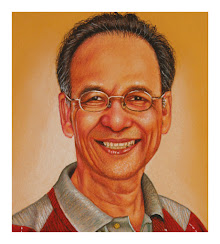
FROM DILIP MUKERJEA

"Genius is in-born, may it never be still-born."

"Oysters, irritated by grains of sand, give birth to pearls. Brains, irritated by curiosity, give birth to ideas."

"Brainpower is the bridge to the future; it is what transports you from wishful thinking to willful doing."

"Unless you keep learning & growing, the status quo has no status."

Saturday, February 21, 2009

THE LEARNING ECONOMY

This is the Age of Competitive Intelligence! It has given birth to The Learning Economy.

And thus, the need for Human Resources, humans standing in reserve, waiting to be used, has been replaced by the need for Resourceful Humans!

In a globally interlinked world, business success is based on cognitive success.

Cognitive has two equally significant meanings: “to know” and “to beget.” When blended, these two meanings suggest that all birth is an awakening to knowledge. To know and to generate are inseparable.

RED ALERT!

Are the actions, transactions, and interactions of your business processes perpetuating the decaying status quo, or are they alive and infused with novelty, value, and passion?

Are your people able to convey unforgettably brilliant first impressions?

Does your organisation recognise that its lifeblood must be open communications of information: thoughts, feelings, and ideas?

Is innovation pursuing you or are you pursuing innovation?

If innovation is pursuing you it means that the rate of change outside your organisation is much greater than that within it. That spells trouble.

Today, innovation must trump bureaucracy, for red tape has morphed into red alert!

The choice is clear: innovate or disintegrate.

Is The Red Tape The ONLY Thing That’s Holding Your Organisation Together?

What are YOU doing about it?

[Excerpted from the 'Leadership, Learning & Laughter' edition of The Braindancer Series of bookazines by Dilip Mukerjea. All the images in this post are the intellectual property of Dilip Mukerjea.]

ARE YOU READY FOR THE MICROCHIP THAT'S WAITING TO REPLACE YOU?

The New Millennium predicament facing organisations and the world is the escalating shortage of creative talent. New ideas, new technologies, and new content are the real issues facing us in an ever-more challenging world.

The marketspace is crying out for idea-boomers, people with creative energy who can inspire great advances.

The alternative is digital conquest, where humans voluntarily succumb their destinies to technology. In such an instance, we become the technological pawns of our technological incarnations.

Are you busy preparing for a set of careers that could soon become obsolete?

Is your Waste Quotient (WQ) sky-high?

If so, you must be operating on obsolete expertise.

Beware and be aware! Your organisation might see you as an expense item, not as a revenue generator!

“What seems mundane and trivial is the very stuff that discovery is made of. The only difference is our readiness to put pieces together in an entirely new way and to see patterns where only shadows appeared a moment before.”

– Dr Edward B Lindman, 'Thinking in Future Tense';

[Excerpted from the 'Leadership, Learning & Laughter' edition of The Braindancer Series of bookazines by Dilip Mukerjea. All the images in this post are the intellectual property of Dilip Mukerjea.]

KNOWLEDGE SHARED IS POWER SQUARED

I reckon that the old axiom, 'Knowledge is Power', often attributed to the philosopher Sir Francis Bacon, is gradually becoming a relic of the 20th century.

We all know that ideas come from individual minds, or rather, knowledge is stored tacitly & implicitly in our heads. Knowledge is thus expressed as power, which in reality, is only potential power. [Please read my earlier post in the 'Optimum Performance Technologies' weblog.]

Interestingly, from an organisational standpoint, I understand that knowledge often implies the maintenance of control, & knowledge is often confined to the managerial & senior levels to keep up with "silo mentalities".

However, in today's rapidly-changing world, & with globalisation & networking, productivity is far more important that what you know inside your head.

Fueled by what we now have readily accepted as the knowledge economy, & powered by the Internet, massive streams of data, information & even people move rapidly across the globe, crossing many international boundaries, multi-cultural barriers & disparate time zones to meet & anticipate shifting global market needs, among other things.

Hence, with the ongoing knowledge economy, where ideas & creativity are central, 'Knowledge Shared is Power Squared', is now the in-thing. The new axiom for the 21st century, so to speak.

In this respect, knowledge emphasises the use of project teams or consortiums, plus the diversity of people & perspectives, to achieve better & more balanced decision making. That is, in essence, to share knowledge & empower cooperative learning.

I really don't know who has actually coined that term as I could not trace its origins.

There are, however, some notable indications that the well-known knowledge management experts, Thomas Davenport & Lawrence Prusak, who had argued that "useful information flow depends on people, not technology" in the nineties could have been the progenitors, at least in conceptual terms.

Nonetheless, I have managed to locate the term 'Knowledge Shared is Power Squared' in the wonderful book, 'Organisational Survival in the New World: The Intelligent Complex Adaptive System', by David & Alex Bennet of the Mountain Quest Institute, a research, retreat & learning center "nurturing human organisational worth".

Their beautiful analogy:

"Knowledge is like a candle flame: sharing it with others (lighting their candles) does not diminish one's own knowledge but increases the light for all to see."

is really great, as it truly captures the essence of 'Knowledge Shared is Power Squared'.

According to him, "knowledge sharing facilitates the creation of even better ideas.

Knowledge is one of those rare things you can give away & still have.


As knowledge is shared & through reciprocal sharing, innovation springs into being. This sharing relationship must be built on a foundation of trust."

In the same vein, I have also found this great comparison from knowledge activist Euan Semple in his weblog:

"Knowledge is like money - if it's not going anywhere, it's not worth anything".

Dilip & I fully embrace the 'Knowledge Shared is Power Squared' philosophy, which explains why we have gotten together to work on projects.

Each of us has always come to an intellectual pow-wow with a handful of cursory ideas, but each of us, during the course of what Dilip calls "junction dynamics", find ourselves grasping with a whole array of fascinating hybrid ideas.

For example, as a simple case in point:

With his superb artistic skills, Dilip has created his 'lifescapes' as powerful visual planning tools for adult professionals.

During the course of one or two of our recent meetings, usually at my place, I have helped him, by exploring together, & also drawing upon my extensive experiences in school projects, to make appropriate graphic & textual changes, & further combining with traditional journalist's questions, to make his original 'lifescapes' more palatable as practical visual planning tools for teens & kids in the schools.

"Two Heads are better than One", as the adage goes.

As a matter of fact, our 'Braindancing Smorgasbord' is a physical manifestation of our planned knowledge sharing.

By the way, David & Alex Bennet have elegantly outlined the following important factors, which help to sustain the 'Knowledge Shared is Power Squared' philosophy:

i) interdependency - both taking responsibility for nurturing & sustaining the relationship;

ii) trust - based on integrity & consistency over time e.g. saying what you mean & following through what you say;

iii) a common framework - based on a common language, shared values or shared vision;

iv) openness - based on willingness to share & is directly related to trust; it contributes to a spread of trust & cooperation;

v) flow - a relationship cannot exist without interaction, without the flow of information & ideas;

vi) equitability - characterised by fairness & reasonableness;

[Here's the link to an interesting article, from which the foregoing has been extracted, by Alex Bennet.]

Friday, February 20, 2009

BOOK REVIEW: 'BREAKPOINT & BEYOND: MASTERING THE FUTURE TODAY', by George Land

[Extracted from the 'Optimum Performance Technologies' weblog.]

In anticipating the future, three things generally fascinate & intrigue me, & they are: Change, Complexity & Competition.

Hence, I am always seeking better understanding - & appreciation - of these critical areas of concern.

In the search of books & resources, I have come across many excellent authors or masters. I have already featured a few in my earlier posts.

In this post, I would like to review one original, thought provoking book, written with warm, passion & clarity as well as mastery of content.

Actually, I had read 'Breakpoint & Beyond' during the mid-nineties, when it was first published. At that time, I had just embarked on a journey to play a better game in the second half of my life.

Oftentimes, I have returned to the book to read certain earmarked pages. In a nut shell, it weaved a compelling story about change by focusing a new & penetrating lens on the master teacher of change, Mother Nature herself.

The authors asserted that understanding the invisible forces of natural change would uncover the hidden patterns that could unlock our potential as individuals & organisations.

The authors also showed that natural growth was characterised by long periods of stability, punctuated by "breakpoints" - bursts of explosive change & showed how we could take advantage of the tremendous opportunities that would arise during these exciting periods.

Amidst the somewhat lofty rhetoric - the book was rather heavy to read - I would like to single out one principle from the book - the Principle of Future Pull.

According to the authors, every single cell in a tree, in a caterpillar, or in a human being would grow & develop not based on its history but by being pulled toward in its internal picture of the possible future. That future was inscribed in the DNA, the genes that reside in the nucleus of every cell. That way, every part of the system could pull together toward the common future.

In human terms, this would translate into living with a powerful vision of the future. A compelling vision could pull individuals & organisations to their desired future.

Let me share some of the authors' ideas of doing it.

Know your purpose & vision:

Purpose can be defined as how an individual & organisation makes the world a better place. A vision is a compelling image or picture of the purpose having been achieved.

The book gave this example:

Landing a man on the moon in a decade was the vision that President John Kennedy held out as an inspiring magnet pulling an entire nation to develop the technological capability for manned space flights.

Purpose & vision are as important for individuals as they are for organisations.

A compelling purpose energises life. Without a compelling purpose, we live life as a fairly haphazard experience, being easily swayed by the latest fad, temporary pressures, or the most recent advice on what others think we ought to be doing with our lives.

Commit to achieve your vision & purpose:

When an organisation lacks a compelling purpose, its people cannot helped but be uninspired.

The book gave an example of the late Anita Roddick & the Body Shop, whose concerns for the environment & the people still infuse the enterprise.

Abundance is Mother Nature's state:

Abundance comes to those who have the courage to follow their dreams. This brings not only material abundance but connection with the opportunities that are vital to the full expression of one's talents.

Today thousands of people are doing what they love to do in the most unlikely occupations & making an excellent living.

No one with a compelling purpose & a great vision knows exactly how it will be achieved. You have to be willing to follow an unknown path, allowing the road to take you where it will. Surprise, serendipity, uncertainty, & the unexpected are guaranteed on the way to the future.

Make the world a better place by living according to shared values:

Values are often thought of as soft stuff of an organisation, something that goes on a bronze plaque in the lobby. Somehow the values get separated from how the business really runs.

Inevitably, employees & customers know it. The purpose & values are the heart of the vision that will pull organisations into their future. These ingredients provide the essential elements of successful self-creation: the picture of that future whole. It is the internal guidance system, the DNA that allows everything to work together.

The purpose, vision & values furnish the internal reference point for making choices & connections in a complex & rapidly changing world. They endow the individual & organisation with direction to be pulled into the future.

With a little bit of hindsight, I am very glad I had made full use of many of the authors' ideas in my own life.

If you are concerned about your own personal change & renewal, you must read this book. It will help you to think about your life -& to stay vital all your life.

BECOMING A CREATIVE GENIUS, by Dilip Mukerjea

Creativity is your prerogative.

For an organisation to transform itself into one that can flow with the pace of change, it will need to transform its thinking. This equates directly with mining our potential now. It is usage, not age, that determines the creative output from our brains.

It will be better still if these brains communicate with each other, for whilst magic does happen in one mind lost in reverie, it becomes dynamic when several illuminated minds meet within a sparkling shower of intellectual enthusiasm.

George Land, in his masterwork 'Grow or Die: The Unifying Principle of Transformation', conveys the basic law of human nature: the most fundamental drive of human nature is growth.

A more down-to-earth version of this sentiment emerged from Ray Kroc, the founder of McDonald’s: “When you’re green you’re growing, when you’re ripe, you rot.”

In referring to the work of George Land, Joyce Wycoff focuses brilliantly on this theme, where three types of growth have been identified: ExpandingExtendingEvolving.

Expanding is about growing to our genetically determined size – physically and mentally. This could happen for example, to plants, animals and us humans.

Extending refers to an organism reproducing or merging and joining others of a similar type.

Once again, plant or animal life for instance, will grow to a finite size and then start producing “babies” that replicate them. This is the raison d’ĂȘtre for survival where all organisms evolve to a point where they are able to biologically reproduce themselves.

In another sense, we humans extend ourselves through our connections with others, be they family, friends, colleagues and even strangers – the need for contact is a fundamental drive in the average human being.

Evolving refers to the progressive change over time towards a more complex and better-adapted form. The time factor varies with the particular life form, but the evolution is certain.

Stimulation through interaction with other organisms and the environment, will instigate change at a faster pace.

Creativity involves all three stages of growth. It is up to us as unique individuals, to light the fires in our moments of darkness.

As James Higgins states,

“The message for the organisation is innovate or evaporate; for the individual, innovate or stagnate; for society, innovate or degenerate.”

In order to encourage creativity and innovation within an organisation, we need to recognise some factors of paramount importance; these deal with the human and humane elements within an organisation: Respect, Trust, Commitment and Recognition.

The biggest barrier to creativity is fear, which would be eliminated by absorbing the ethics of the four qualities just mentioned.

Fear leads to stress, which leads to distress.

Consultants, specialists, psychoanalysts, experts in various denominations of dysfunction, all proliferate in a society where fear has been allowed to prevail. Organisations fragment and crumble, educational institutions get enveloped in a fog of myopia, families communicate only virtually, and governments lead by misleading.

The recent spate of Fortune 500 corporate mega-scandals has led to the loss of millions of jobs, and done nothing to inspire hope: casualties of greed via creative accounting.

What a start to the New Millennium! It is the thinking-feeling individual that will transform society into one where humanity can prosper, by rediscovering a fresh consciousness of spiritual awareness.

We realise more of our divinity as we become more creative. The more creative we become, the more our spirits soar. When our creativity reaches a climax, when our lives radiate with creativity, we live in God (whatever our concept of Him or Her may be).

When we love what we do, creativity emerges as a fragrance from the blossom that lives within us. The value is intrinsic. Creative acts are love-affairs of the human spirit. No matter how small an experience may seem, it becomes great by the touch of love and delight.

[Excerpted from the 'Ideas on Ideas' edition of The Braindancer Series of bookazines by Dilip Mukerjea. All the images in this post are the intellectual property of Dilip Mukerjea.

From Say Keng:

In the light of Dilip's exposition, it is obvious that creativity obeys Mother Nature's command to grow or die, which is her single mandate. As a matter of fact, as George Land had articulated so beautifully, growth is the most basic & universal of drives, through which all biological, physical, chemical, psychological, & cultural processes are intrinsically equivalent.

Please read my personal review of George Land's more or less follow-up book, 'Breakpoint & Beyond: Mastering the Future Today'.]

A GATHERING OF EAGLES

This morning, Dilip & I have the rare opportunity of visiting the Panasonic Avionics facility in Loyang Way to see a live demonstration of the breakthrough, patented, ultra-small, easy-to-use, environmentally friendly Smartt Papers, World's Leading Compression & Transformation Technology.

The visit has been specially arranged by Sue Chow, Managing Director of P-Cube International Pte Ltd.

We also get to meet the creative superbrain & entrepreneurial genius behind the Smartt Papers technology, Dr Winston Wei.

In a nut shell, Smartt Papers is a massive electronic delivery system for multi-media embedded digital publications at high-speed/high-volume/high res full resonant colours - but with unbelievable ultra-small file sizes - to airline video panels (in-flight entertainment), PCs, PDAs, laptops, mobile phones & information kiosks.

Dilip, Sue & I are currently exploring new collaboration possibilities in using the Smartt Papers technology to move our learning & creativity projects to the next level.

The way we see it, Smartt Papers will eventually change the way we read, learn, play, work, thrive & prosper in the not-too-distant future!

[The digital snapshot in this post shows the gathering of eagles, from the left, yours truly, Sue, Winston & Dilip in front of the office building at Loyang Way.]

MAKING DISTINCTIONS: CREATIVITY vs INNOVATION IV

[continued from the Last Post.]

I take this opportunity to share the following easy-to-understand definitions from Gerald Haman, the creative brain behind the award-winning KnowBrainer & innovation tools:

[He is also the founder of SolutionPeople®, developer of the Chicago Thinkubator®, adjunct professor of innovation at Northwestern University, editor of InnovatorsDigest.com and creator of the InnovationToolofTheMonthClub.com. He is recognized by clients as “Solutionman”, because of his ability to quickly help people develop breakthrough solutions.]

"CREATIVITY

is developing

new, interesting, or different

IDEAS"


"INNOVATION

is the process of transforming creative ideas into

valuable or profitable

SOLUTIONS"

Creative Ideas Provide Energy for Innovative Solutions!

It appears that many people are more comfortable talking about innovation than creativity. Their discomfort in talking about creativity may be rooted in the perception that that creativity is just fun and games. However, creativity is necessary for innovation to occur.

Creative thinking yields the ideas that fill the pipeline of innovation. Innovation cannot happen without the energy generated by creativity.

Haman's definition also has makes a subtle, yet important distinction between IDEAS and SOLUTIONS.

Creativity produces the ideas and once they yield value or profit, they become solutions.

Below is Haman's other "creative" definition to help people define the relationship between creativity and innovation.

"Innovation is how people make money

or create value from creativity"

[to be continued in the Next Post.

Way back in the nineties, I had used the Pocket Innovator, the precursor to the KnowBrainer innovation tool, from Gerald Haman. In fact, I was also one of his retailers in this part of the world during that period. Naturally, I also own the first generation of the KnowBrainer, in addition to The Persuasive Advantage, a creative marketing planning tool.]